


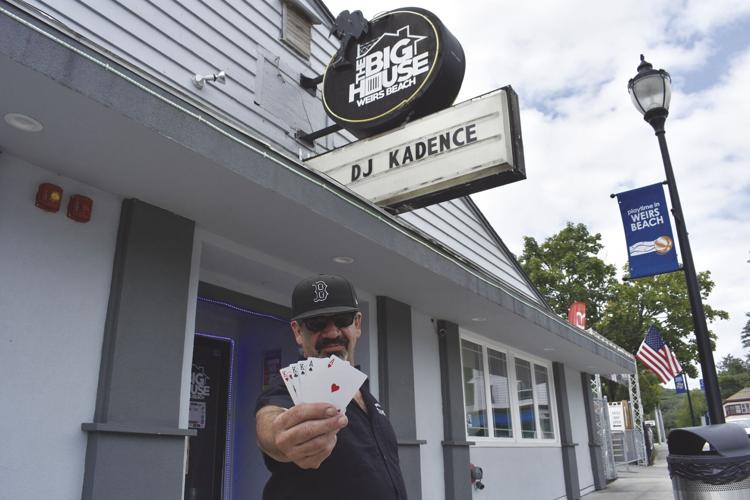
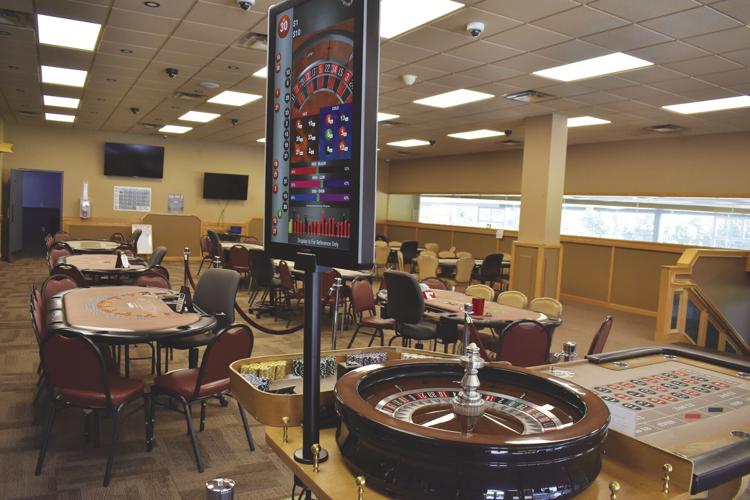
LACONIA — Weirs Beach’s most prolific entrepreneur wants to convert a dance club into a casino for charitable gaming. To succeed, he would need to not only get approvals from the appropriate state agencies; he would also need the city to figure out if, and how, such an activity should be permitted under the current zoning ordinance.
Still, “I like my odds,” said Anthony Santagate, owner of several Lakeside Avenue establishments, including Tower Hill Tavern, the Sidecar Sports Bar and, currently occupying the space he’d like to convert into a casino, The Big House Nightclub.
Gambling, so long as it benefits nonprofit organizations, has long been permitted under state law. The activity is turning into an industry in the Granite State, helped along by legislation designed to make feasible larger, more sophisticated businesses.
The most recent example of such legislation is SB 120, signed into law earlier this year, which raised betting limits from $10 per single bet to $50, and the total amount a player can gamble in a game from $150 to $2,500, among other adjustments.
The legislation was sponsored by Sen. Tim Lang, a Republican from Sanbornton, who said his objective was to “modernize” the state’s gambling regulations in order to remain competitive with casinos in other New England states.
“All of them have casinos now,” Lang said. “We wanted to give charitable gaming the ability to increase bet limits, so people wouldn’t run to Foxwoods or Oxford.”
Increased bet limits are necessary, he said, to provide the revenue margins that could support some of the higher-paying administrative and compliance positions that help run larger casino operations.
Lang sits on a committee that studies the gaming industry, and is working to recommend regulatory changes to help New Hampshire remain competitive.
But, as Santagate is experiencing, it’s not just state rules that casinos have to clear. Local ordinances may not have been written with gambling in mind, and that’s certainly the case in Laconia. Santagate came before the government operations committee, a working group of the city council, in late August to express his desire to start a charitable gaming house in the city, even though there aren’t any zones that permit gambling.
The committee, made up of Councilors Robert Soucy (Ward 2), Tony Felch (Ward 6) and Bruce Cheney (Ward 1), was receptive to the idea, though they noted making any changes to the city’s zoning ordinance would be a complicated, lengthy process. More efficient would be an administrative decision that declared gambling allowed under another existing activity.
“I’m looking at it the same way as entertainment. I’m looking at [Lakes Region Casino], they’ve been doing it forever,” Felch said during the committee meeting. “I don’t see a problem with it.” He said it would be wise for the city to figure out the logistics of allowing charitable gaming, so that local businesses would be able to respond if state regulations expand to allow gambling more broadly.
“I think it’s great,” said Soucy, though he noted that, like rooms and meals tax, the revenues wouldn’t directly benefit the city. “I want to know what can we do for the city, that’s where I’m from.”
“I would like to look at this and I think there’s a likelihood that we will approve it,” Cheney said.
“I think we’d be foolish to not look at it,” Felch said.
The committee is expected to continue working on the question, with the further expectation that it will bring a recommendation before the City Council to consider.
Betting on old horses
Santagate, after the committee meeting, said converting his dance club into a charitable gaming house would take an investment in the range of $1 million, with a significant portion of that going toward surveillance and security equipment. But, he said the property has the potential to grow into a large casino. The Big House currently occupies a building 6,800 square feet in size, according to city tax records. Santagate said he could expand in the future along the ground level, and could also extend vertically with multiple stories.
The biggest challenge, he anticipated, would be staffing such a business. Dealers require a skill set and training that currently doesn’t exist in the Lakes Region labor pool, though it would pay well, relative to other hospitality positions, and has the potential to provide year-round income.
Santagate isn’t the only one with growth plans. Ryan Gloddy, general manager at Lakes Region Casino, said his facility is in the midst of an expansion that will add four new tables for card games, as well as a raft of historical horse racing machines — electronic games that look like slot machines but which allow players to bet on the outcomes of past horse races.
Gloddy said the current expansion will represent a growth of the operation by about 20%. While bottom line figures have been “wacky” since COVID arrived, he said this year has been strong.
“We are up well over last year,” Gloddy said.
If it’s not here, they’ll do it elsewhere
Karmen Gifford, president of the Lakes Region Chamber of Commerce, looked favorably at the development of charitable gambling in the region. It is a means for nonprofits to generate revenue, she said, and it adds a new element to area’s hospitality and tourism portfolio.
“If they’re not going to gamble in Laconia, they’re [still] going to be gambling,” Gifford said. “It’s an experience, it’s an element. If it’s not in Laconia they’re going to experience it in another community.”
She said it wouldn’t make sense for a casino to pop up in the middle of a residential area. She did, though, identify reasons to support such a venture in certain parts of the city.
“Looking at The Weirs, Tower Hill, The Big House, that’s a year-round area already. There are more residences coming in, they are going to need things to do.” Gifford noted that Santagate’s businesses already know how to handle food and beverage service, which would be necessary elements of a casino.
What would hold back such an industry?
“As with any industry, it’s staffing,” Gifford said. However, developing a business into a year-round employer would help Santagate to keep and develop a labor pool. One overlooked source of labor, which might be intrigued by the possibility of working in a casino, is the population of people who are moving to the region for their early retirement years.
“It doesn’t have to be full time,” at a casino, Gifford said. “As our populations change, that’s definitely an area for recruitment.”
Gifford said that Santagate isn’t the only local entrepreneur exploring the possibility of opening a casino in Laconia.
“I’m excited to see where they go with the process. I think it’s an opportunity and we have to be careful not to miss out.”
Mayor Andrew Hosmer said he wasn’t ready to endorse Santagate’s proposal, as he hasn’t seen a plan yet.
“I don’t know enough to have an opinion right now,” Hosmer said.


(1) comment
Who is this man? Why and how does he hold so much power and stranglehold on the city of Laconia? Seems to always get his way to put more money in his pocket disguised as good for the community. Something doesn't look right here. Is this really what residents of Laconia need or even for any residents? How does it benefit the city? Believe our local politicians have greater common good issues on table in this city than adding a casino, especially to Weirs. Homeless, housing, can think of many more issues to mention that should be addressed.
Welcome to the discussion.
Log In
Keep it Clean. Please avoid obscene, vulgar, lewd, racist or sexually-oriented language.
PLEASE TURN OFF YOUR CAPS LOCK.
Don't Threaten. Threats of harming another person will not be tolerated.
Be Truthful. Don't knowingly lie about anyone or anything.
Be Nice. No racism, sexism or any sort of -ism that is degrading to another person.
Be Proactive. Use the 'Report' link on each comment to let us know of abusive posts.
Share with Us. We'd love to hear eyewitness accounts, the history behind an article.