


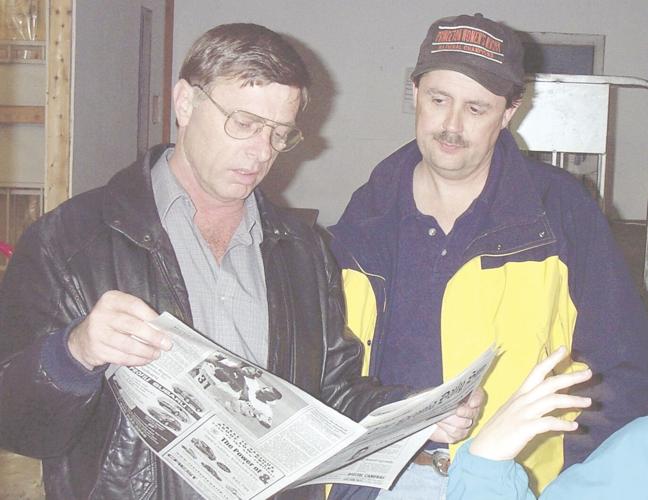
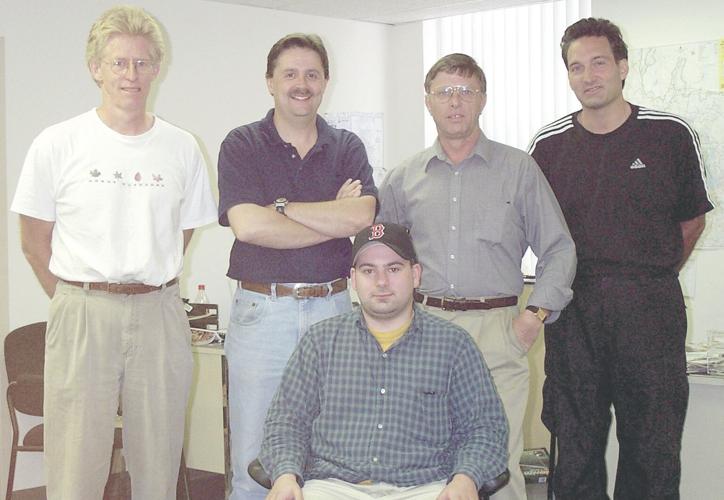
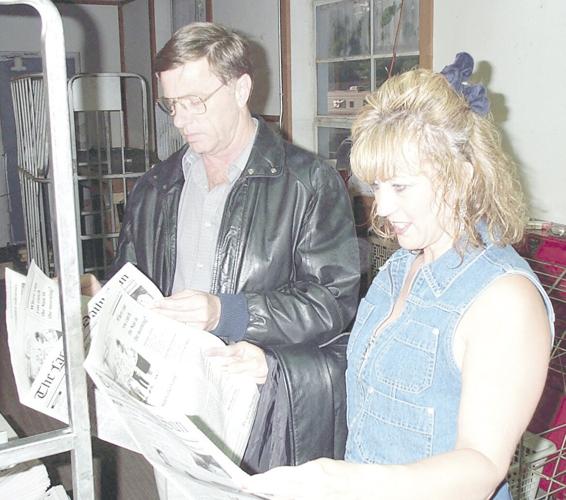
LACONIA — When the bare-bones team launched the Laconia Daily Sun on June 5, 2000, it turned out to be even more challenging than they expected. Ed Engler, current president of the company and then the editor and publisher, said they struggled to even give advertising space away, even discounted to about 10 percent of market rate.
It didn’t take long, though, for him to find the paper’s editorial voice. Where the formidable competition, the established, legacy newspaper The Laconia Citizen, had a small army of recent journalism school graduates, Engler focused on having good, smart writers. Maybe they didn’t have conventional journalism backgrounds, but they could produce stories that were more sophisticated, thereby capturing the attention of business owners and professionals – people he called the “decision makers.”
And after taking some extreme measures to drive home the point that the paper was free, circulation was picking up. That was something Engler saw on a daily basis, as he delivered papers to the downtown area during the early days. When he’d bring a new edition to a box or into a shop, people would come up to him and thank him for bringing a free newspaper to Laconia.
He said those moments, unsolicited and unexpected expressions of gratitude, meant a lot to him, he said.
“You can’t take that to the bank, but you can say, if we can hang on long enough, eventually this will pay off,” Engler said. “Even when we were suffering. Even when we were broke, it was unbelievable how many people would come up to you and tell you how much they loved the paper. They would stop you in the street.”
Those moments were among the few “glimmers of hope” that appeared in the early years of the paper. In between were some darker times, he said, explaining that sometimes the only thing that kept him from thinking about closing the paper was the fact that he had so many other tasks to accomplish in order to put the next day’s issue out.
“There were plenty of times when you wanted to quit and give up. It seemed hopeless, impossible. Getting up every day and putting the damn paper out. It’s hard to overestimate the importance of just keeping going,” Engler said.
‘It’s a daily paper, you know’
Those first years saw the addition of some names that are still printed in The Laconia Daily Sun. The first front page bore two photos, both taken by Alan MacRae.
Photography has been MacRae’s passion since he was 14, he said, though it was never a vocation until he saw an announcement that the city was going to get a new newspaper.
“My photography, for many years, was just a personal thing for me. It was just something I did for me, there were not a lot of people who saw my photographs. For me to approach The Sun and ask them to do some freelance stuff was really stepping out of my comfort zone,” MacRae said.
He recalled sitting down with Engler and John Hourihan, the paper’s first editor, with his portfolio, and establishing a freelance relationship. The news team had the luxury of time to prepare for their first edition. He had the thrill of knowing that his photographs were being viewed by hundreds of people – and then he got a reality check about the newspaper business.
“John Hourihan, you might describe him as being a little rough around the edges,” MacRae said. He said he went to work at his day job on June 5, 2000, the day that The Laconia Daily Sun was introduced to Laconia, and got a phone call from Hourihan, who wanted to know what MacRae had photographed that day. He told the editor that he didn’t have anything, and Hourihan shot back, “Well, it’s a (expletive) daily newspaper, you know!”
MacRae got the message, and his images have graced The Laconia Daily Sun’s front page countless times over the past 20 years, and he said he looks forward to the next assignment.
“I think The Sun over the years has done a lot for the community. It’s been a great success story, it’s opened up a lot of opportunities for me, it’s been a fun ride. I’m looking forward to doing more stuff,” MacRae said. “It’s been fun having my photography out there.”
Only Engler and MacRae have a longer tenure at The Laconia Daily Sun than Crystal Furnee, currently the paper’s advertising sales manager.
Furnee came to The Daily Sun with some newspaper experience. She had gone to work at The Citizen, and had risen to circulation manager. She left in December 2000, because she said her whole department was laid off and she was told she could re-apply for an entry-level position. She carried that memory with her when she came to work for The Daily Sun.
“I wanted to stick it to The Citizen,” Furnee said. She joined The Daily Sun in February 2002, and has helped the company to grow from a print run of 4,500, when she joined, to its present circulation of 18,000.
“It was definitely a growth process, and a lot of it started with Ed’s hard work, on the business side and the news. He was a one-man wonder,” Furnee said.
Turning the corner
After the fifth year, those hopeful glimmers started to come in clumps, and soon the darker moments were fewer and fewer. An important development came in 2005, when Adam Hirshan, one of the three owners – the third is Mark Guerringue, who steers the Conway Daily Sun – began working in the Laconia office. He came to fulfill community editor duties, but ended up taking over the advertising operation. That allowed Engler to focus his energies on news, and both sides of the operation improved.
“There were a number of big moments in the paper, and when Adam started working in sales, that was one of them,” Engler said.
As momentous as that was, it was something of an accident, Hirshan explained. He and Guerringue were excited to see how far they could push their business model, and had started looking at the state’s largest market for the next test for The Daily Sun title.
“We decided we were going to start another Daily Sun in Manchester,” Hirshan said. He and his family were living in Jackson, and as part of their preparations for the expansion, the Hirshans moved to Concord to be closer to The Queen City. A quick-footed competitor got the jump, though.
“What happened was Jody Reese of the Hippo Press, he got wind of us and he pre-empted us with the Manchester Express,” Hirshan said. The Hippo, a free lifestyle weekly, already had a hold of the Manchester market and wasn’t about to let a daily publication open in its backyard. “When he did that, we had a big change of plans,” Hirshan said.
With his family already living in Concord, Hirshan said he came to Laconia as a “Plan B.” Years later, when his daughters had moved out, Adam and his wife, Elaine, who also works in the advertising office, moved to Gilford to better engage with the community.
The city’s paper
The Daily Sun, as of this spring, is located at Lakeport Square, in the historic Lakeport Opera House building. For the previous several years, the newspaper’s offices were at 1127 Union Avenue. When the paper was founded, it was at 65 Water Street, practically in the shadow of The Laconia Citizen, which occupied a building at the other end of Water Street.
John Howe said he was incredulous when Engler and his rag-tag operation opened. Howe, who was with The Citizen for more than 32 years, was the editor in 2000, when The Daily Sun started.
The business model of a paid newspaper is hinged on having paid subscribers, Howe said. The sales department would then use that figure to set advertising rates. So, when he learned that a newspaper was going to be giving away its product, it didn’t make sense to him.
“When The Daily Sun came along, it was like, you’ve got to be kidding me,” Howe said. “Actually, it worked out to be a winning model.”
It was hard to compete with someone whose product was free, Howe said. He also noted a couple of things that The Daily Sun did differently. Firstly, The Citizen was an evening paper at that time, which was a relic of the city’s manufacturing heyday. Shift workers wanted their daily paper at 3 p.m., when they got home from work, Howe said. But The Daily Sun was always distributed in the morning, which meant that they had the chance to print news first.
The Citizen also had a more stringent letters policy, while The Daily Sun was far more lenient. And when it came to community news, press releases submitted by outside groups, The Daily Sun printed them as soon as they could, while The Citizen liked to collect press releases on similar subjects and print them all together.
In some ways, Engler’s philosophy of making the newspaper more closely tied to the community was in line with the views of Ed Gallagher, who founded The Citizen in 1926, Howe said. But by 2000, the paper had a more professional idea about itself.
“The biggest thing that a newspaper could do is stay closely connected to the community, and I think Ed has done that,” Howe said.
Engler, who served as editor until November 2015 and continues to manage the opinion section, further followed in Gallagher’s footsteps in 2013, when he successfully ran for mayor of the city. Engler served three terms. Gallagher had also served as mayor in the 1930s.
Engler said that the only thing that most people knew about him was that he was involved with the newspaper, and he took their support to mean that they valued The Daily Sun.
“I was only living in Laconia for 13 years and I was elected mayor… I think I got elected because of the paper. I don’t think I was known by any large number, I think it was like The Daily Sun was running for mayor,” Engler said. “I think it’s a real testament to the paper.”
‘End of Part 1’
Once The Daily Sun found its financial footing, business growth continued almost unchecked. Even during the Great Recession of 2008-09, there was only one bad month, Engler said. That was February 2009. “Then things picked up again in March, and we kept rolling. We grew right through the recession.”
Around those years, The Daily Sun’s growth crossed The Citizen’s decline, and the new paper became more dominant. By the time The Citizen ceased publication, on Oct. 1, 2016, “it was anticlimactic,” Engler said.
There was one change, though. Warren Huse, who wrote a popular history column for The Citizen, began writing for The Daily Sun. He said it was interesting to observe the 16 years during which the two newspapers competed for readers.
“Of course, The Sun’s reporting has helped to place sunshine — the best disinfectant — into many dark corners. Obviously, the interplay between two competing newspapers was a stimulus to wider, deeper reporting, which is a good thing. As reporters or editors, we all have notions as to what should be covered in the news columns — and we don’t always agree on where the emphasis should be placed. So having that competition, along with differences of opinion of what to cover, had a good effect. On some stories, I think The Sun did a better job; but, at the same time, on others, the laurels went to The Citizen. I can say that I have felt a sense of collegiality with the Sun newsroom throughout the past 20 years, not just the past four,” Huse said.
The Daily Sun’s triumph over The Citizen might be the first time such a thing has happened in post-World War II America, Engler said. The company has also survived one recession, and is now facing another difficult period, as the broader economic challenges brought by coronavirus are affecting the newspaper’s advertising base.
“It feels like we’ve been knocked back years,” Hirshan said. His projections show that 2020 will be the first of negative growth for the company, and he and his partners are trying to figure out how to adjust operations to make revenues cover expenses.
“How will we position our business?” Hirshan answered his own question by reaffirming the newspaper’s commitment to its community, both to readers and advertisers.
“We’re going to have to be champions of the business community, and we’ll have to be champions of our readers, as far as health and safety,” Hirshan said. He predicted change for the organization over the next few months, which will reposition the business to continue in the post-coronavirus world. “The next chapter is still being written. It’s the end of Part 1.”
Engler said he thinks back to those early days of struggle, how his newspaper was given a chance, and feels grateful to the city.
“I think we’ve been extremely fortunate. And I think –and I’ve said this a million times and I mean it – Laconia in particular and the Lakes Region in general, accepting us when we opened as though we dropped in from Mars, was remarkable when you think about it,” Engler said. “I think it says a lot about the community’s willingness to accept newcomers. Even though the concept was foreign, the people were foreign, everything was foreign about it. There was no reason for them to accept us. It took an extraordinary community for us to be successful.”
Engler also can’t say what the next chapter holds for his business, but he has a strategy for finding out.
“There’s a lot to be said about putting one foot in front of the other,” he said.
•••
To contact Adam Drapcho, send him an email at


(0) comments
Welcome to the discussion.
Log In
Keep it Clean. Please avoid obscene, vulgar, lewd, racist or sexually-oriented language.
PLEASE TURN OFF YOUR CAPS LOCK.
Don't Threaten. Threats of harming another person will not be tolerated.
Be Truthful. Don't knowingly lie about anyone or anything.
Be Nice. No racism, sexism or any sort of -ism that is degrading to another person.
Be Proactive. Use the 'Report' link on each comment to let us know of abusive posts.
Share with Us. We'd love to hear eyewitness accounts, the history behind an article.