


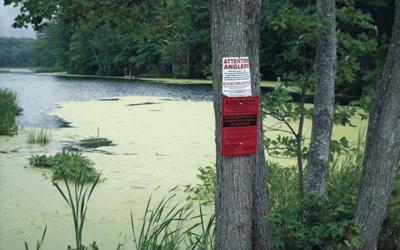
ALTON — A draft permit by the U.S. Environmental Protection Agency would require the Powder Mill State Fish Hatchery to improve the quality of wastewater that eventually flows into Lake Winnipesaukee’s Alton Bay, but community leaders say even tighter standards are needed for the hatchery in New Durham.
The Alton Board of Selectmen sent a letter to Danielle Gaito of the EPA on Jan. 27, calling for tighter regulations and saying the town’s tax base is heavily dependent on waterfront property.
“Our town and its economy, like many in the NH Lakes Region are also dependent on vacationers to our area throughout the year,” the selectmen stated in the letter.
Phosphorus in the wastewater is a particular concern, as its presence can lead to conditions that make the water unsafe for swimming, wading, and fishing.
“Continued high total phosphorus loads entering Alton Bay will degrade the water and may result in algal and cyanobacteria blooms which will prove esthetically unpleasing, disrupt primary contact recreation and eventually may also impair aquatic animal life,” the letter said.
The selectmen said the Platte River Hatchery in Michigan has been able to discharge water with phosphorus concentrations no higher than that of its intake water.
Wastewater from the Powder Mill hatchery has been measured as containing 12 times more phosphorus than its intake water.
The EPA’s draft plan called for phosphorus levels of 14 parts per billion in the hatchery discharge water, increasing to 25 parts per billion in the winter months.
Fred Quimby, a retired professor of environmental toxicology at Cornell University, is on the Alton/New Durham Cyanobacteria Mitigation Steering Committee. The standards being proposed by the EPA would not solve the problem, he said.
“The community does not think it will make a demonstrable change,” he said. “The community thinks that would be high enough to allow cyanobacteria to grow in the river.”
His group has established a water quality goal of a year-round monthly average of no more than 10 parts per billion of total phosphorus throughout the Merrymeeting River.
Danielle Gaito, of the EPA, held a meeting last week to take public comment on the draft permit.
Quimby said the consensus among those who commented was that the permit should call for tighter standards on phosphorus and should contain regulatory standards for nitrogen and solids.
“In the last five years, over 80 tons of suspended solids have been discharged into the river, and they have also put in over 35 tons of nitrogen,” he said.
He praised the state for trying to improve wastewater quality.
“They have gone on their own and built a brand new way of disposing of the solids they collected and it has been a vast improvement,” Quimby said. “Now, they are vacuuming them up and putting them into concrete tanks that break down nitrogen and absorb the phosphorus.”
Jason Smith, chief of Fish and Game’s Inland Fisheries Division, who oversees the hatchery, was on vacation and unavailable for comment.
Meanwhile, the Conservation Legal Foundation is suing the state for allegedly violating the Clean Water Act with pollution from the hatchery.


(0) comments
Welcome to the discussion.
Log In
Keep it Clean. Please avoid obscene, vulgar, lewd, racist or sexually-oriented language.
PLEASE TURN OFF YOUR CAPS LOCK.
Don't Threaten. Threats of harming another person will not be tolerated.
Be Truthful. Don't knowingly lie about anyone or anything.
Be Nice. No racism, sexism or any sort of -ism that is degrading to another person.
Be Proactive. Use the 'Report' link on each comment to let us know of abusive posts.
Share with Us. We'd love to hear eyewitness accounts, the history behind an article.