


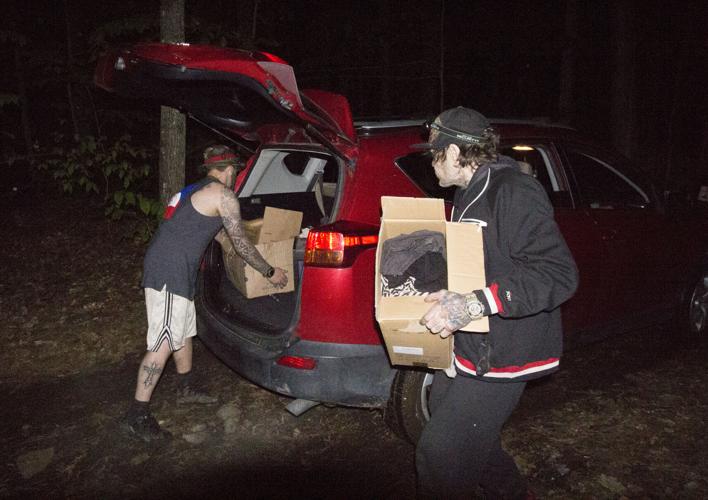
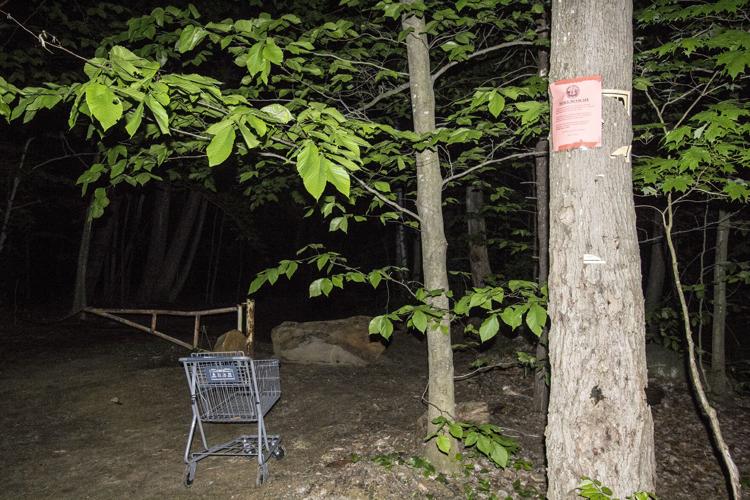
LACONIA — In the dead of night, headlights bobbed and bicycles rattled in the darkness at the end of Spruce Street. Within the black and green of the woods, residents of so-called Tent City were hard at work packing up their lives. It was 11:50 p.m. on Sunday, the day the city planned to clean out the camp.
Two weeks ago, Mayor Andrew Hosmer announced the camp at the end of would be cleared out after nearly three years of occupancy, citing health and safety concerns.
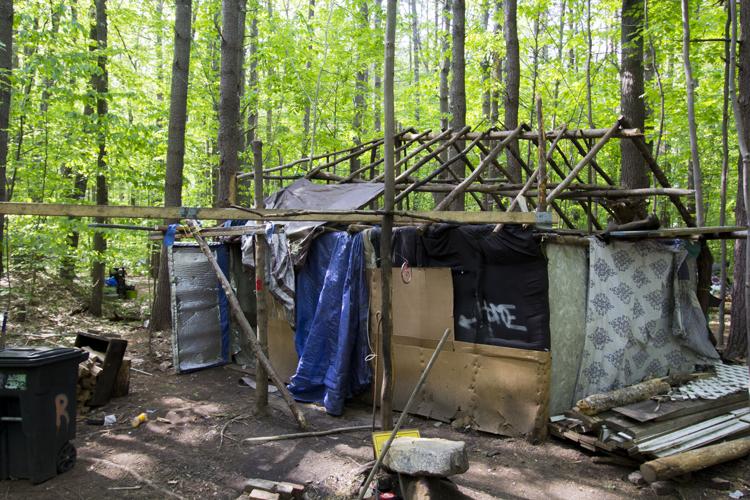
During those three years, members of the city's community experiencing homelessness have stayed in the woods in tents and tarp cabins with varying degrees of permanency. Camping is technically illegal, as it is throughout Laconia, but the city has, for the most part, looked the other way in the absence of a long-term solution.
After a suspected overdose death on April 28, the continued accumulation of human waste, trash and the concerns of homeowners on Spruce Street, Laconia is pulling the plug on Tent City.
“People are worried about the homeless now, just wait 'til the camps are cleared,” said one woman as she packed up her belongings.
Hosmer reflected this concern at the May 8 city council meeting, when he noticed the closure of the camp. Hosmer quoted Police Chief Matt Canfield, stating the problem is “like squeezing a balloon.” There were between 60 and 100 occupants of Tent City.
“Nobody's trying to stay, we're all trying to get out,” said a resident who identified himself as J, and said he lived in the forest since 2019.
“It's not right though in my eyes, I really don't want to [leave], but I don't want to go to jail.”
From J's perspective, occupants kept the camp relatively clean and hadn't bothered much of the neighborhood. Residents on Spruce Street, including Rep. Steven Bogert (R-Laconia) had a different story, complaining of stolen propane tanks. Another neighbor claimed his tomatoes had been stolen by people living in the woods.
One Tent City resident acknowledged these thefts as instrumental to the closing of the camp.
“Not all of us are stealing from the neighborhood,” he said. Referring to the thieves, “they ruined it for us.”
When J first moved to the forest, he was one of a few. In recent years, that number has grown by the dozens. Another couple, Nate and Cass, said the current head count was around 75, all of whom will scatter across the city.
“No one's telling each other where they're going,” said Nate, “because they don't want it to get too big like it did here.”
With that secrecy comes a lack of security. In Tent City, clusters of campers watched out for one another by sharing resources and guarding each other's possessions when they were away. Now, what little sense of community that existed is gone.
“There's not gonna be anyone checking on each other,” Nate said. “[The city] said they're sick of turning a blind eye to it, but now they're gonna be forced to stare at it.”
Midnight came and went, but the police never showed. A few friends and family members brought their cars into the forest to help with transporting belongings, while some biked out with or dragged their possessions out on carts and tiny trailers.
As representatives from the city failed to appear, some residents speculated the clear-out would happen in the early morning hours.
It was sometime just past 9:30 a.m. on Monday when Det. Eric Adams arrived with Officer Anna Brewer-Croteau to assess the camp. By then, personnel from Lakes Region Mental Health Center and the Community Action Program had set up shop to provide assistance to the displaced campers. Adams and Brewer-Croteau quietly walked along the paths, speaking with those remaining, most of whom seemed to be in the stages of packing up and leaving.
Adams has long taken a more nuanced and progressive approach to communities experiencing addiction and homelessness, an approach that is being implemented in cities across the state. According to him, the city will be using a private company to conduct the cleanup once people have left.
“Right now, we don't have a viable solution,” Adams said. “We're working on some stuff, but it's not an easy fix. It's like this all across the country, we need to just take it one day at a time.”
Adams added that there were many volunteers who wanted to help clean up, but the city chose a private service due to safety hazards including human waste and used needles.
Many camp sites were abandoned by Monday morning, leaving behind the skeletons of tarp cabins, furniture, decorations, bicycle parts and trash.
Another occupant, Amy, said authorities were giving campers more time to sort their belongings, taking a less confrontational approach this time around. When Hosmer announced the clearing of the camp, he emphasized that extra care would be taken so that people's important documents and items like identifications would not be thrown away.
“I will say, everyone that I've talked to has been very nice and respectful,” Adams said after speaking with a camper. “They understand. It's not easy.”
Over the course of several visits to the camp, occupants pointed to fears of arrest if they were to return to the city streets.
“The chief and I have had conversations, it's not the goal to just push everybody out of here so we can just start arresting,” Adams said. “We want to come up with solutions that can help both, right?
“But if we're getting calls for people trespassing on private property, we have to take action. It doesn't mean we have to arrest them right away, we can try to move them along. That's more of the case than anything else.”
One of the key factors in the closing of Tent City was its growth. What started out as a trickle of people experiencing homelessness became a river flowing from the end of Spruce Street to downtown. J chalked up the population growth to Isaiah 61 Cafe, which provides services including free food, recreation and even a low-barrier shelter in the winter. According to Adams, most of the new arrivals are from outside the city.
“They're coming from further away, that's been confirmed by our patrol officers, it's been confirmed by the CAP program, it's been confirmed by Lakes Region Mental Health. It is what it is,” Adams said. “That's part of the issue. They're coming from all other areas. How they get here, we don't know.”


(0) comments
Welcome to the discussion.
Log In
Keep it Clean. Please avoid obscene, vulgar, lewd, racist or sexually-oriented language.
PLEASE TURN OFF YOUR CAPS LOCK.
Don't Threaten. Threats of harming another person will not be tolerated.
Be Truthful. Don't knowingly lie about anyone or anything.
Be Nice. No racism, sexism or any sort of -ism that is degrading to another person.
Be Proactive. Use the 'Report' link on each comment to let us know of abusive posts.
Share with Us. We'd love to hear eyewitness accounts, the history behind an article.