


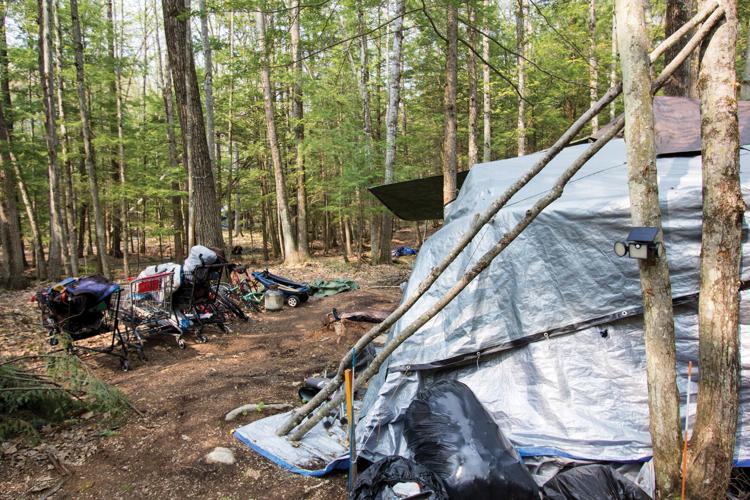
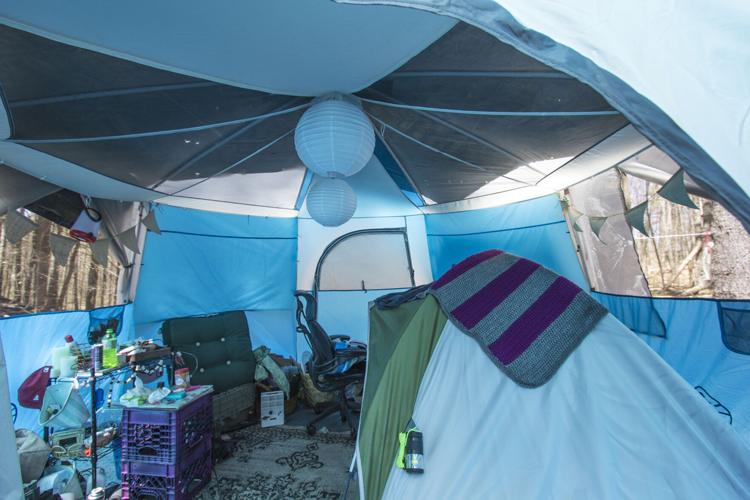
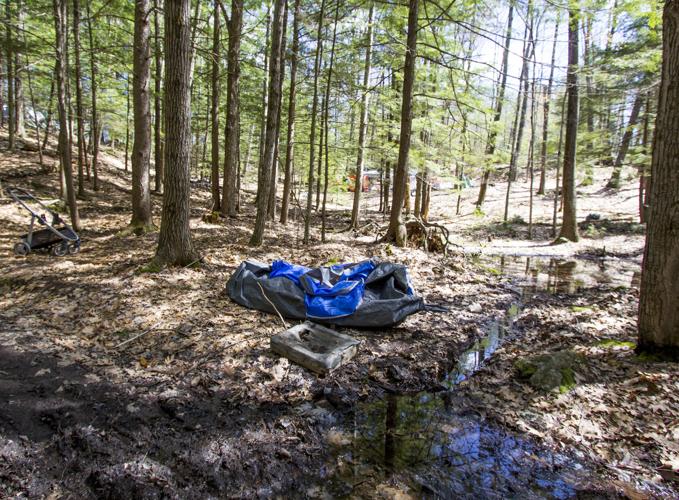
LACONIA — Spruce Street ends abruptly, revealing a starkly different reality behind a thin veil of trees. To one side lies a seemingly ordinary neighborhood. On the other side is a community of approximately 100 people surviving in tents and under tarps. To some occupants, this place is known as Tent City.
Mayor Andrew Hosmer announced at the council meeting May 8 that the city would clear out the encampment on Sunday, May 21. Tent City residents were informed ahead of time about the cleanup by staff from the Community Action Program of Belknap and Merrimack counties.
For the past three years, a portion of those experiencing homelessness in the city have sought refuge there. However, their presence has not been without consequence. The accumulation of trash and human waste, as well as concerns from nearby homeowners have reached a boiling point.
“We’re all going to be out there on the streets, it’s going to be Bike Week, that’s already a big enough problem for law enforcement,” said Ace, a Tent City resident. “What are the homeless supposed to do? Where are they gonna go?”
As the mayor has repeatedly acknowledged, there is no easy answer to that question.
“The city is faced with the choice again, do we enforce the city ordinances and immediately move all those folks off that property?” Hosmer said. “We know that if we do that, as happened a few years before, those people experiencing homelessness just move to another part of the city.”
“Being at this camp like this, they know where everyone is, but once this clear out happens, they’re gonna be scattered all over town,” said Justin Stonie, a city resident who has been bringing food to the camp. “I think people are going to see a lot more things that they don’t want to see.”
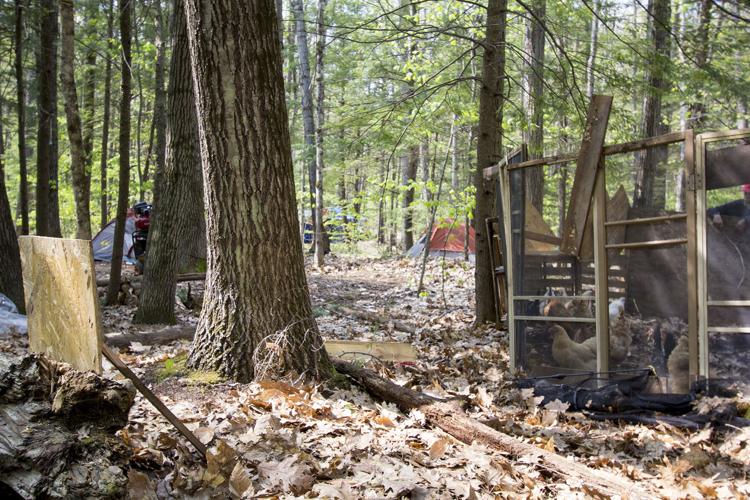
Camping in the forest is illegal, and until now, the city has turned a blind eye, even providing biweekly trash pickup at the end of Spruce Street. This flexibility, combined with the forest’s close proximity to downtown, has allowed an entire village to sprout up among the trees. There are bucket and tarp outhouses, wooden pallet bridges across muddy trails, and for a time, a chicken coop. One camper even had a wood stove attached to his dwelling.
There is a simultaneous sense of community and every-person-for-themselves survivalism within the woods. Fights, thefts and assaults are not uncommon, but few are reported. At the same time, campers will check in on older or injured members, and share resources like water.
The occupants often camp in tent clusters to keep watch on each other’s belongings. Some keep to themselves and stay out of trouble; others are still in the clutches of addiction, continuing to use substances within the camps.
“This experience is absolute survival,” said Nate, who lives in the camp with his significant other, Cass.
“Everyone calls homeless people lazy; I’ve never worked so hard to get basic resources to survive,” Cass said. “If you’re lazy, you die out here.”
For Cass and Nate, seeking out something as simple as drinking water requires careful planning and hours of work. “It takes all day to get ready for the night, basically,” Nate said. “People don’t think about that.”
"People are like, 'Oh, get a job.' Well, survival is your job," Cass said. "We get stuck in that rut because you can't get a job. You think, 'Oh, I'll do that the next day, maybe I'll have a little more time.' But you just don't."
"I work three days a week, but she's here getting everything ready," Nate said. "If I was on my own, working and not getting out until 3:30 or 4," I'd be in trouble.
Those who are on their own risk losing everything in their camp to theft while they are out working, seeking work, or gathering supplies.
Fear of theft was a primary reason the city’s temporary cold-weather shelter on the former State School property went virtually unused this winter, with just two individuals taking cover there. Instead, Tent City residents endured sub-zero temperatures, relying dangerously on space heaters inside their tents to keep warm.
One person nearly lost a thumb to melting nylon after his tent caught fire. Others suffered through frostbite injuries instead of using the shelter.
Nate and Cass said they led relatively normal lives until last November when a combination of the impact of COVID-19 and a literal back-breaking accident left them unable to pay the bills.
"I always had a car, a job, a house. Life was normal," Cass said.
"We didn't even know anyone who was homeless before," said Nate.
After losing their home and braving the winter in the forest with only a tent within a tent, a common technique for keeping warm, the couple says they are completely transformed.
"I feel like a survivor, a ... warrior," Cass said. "I literally feel stronger than I've ever been in my life."
Despite the harsh conditions and rampant drug use within Tent City, there has only been one reported death.
In the early hours of April 28, 39-year-old Nicholas Gauvreau died in a small tent. He was alone and new to Tent City. His death is being investigated as an overdose.
"At 1 to 2 a.m., someone was making these animal-sounding noises," said someone staying in a neighboring tent, who had told the noisemaker to shut up, not realizing those sounds were final breaths. "Right after that, it stopped."
Eventually, the neighbor opened Gauvreau's tent to check on him.
"It took 10 years to forget about seeing my dad like that," he said. "I don't know why I looked in there. That'll take another 10 years to forget that."
Public pressure from residents of Spruce Street has increased with the size of the camp. Rep. Steven Bogert (R-Laconia), who lives just a few houses from the entrance to Tent City, said the camp “had run its course” and that enough was enough.
“I’ve had my gas tank from my grill stolen, my other neighbor next door had a his tank stolen from his grill,” Bogert said.
Bogert cited other incidents, including a person using drugs in the middle of the street, and a woman assaulted by fellow campers.
"We have this constant stream, every day," Bogert said, gesturing to people walking up and down Spruce as he spoke. "There's more people coming up and down the street than cars on Union Avenue. ... When they get this close to your house, it's only a matter of time before they're in your window and taking what they want."
Bogert's neighbor, Shayna Hughes, a mother of three young children, expressed empathy for those grappling with homelessness but harbored concerns for her children's safety and the safety of those in the encampment. She voiced particular worry for young women in the camps.
"I've seen some who appear to be between the ages of 17 and 21," Hughes said. "It seems like they're alone, not walking in a group. And that's a very big concern for me, because I spoke to someone in Manchester who said the women there are experiencing assault, sexual assault, robberies. They're just not safe."
Bogert criticized those staying in Tent City as unwilling to improve their situations.
"I feel bad for them," Bogert said. "But I look at these people all day long, and I ask, 'Why aren't you working?' No one wants to ask that question."
People experiencing homelessness interviewed for this story and those who participated in the city's recent forums have said businesses refuse to hire them once their housing status is revealed. The absence of a fixed address complicates job applications. When people list an address like the Isaiah 61 Cafe, the applications are thrown out.
Bogert asserted that people experiencing homelessness should seek jobs in construction or dishwashing. “They have the ability to do menial labor,” Bogert said. “There’s landscaping crews. This is the hottest time in the world to go work for a landscaping crew. They don’t care if you’ve been to prison or not because you’re not bothering anybody’s house, you’re doing landscaping.”
During last week's city council meeting, Hughes publicly shared encounters with Tent City residents trying to interact with her children and, in one instance, her newborn baby.
“I feel like this is an issue that I have been very understanding about, because I understand addiction and mental health probably more than most people in this room,” Hughes said at the meeting. “However, I have seen an increasing number of people that do not want to accept help, and I don’t know what avenues we’re supposed to take for those people.”
Those willing to accept help often face a seemingly complex bureaucracy, and long waiting lists for substance misuse treatment or housing assistance. One woman in Tent City said she had been on a housing waitlist for 10 years.
After telling one of the Tent City residents to leave his neighborhood, Bogert discovered she was originally from Gilford.
“I says, 'Why don’t you go back to Gilford?'” Bogert said. “She said, ‘They told me to go to Laconia.’ Hence, all the surrounding towns don’t want to take care of the problem, so they send them to Laconia. What I’d actually like to see is a state regulation that changes welfare into a county function and part of the county budget. Then, this welfare money is automatically pulled from each town, so every town contributes, so that we have at least some resources, and not one town’s resources are being absorbed, when not all of these people are from Laconia.”
Bogert also proposed that the city permit people to camp on the former State School property due to its distance from town and neighborhoods. He also suggested the downtown parking garage, half of which is not structurally sound enough for vehicles, be converted into an enclosed encampment.
“It’s not suitable for cars,” Bogert said. “But it is suitable for tents. It is suitable for safe protection. It’s next door to Lakes Region Mental Health, it’s got drug rehabs in the area, it’s got all the services available, and they’re located in one safe area.”
In interviews with 50 people experiencing homelessness in Laconia, most of whom called Tent City home, the majority said they were from the city, and cited the city’s steep housing prices and housing scarcity as their primary barriers to escaping homelessness.
Even those who work full time are often unable to find an affordable apartment.
“They need to bring back the apartments they took and tore down just to rebuild it for rich people,” said Matt, a Tent City resident working 40 hours per week. “I’m homeless because of that.”
Matt was one of a group of residents displaced by recent revitalization in Lakeport, where older apartments were torn down to make way for condominium development. He said he and his wife had been living at their residence for less than six months before it was sold to a new owner and scheduled for demolition.
While there are some affordable apartment projects in the pipeline, including one right behind the current location of Tent City — an effort Bogert voted in favor of — they have yet to break ground.
In the meantime, prices continue to increase, and long-standing city zoning practices have made building multi-family dwellings difficult, and at times, cost-prohibitive.
The closing of the camp, Hosmer acknowledged, will only scatter the population experiencing homelessness across the city.
“As Chief [Matt] Canfield once put it, it’s like squeezing a balloon,” Hosmer said at the city council meeting. “It is my goal personally to see people experiencing homelessness to move from that to a stable housing environment. It’s certainly a tall task, but I know the city of Laconia is not unique in this state, this region, this country or even this world. This is something that is going on worldwide right now and it’s growing in numbers.”


(0) comments
Welcome to the discussion.
Log In
Keep it Clean. Please avoid obscene, vulgar, lewd, racist or sexually-oriented language.
PLEASE TURN OFF YOUR CAPS LOCK.
Don't Threaten. Threats of harming another person will not be tolerated.
Be Truthful. Don't knowingly lie about anyone or anything.
Be Nice. No racism, sexism or any sort of -ism that is degrading to another person.
Be Proactive. Use the 'Report' link on each comment to let us know of abusive posts.
Share with Us. We'd love to hear eyewitness accounts, the history behind an article.