


LACONIA — In Laconia, there are an estimated 400 people experiencing homelessness. Many are invisible to passersby, living in cars, or couch surfing as they try to piece together a living. Others make camp around the city in nooks, crannies and forests, transporting their possessions on their back or in carts. It is this group, the visible people, who have sparked debate and concern amongst the city.
Mayor Andrew Hosmer noticed the clear out of an encampment at the end of Spruce Street last month. For nearly three years, people have camped there, albeit illegally. Previously, the city had offered trash pickup for the camp, but the growing population, sanitation and safety concerns, especially those of nearby homeowners, forced the city to act.
The camp is currently being cleared out. Right now, there is no ready solution. There is no land where people experiencing homelessness can legally camp. Simultaneously, as the police department has acknowledged, it is not illegal to be unhoused.
In an effort to better understand the city’s homelessness crisis, The Daily Sun interviewed 50 unsheltered people at several locations to gather data.
Participants were asked basic questions such as sex, age, race, employment and veteran status, in addition to more personal points such as how they lost their home, if they had a substance use disorder, and what they perceived as their biggest barrier to achieving housing.
Surveys were conducted at the Belknap House, the camp near Spruce Street, downtown, Rotary Park, and Isaiah 61 Cafe. A majority of those surveyed were camping in the woods at the end of Spruce Street.
Demographics
Of participants surveyed, 66% were male, 34% female. The average age was found to be 43 1/2 years.
The youngest participant was 26, while the oldest was 65.
Of the respondents, 92% identified as white, 4% identified as Hispanic, 2% identified as Black and 2% identified as Latino. Only one individual identified as a veteran.
Origin
Every participant said they lived in New Hampshire before losing their homes. Of the 40 participants that listed which town they previously resided in, 27 were from Laconia and two were from Belmont. The additional 12 were each from different communities in New Hampshire, including Alton, Center Harbor, New Hampton, Northfield, Franklin, Alexandria, Bethlehem and Rochester.
Primary factor in losing housing
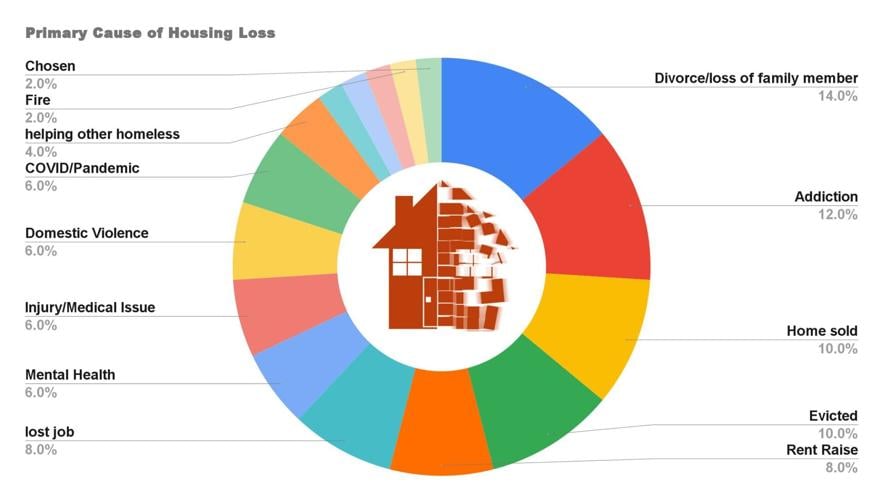
Homelessness is often the result of multiple factors converging. For example, someone needs a car to commute to work, and the car breaks down. The repair is so expensive they have to choose between paying rent on time, or fixing their car to travel to work. Either choice could result in eviction. Sixteen primary factors were identified in contributing to the loss of housing by participants.
There were four top causes.
Divorce or the death of a family member made up 14% of responses. For many, the sudden shift from a two-income to a single-income household was not economically bearable. In the case of some female participants, their spouses were the only source of income. After losing that spouse to either death or divorce, they were unable to find suitable income to replace them. For divorced or separated males, the financial hit was a significant factor.
Addiction made up 12% of survey answers. Of those surveyed, 52% had a substance use disorder, and 69% had a substance use disorder before losing their homes. The remainder developed a substance use disorder after losing housing. Of the 24 individuals who said they do not currently have a substance use disorder, two said they had one before experiencing homelessness.
A landlord selling the property where they were renting an apartment was the cause of losing housing according to 10% of respondents. This constituted people who were living in apartments that were then purchased by a new owner.
And additional 10% lost their homes to eviction.
Of the remaining people surveyed, 8% said a raise in rent was the cause of home loss, and another 8% cited job loss. Of survey respondents, 6% lost their homes because of a mental health disorder, 6% because of physical health, 6% due to domestic violence — all female, and 6% following the pandemic. Another 4% said they lost their homes because of helping other people without housing, 2% listed a loss of benefits, 2% said loss of transportation, 2% cited a fire, and 2% said a flood was the primary cause of losing their homes.
Just 2% of participants said they chose to be unhoused.
Employment
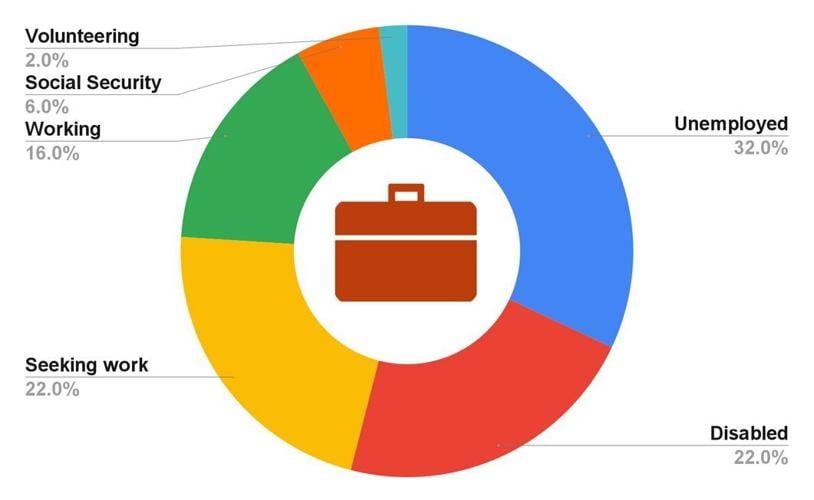
Finding and keeping a job while experiencing homelessness can be particularly challenging. Those able and willing to work reported having applications ignored once employers were aware of their housing status. Others pointed to physical and mental illness as preventing them from being able to get a job.
In the survey, 32% of people said they were unemployed, and 22% said they were actively seeking work. Another 22% said they were disabled. Of survey respondents, 16% said they were working either full or part time. Other answers were 6% receiving government assistance, and 2% said they were volunteering.
Length of experience, modes of shelter
Like age, the time spent experiencing homelessness was a significant range, from four days to 18 years. The average person surveyed had been unsheltered for nearly 4.5 years.
The majority of participants, 78%, were camping. Another 10% said they were couch surfing, while 8% were staying in a shelter like Belknap House. Just 2% of those surveyed lived in a vehicle, and an additional 2% were staying with a family member.
Barriers to finding new housing
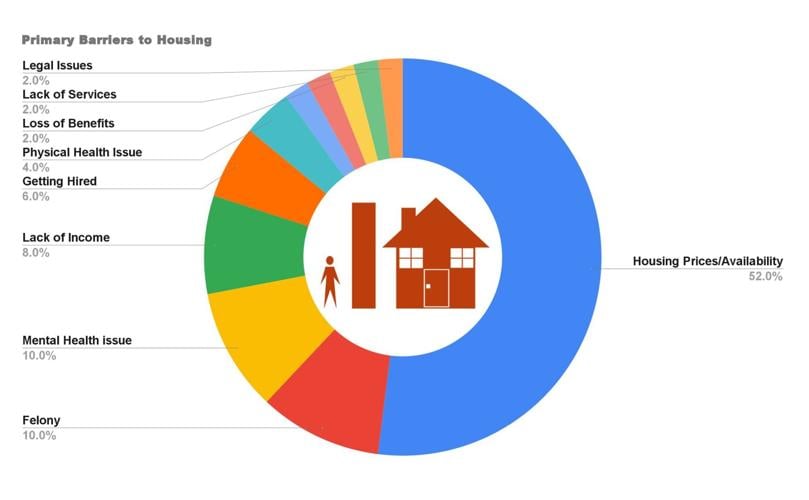
Obstacles to achieving housing can be just as, if not more, complex than the reasons people lose their homes.
When asked about the most significant, or largest barrier, 52% of survey participants listed housing prices and availability as the primary barrier. With a less than 1% vacancy rate and inflated rental rates, it's incredibly difficult for those working at or near minimum wage to find an affordable place to live.
A recent search on apartments.com for a one-bedroom apartment in Laconia yielded just four results, ranging from $1,400 to $1,725. Using the rent as one-third of income philosophy, a person would need to earn over $50,000 annually to afford the lowest priced listing. By contrast, someone working for minimum wage, 40 hours per week only takes home $950 in New Hampshire. Inflated rents can be tied to the state’s deficit of housing units and influx of luxury condominium construction.
Other responses include having a felony conviction — 10%, and 10% listed a mental health disorder. Another 8% cited lack of income, 6% said an inability to get a job, 4% listed physical health problems, and the remaining 6% were split evenly among legal issues, a lack of services, and a loss of benefits.
Trends in data
The average person in Laconia experiencing homelessness is a 43-and-a-half-year-old unemployed male with a substance use disorder developed before losing their home to divorce or the death of a family member. They are camping for shelter, and have been unhoused for around 4.5 years. Their primary barrier to achieving housing is cost and availability.
What is clear is that as people age, they become more vulnerable to losing their homes, especially if they are relying on a partner or family member to share the cost. Substance use disorders also play a factor. The difficulties of getting a job once someone no longer has a stable address also appears to be a factor. The 16% of people surveyed who are employed were often only able to work part time. Having a felony record also appears as an obstacle to people obtaining work or housing.


(0) comments
Welcome to the discussion.
Log In
Keep it Clean. Please avoid obscene, vulgar, lewd, racist or sexually-oriented language.
PLEASE TURN OFF YOUR CAPS LOCK.
Don't Threaten. Threats of harming another person will not be tolerated.
Be Truthful. Don't knowingly lie about anyone or anything.
Be Nice. No racism, sexism or any sort of -ism that is degrading to another person.
Be Proactive. Use the 'Report' link on each comment to let us know of abusive posts.
Share with Us. We'd love to hear eyewitness accounts, the history behind an article.