


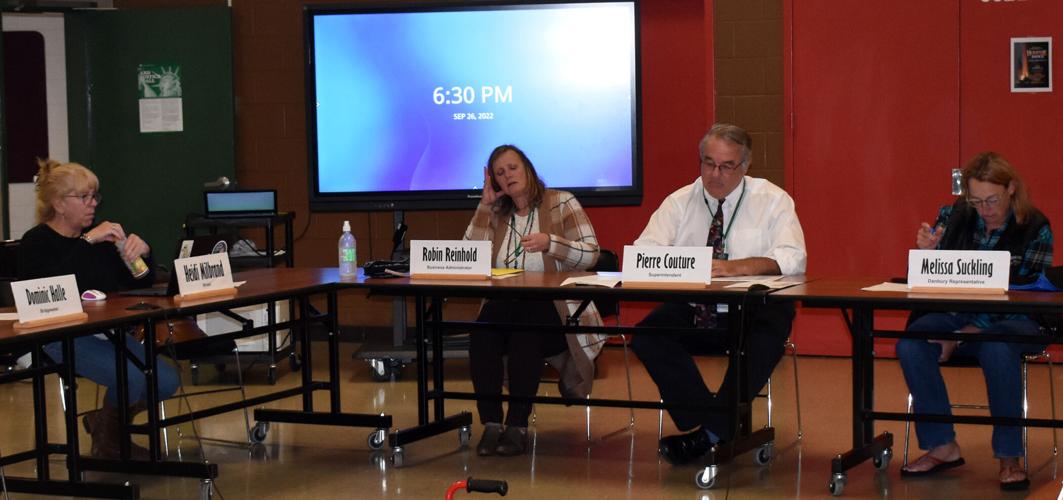

BRISTOL — The Newfound Area School Board has accepted on first reading a budget planning policy that, according to Superintendent Pierre Couture, “Will be aligned with what is actually happening" in the district.
The current policy dates back to 1998, before the school district had a budget committee, a tax cap and a split district meeting, having adopted the Official Ballot Act, commonly known as SB2, after that date. Couture said the new policy comes at the request of the budget committee, which is not even mentioned in the current policy.
The proposed policy removes the school board from the budget preparation process, giving the superintendent the authority to set the guidelines and present a proposed spending plan directly to the budget committee.
Until recently, the school board retained control over the initial budget preparation, making its recommendation to the budget committee. The budget committee then made any adjustments and developed the final recommendation to go before the voters. This process is followed by most school districts and municipalities, and it is reflected on the budget forms required by the state.
In recent years, the Newfound district has condensed that process, with the administration making its budget presentation simultaneously to the school board and the budget committee. Couture said that, in the three years he has been with the district, the school board waits for the budget committee to develop a budget; then, if board members disagree, they make that known to the voters during the deliberative session.
“They do vote at one point to approve the budget, but I think they get a pretty good idea of what’s in the budget through my presentation,” Couture said during a wide-ranging interview at his office. “And if there’s anything where we’re recommending a change in personnel — reducing teachers or adding a teacher or whatever — they’re well aware of that ... so they are involved.”
The change is prompted, in part, by the condensed timeline for developing a budget. Under the traditional annual meeting process, budget preparation can last until February. In order to meet the requirements of the Official Ballot Act, the budget has to be completed by January. That means that principals have to start developing their budgets for the following year as soon as school opens, just two months into the current budget, which took effect on July 1.
Budget preparation has to start early to allow time for the budget committee to do its work, Couture said.
“We do a lot of work on the budget here, and we try like heck to get it to that 2% tax cap before it goes to the budget committee,” Couture said.
Tax cap constraints
Newfound’s tax cap limits the increase in assessments to the towns by 2%, which means that revenue increases can allow the district to spend more than 2%, while revenue decreases can mean less spending than the previous year.
Two years ago, there was a large increase in health insurance costs at the same time the state was imposing a 4% increase in retirement system obligations.
“It was like the perfect terrible storm,” Couture said. The district had to look at severe cuts and the budget committee recommended eliminating sports. Athletics were saved only when a huge turnout at the district meeting overrode the tax cap.
Couture said 80% of the budget goes to salary and benefits, and things like heating oil and bus contracts account for another 13%.
“Essentially, 7% of our budget was somewhat negotiable, but even within that, you would be removing things you traditionally have,” Couture said. “I think that some of the budget committee members were like, ‘Well, there wasn’t really much for us to do.’”
The school board retains the ability to adjust spending as long as it does not exceed the total budget figure. If the budget committee recommends eliminating five teachers, the school board might shift other spending to retain three of them, Couture said as an example.
Last year, without increases in health insurance and retirement, and with more adequacy aid coming to the district, remaining under the tax cap was easy, Couture said. This year, he knows that retirement costs will see a slight decrease, but he does not yet know what the health insurance cost will be.
Administrative work on next year’s budget is underway and Couture plans to make his joint presentation to the school board and budget committee on Monday, Nov. 7.
Facilities
At the school board meeting Sept. 26, Danbury Elementary School Principal Norma Ross gave a presentation on the constraints the building faces, with her small office doubling as a conference room, classrooms that double as space for occupational therapy, and a library that is on a cart in the multipurpose room.
“It’s just a really great picture of how we make magical things work in our buildings,” Ross said, “and we’re there for kids every single day. But we really need to think about how we can do better for our students.”
The district is reviewing the space needs at each of its elementary schools, and has engaged an architectural firm to pull together information for potential building plans to address the needs. Public tours are scheduled at each of the elementary schools in early October, followed by a public listening session Tuesday, Oct. 18, at 6 p.m. at Newfound Regional High School.
The school board is aiming to have a plan to present to voters in 2024, with Chair Melissa Suckling saying they do not want to rush into it, giving people time to understand “what it really means.”
As part of the process, the board voted Sept. 12 to join the New England School Development Council, at a membership cost of $970, to project the district’s enrollment. During Monday’s public comment period, Bridgewater resident Aubrey Freedman complained about that decision, noting that the district has enough enrollment history to do its own projections.
“I looked at their website,” Freedman said, “and they made nice reports. But, honestly, what do they know about the future any more than the rest of us?”
Freedman also objected to the district providing flu and COVID vaccination clinics.
“I don’t think that should be taking place during school hours on school grounds,” Freedman said. “People will say, ‘Well, it’s convenient for parents to be done at the school.’ The thing is, that can be done at CVS, Walgreens, Rite Aid; I was at Walmart yesterday, they had a sign up for vaccinations and make it quite easy these days to get your kids vaccinated.”
Angela Eckstrom of the Central NH Public Health Network, who is the public health emergency preparedness coordinator for Central New Hampshire and advisor for school-based clinics, said the vaccination clinics are designed to address the lack of public transportation that prevents some rural residents from accessing the vaccines.
“This program affords families to be able to have a choice of whether to vaccinate their minor not, because the vaccine will be available to them,” she said. “And there’s public transportation available for them to get to and from school.”
The school board voted to offer both flu and COVID clinics at each of the schools, but at separate times so that, if a child has an adverse reaction, it will be apparent which vaccine was the cause.


(0) comments
Welcome to the discussion.
Log In
Keep it Clean. Please avoid obscene, vulgar, lewd, racist or sexually-oriented language.
PLEASE TURN OFF YOUR CAPS LOCK.
Don't Threaten. Threats of harming another person will not be tolerated.
Be Truthful. Don't knowingly lie about anyone or anything.
Be Nice. No racism, sexism or any sort of -ism that is degrading to another person.
Be Proactive. Use the 'Report' link on each comment to let us know of abusive posts.
Share with Us. We'd love to hear eyewitness accounts, the history behind an article.