


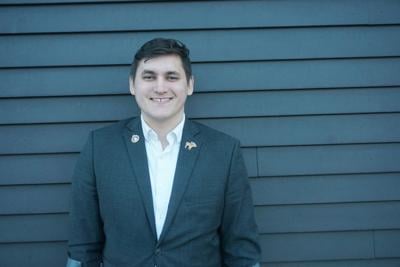
Leaning on his experience in New Hampshire’s Statehouse, state Rep. Heath Howard (D-Strafford) is running for the seat currently occupied by Chris Pappas (D-NH) in the U.S. House of Representatives. Pappas is running for Senate.
And it's universal health care that’s on Howard’s agenda.
He suffered a severe back injury at 15, requiring an eight-hour surgery for his spinal cord to be rebundled, and had four rods and eight screws put in.
“I’m very thankful that I’m able to walk and able to stand, but that experience really showed me just how broken our health care system really is,” he said. “And why we need to have a universal health care system that works for everyone.”
Caps on drug prices, and shifting incentives so pharmaceutical companies work for the public, are two aspects of reform he’d support, he said.
“We spend $4.9 trillion annually on health care here in this country and this is something where a Medicare for All system would cost $3.5 trillion,” Howard said. “It’s a much cheaper alternative, and one that provides better care.”
Though Howard is one of the younger representatives in New Hampshire’s Legislature, he’s got more legislative experience than any of his opponents in the race to represent New Hampshire’s First Congressional District, he said in an interview.
The two-term Strafford representative is pushing to win a seat at the table to advocate for numerous federal policy reforms. He said he’s adept at working out compromises, having worked to do so in New Hampshire’s Statehouse.
“I’ve been a coalition builder my entire time in the Legislature,” he said. “I had 28 of my bills pass our chamber last year, I had seven signed by the governor. I’m very proud of the work I’ve been able to do, and the bipartisan efforts that we’ve been able to lead. That’s the type of mentality that we have to have — we have to build those coalitions and find those votes wherever we can.”
Howard referred to his experiences as a child, observing as the United States engaged in the war in Iraq that led to the capture of former President Saddam Hussein in 2003, and his execution in 2006, and resulted in an entrenched and protracted conflict which saw U.S. service members operating in that country for years thereafter.
“We’re talking about people’s lives, and I don’t think that we should be engaging in foreign, overseas wars for resources. I don’t think that’s a necessary thing that we have to do right now. It’s a moral issue that I think affects all of us,” he said. “I don’t think that this is something that we should be pursuing.
“We need to think about cutting Pentagon funding. This is an organization that failed its last six audits,” he said. “If we took half of our Pentagon funding, and put it toward things like universal health care, education, eliminating food insecurity completely, we would still have the best-funded military anywhere in the world, and we’d be able to pay for all these other things.”
On tax policy, Howard expressed reluctance to continue the status-quo, which he said provides large breaks and subsidies to corporations.
“Then these large corporations turn around and tell their employees how they can qualify for federal benefits,” he said. “That is a real joke in a lot of ways where, you know, we’re seeing a lot of money being wasted on programs like that, where we have government-provided services for corporations essentially, and that’s another level of corporate welfare.
“When Republicans say we live in a welfare state, they’re technically correct,” he said. “It’s just the welfare state benefits the corporations, not the individuals. And that needs to be made very clear, because we’re seeing a lot of our tax dollars go to waste, and go right into the hands and pockets of large C-suite executives for a lot of these companies.”
Howard said he’d be in favor of tax subsidies for small businesses, not large corporations, and taxing large corporations accordingly.
“When we’re talking about these additional tax breaks that they’re being given, we need to eliminate those and actually tax them fully, because they should be paying a fair share and that’s not something that they’re doing at this current moment,” he said. “We also need to tax the billionaires and make sure that they’re paying their fair share, as well. We’re at this point where we’re seeing a consolidation of wealth across multiple different levels and it’s very concerning.”
Private equity in the housing market has distorted it, leading to problems particularly in the market for single-family homes, Howard said. He said private equity firms are purchasing these properties and turning them into rentals, reducing the vacancy rate but not increasing the supply.
“We talk about building, building, building — we never talk about who’s buying,” he said. “That’s a huge problem, because we’re seeing young people flee the state because of housing prices, because of cost of living prices, because we have the highest in-state tuition for our public university system anywhere in the country, so people are leaving and they’re not coming back.”
He described the centralization of wealth in the United States a “huge issue.”
“We have more wealth inequality today than [they] did in revolutionary France,” he said. “That, I think, says a lot as to the state of this country, because we have all of our elections bought and sold for, we have very little say in terms of what we can do. Our job and our opportunity to pay our bills is very much tied to what political action we take, for instance, and that I think is very concerning.”
Howard said he isn’t taking any corporate political action committee funds, but his campaign is supported by IBEW 104, a union PAC, and also by ideological PACs. He said his campaign is different compared with his opponents, who have access to vast wealth.
“I was the first union-endorsed candidate in this race, I’ve got the support of nearly 40 state representatives and other elected officials and, despite being 25, and younger than some of my opponent’s kids, I am the one with the most experience as an elected official in this race,” Howard said. “I have the most relevant experience to fill the job Day 1, and I think that’s very important, because I’m one of two people with a record.
“I’ve been able to talk to voters who feel disillusioned about what they want to see from their politicians, and they’re excited by the type of message that we’re putting out, because we’re not a standard [Democrat], we’re not a standard Republican,” he said. “[I’m] an independent-minded thinker, and that is a different scenario than what people have seen previously.”


(0) comments
Welcome to the discussion.
Log In
Keep it Clean. Please avoid obscene, vulgar, lewd, racist or sexually-oriented language.
PLEASE TURN OFF YOUR CAPS LOCK.
Don't Threaten. Threats of harming another person will not be tolerated.
Be Truthful. Don't knowingly lie about anyone or anything.
Be Nice. No racism, sexism or any sort of -ism that is degrading to another person.
Be Proactive. Use the 'Report' link on each comment to let us know of abusive posts.
Share with Us. We'd love to hear eyewitness accounts, the history behind an article.