


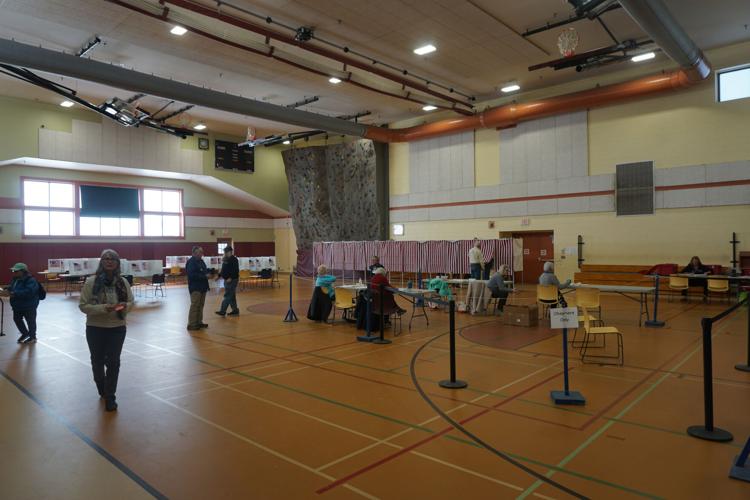
MEREDITH — The townspeople of Meredith gathered at the community center Tuesday morning to decide on their local elections.
On the ballot: several uncontested races and an important zoning question relative to short-term lodging in the town.
By 11:30 a.m., turnout was low, but the day was just getting started. Clerks there said just 127 of 5,581 eligible voters had cast their ballots.
Article V on the town warrant addresses short-term rental properties and would make minor changes to the rules governing their operation and use. Tuesday morning, there were seven voters at the community center, and several expressed support for the warrant article.
A long-term community committee evaluated the short-term rental market in Meredith, paying particular attention to data and impacts. The town also conducted public surveys and considered their responses. The language presented in article V represented their findings, to some degree.
An important aspect to the proposed change is to define a distinction between short-term rentals in owner-occupied dwellings and those not occupied by the owner relative to the number of days each year a short-term rental property can be in use.
A large share of the short-term rental market consists of owners not in residence.
Meredith Selectboard Vice Chair Jeanie Forrester wrote in The Laconia Daily Sun the amendment represented in warrant article V is the result of “the Short-Term Rental Committee’s effort to reduce the number of commercial-interest, short-term rental properties in residential zones and the associated potential negative impacts.”
Without the changes proposed in article V, there is no meaningful distinction — owners are able to rent their dwellings for 120 days each year. If the change passed Tuesday, owner-not-occupied dwellings could be rented out 90 days each year, and owner-occupied dwellings could be rented out for 120 days.
Short-term rentals are an accessory use of detached single-family dwellings for less than 30 consecutive days.
If passed, the amendment would also set occupancy limits in an effort to prevent overloading infrastructure, including septic systems. The new limits include one car per bedroom, two people per bedroom, plus an additional two people.
Accessory dwelling units cannot be used as short-term rentals.
Sandra Dame-St. Gelais was one of several voters present at the polls late morning on Tuesday. She knew about the zoning question on the ballot and was interested in the forthcoming results.
“I’m glad that was covered on the ballot,” Dame-St. Gelais said. “I live in Meredith and right around the area of the Airbnbs.”
Her neighborhood contains at least one of the pertinent short-term rentals, and the property owner is respectful and responsible.
“People aren’t concerned on my street,” she said. “I’m a very proactive voter — I’m a poll worker ... it’s very important.”
June Sarno said she supports the proposed rules, but isn’t sure how they could be reliably enforced.
“I’m in favor of it, we have many Airbnbs in our development. You need the rules — the homes should be safe and rented out to the number of people it can support,” she said. “I think it’s going to be difficult to implement it, but it’s a start.”
Concerns regarding verification and enforcement were common themes expressed by voters Tuesday morning, but so was optimism that implementing the amendment was a win for their neighborhoods, and the broader environment.
“I thought that the planning board has done a great job,” Eric Cohen said.
Meredith’s Town Meeting is set for 7 p.m. on Wednesday, March 12, at Inter-Lakes High School.
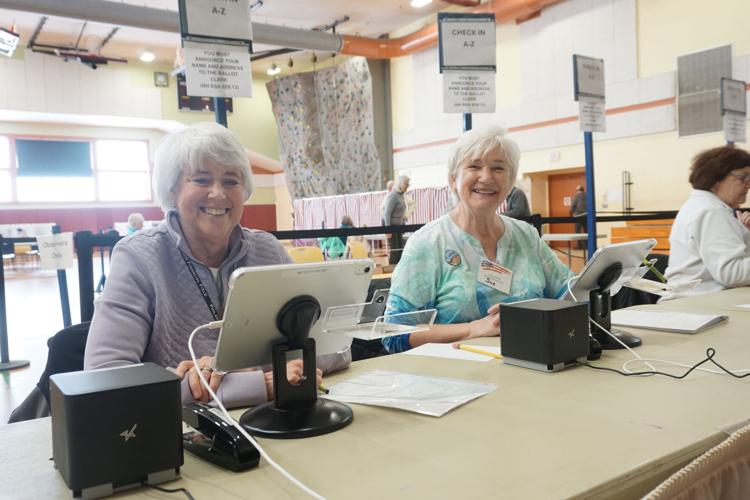
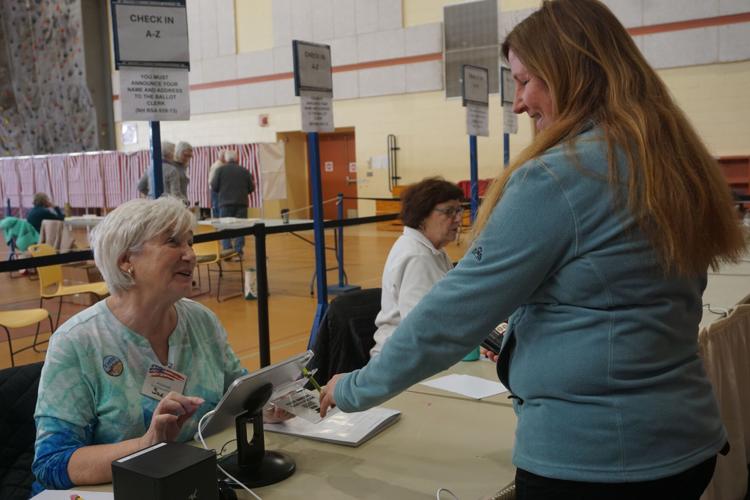
In the midst of a centuries-old tradition, something new came to Meredith Tuesday morning — an electronic system used by ballot clerks to check voters in upon their arrival, which could save them hours of tedium on the backend.
Ballot clerks Lissa Goodby and Sue Mangers were happy to use the new system.
“It’s easier on everybody,” Goodby said.
With the electronic system, a voter states their name, scans their ID, and the clerks are able to verify the information on a tablet. It takes about 30 seconds, they said, and at the end of the day they don’t need to spend one to three hours comparing the check-ins with the outs.
“With a General Election, with such a high turnout, we were here for several hours once the polls closed,” Goodby said.
Pollworkers weren’t finished until about 9:30 p.m. during the election in November 2024.
“It’s going very well,” Town Clerk Kerri Parker said. “I’ve wanted to do this for a long time.”


(0) comments
Welcome to the discussion.
Log In
Keep it Clean. Please avoid obscene, vulgar, lewd, racist or sexually-oriented language.
PLEASE TURN OFF YOUR CAPS LOCK.
Don't Threaten. Threats of harming another person will not be tolerated.
Be Truthful. Don't knowingly lie about anyone or anything.
Be Nice. No racism, sexism or any sort of -ism that is degrading to another person.
Be Proactive. Use the 'Report' link on each comment to let us know of abusive posts.
Share with Us. We'd love to hear eyewitness accounts, the history behind an article.