


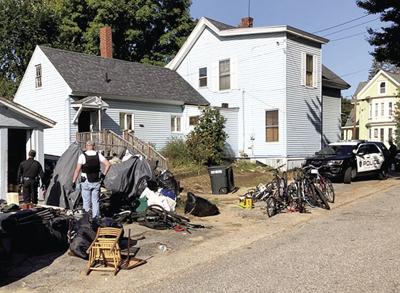
LACONIA — Just hours after police raided a suspected drug house in the city’s South End on Monday a neighbor was sitting on his porch watching police offiers go in and out of the residence, which police had been watching for months.
“Be sure,” the neighbor told a reporter, “to say that the cops did a terrific job.”
The raid, which resulted in the arrest of two people on drug possession charges, came after a lengthy investigation which involved countless hours of time by Laconia Police Department detectives and other officers. It also involved surveillance by officers in marked police cruisers parked outside the building, as well as a camera mounted on a utility pole across the street which recorded all the comings and goings.
When the article appeared in The Daily Sun the following day, more than a dozen people posted comments about the news on the paper’s Facebook page. One of those comments took police to task for not being aggressive enough in dealing with the city’s growing drug crisis.
“So many issues,” the commenter wrote, “and my friend has called the police about homeless and drug issues in her neighborhood and they don’t do anything.”
Police Chief Matt Canfield said he sympathizes with the public’s frustration. But he said that oftentimes people fail to appreciate just how much information police have to gather before they can force their way into a home and search for drugs or other contraband.
“Just because we have suspicion does not mean that we can go into someone’s house without their permission,” he said, explaining that police need to assemble enough evidence to show probable cause that criminal activity is taking place in the premises and/or those responsible for that activity can be found there.
Canfield said when people say the police should be quicker in tackling drug activity he said he asks them to “look at the other side of the coin.”
”Would you want police to have such a low threshold to come into your house based only on someone else’s suspicion?” the chief asked. “We need to lay out probable cause and lay out the reasons why the violation of their rights (against search and seizure), are outweighed by the risk posed by drug dealing inside the premises.”
“In general it’s months of investigation before we can go into a residential location,” said Canfield, noting that the doctrine that a man’s home is his castle places the bar very high for police seeking to get a search warrant for a residence.
In order to obtain a court warrant police need to provide a judge with a sworn affidavit stating the facts as to why there is an adequate reason to conduct a search or arrest someone. Affidavits usually are released once the police formally file charged with prosecutors, though in some cases a judge may rule that affidavit can be kept secret to protect an ongoing investigation.
The charges in this case had not been sent over to the Belknap County Attorney’s Office as of Friday. Canfield said the case would be forward to prosecutors sometime next week. Police have 10 days to get the case to prosecutors, he said.
To build a drug case, police typically receive information from sources, such as patrol officers, members of the community, confidential informants, and other agencies involved in law enforcement.
In this case police even resorted to frequently assigning officers, sitting in marked police cruisers, to watch people as they came and went from the house. They also installed a dome camera on a utility pole to record activity. Canfield said police had hoped that these steps would cause any suspects to move out of the neighborhood, but to no avail.
“These people can be very bold,” he said.
When the raid occurred at 6 a.m. Monday, two people were arrested on charges of possession of fentanyl. One of those arrested was already facing five other felony charges.
Stephen E. Anderson, 27, has pending cases of drug possession, receiving stolen property, forgery, and driving after having been certified an habitual offender, according to the Belknap County Attorney’s Office.
An indictment is not an indication of guilt, but a finding by a grand jury that enough evidence of a potential crime exists to warrant bringing a case to trial.
Police did not expect to find Anderson in the house, Canfield said. But in light of his record and the number of active cases against him, Canfield said it shows the state’s new bail law needs to be re-evaluated.
“Even if they are a common-known drug dealer, we don’t hold them. We bail them and they are out in an hour,” Canfield said.
“The law needs to be looked at,” he said, adding: “The New Hampshire police chiefs association have been against it from the beginning.”


(0) comments
Welcome to the discussion.
Log In
Keep it Clean. Please avoid obscene, vulgar, lewd, racist or sexually-oriented language.
PLEASE TURN OFF YOUR CAPS LOCK.
Don't Threaten. Threats of harming another person will not be tolerated.
Be Truthful. Don't knowingly lie about anyone or anything.
Be Nice. No racism, sexism or any sort of -ism that is degrading to another person.
Be Proactive. Use the 'Report' link on each comment to let us know of abusive posts.
Share with Us. We'd love to hear eyewitness accounts, the history behind an article.