




(Photo by Vitaly Gariev via Pexels)
By Stephen Beech
People really can sound tired, reveals new research.
Physical exertion affects the coordination between breathing and speaking, say scientists.
The study shows that it alters the pitch, intensity, and temporal characteristics of how we talk, making speech recognition difficult for systems used by emergency response personnel and wearable devices.
American researchers explained that the "talk test" is often used as a low-tech way to measure exercise intensity.
If you can easily talk or even sing, your workout is fairly light.
But if conversation is difficult, you are exercising vigorously.

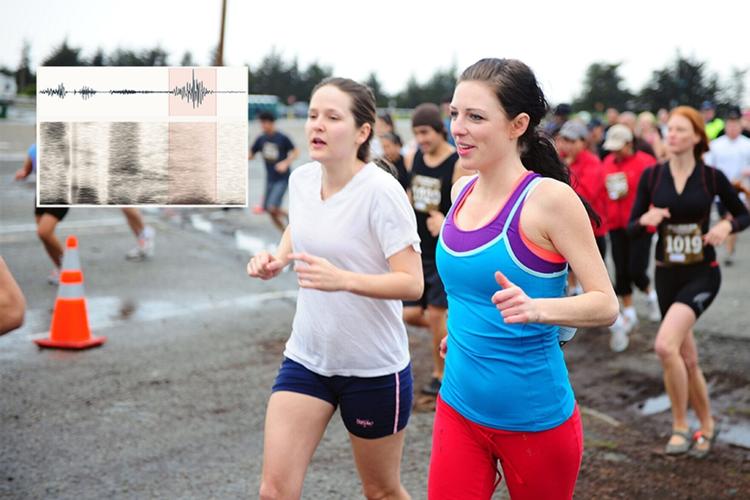
Vocal pitch, intensity, and pause structure are the vocal characteristics most impacted by changes in breathing and exercise. (Z Omidi / Presidio of Monterey via SWNS)
Study leader Zahra Omidi said: "Physical exertion directly alters respiration and phonation, and because speech shares the same respiratory system, these changes propagate into pitch, timing, and voice quality."
She says vocal pitch, intensity, and pause structure are the vocal characteristics most sensitive to changes in breathing and effort.
Omidi, from the University of Texas at Dallas, said: "Pitch and intensity both increase, while intensity also becomes less stable.


"Because speakers need to allocate more time to breathing, their speech rate slows down and becomes more segmented with longer and more frequent pauses."
Some of the changes might not be so noticeable to a listener, but the findings show that measurements clearly indicate a physiological difference.
Omidi said: "Features like pitch, intensity, and timing show clear and consistent changes, even when those differences are not immediately obvious by listening.
"This suggests that physical stress may operate below the threshold of perceptual salience in some cases but still induces measurable changes in the production mechanism."

(Photo by Ketut Subiyanto via Pexels)
Understanding exactly how physical stress causes changes to vocal patterns can help train speech recognition systems, which often struggle with speech that differs from the average.
Omidi said: "Examples include emergency response, military operations, aviation under workload, and wearable voice interfaces, where people are speaking while physically active.
"In all these cases, speech deviates from neutral conditions due to respiratory and vocal effort constraints, leading to reduced intelligibility and system performance."
To better represent real-world speech behavior, Omidi hopes researchers will adapt a more holistic view of speech variation as a reflection of a speaker's characteristics rather than focusing solely on linguistics.
She says task stress is just one of the many physiological variables that can affect the variations.
Omidi added: "Human speech is inherently shaped by the body, and physical task stress provides a clear example of how physiological factors influence speech production."
The findings were presented at the annual meeting of the Acoustical Society of America in Philadelphia.


(0) comments
Welcome to the discussion.
Log In
Keep it Clean. Please avoid obscene, vulgar, lewd, racist or sexually-oriented language.
PLEASE TURN OFF YOUR CAPS LOCK.
Don't Threaten. Threats of harming another person will not be tolerated.
Be Truthful. Don't knowingly lie about anyone or anything.
Be Nice. No racism, sexism or any sort of -ism that is degrading to another person.
Be Proactive. Use the 'Report' link on each comment to let us know of abusive posts.
Share with Us. We'd love to hear eyewitness accounts, the history behind an article.