



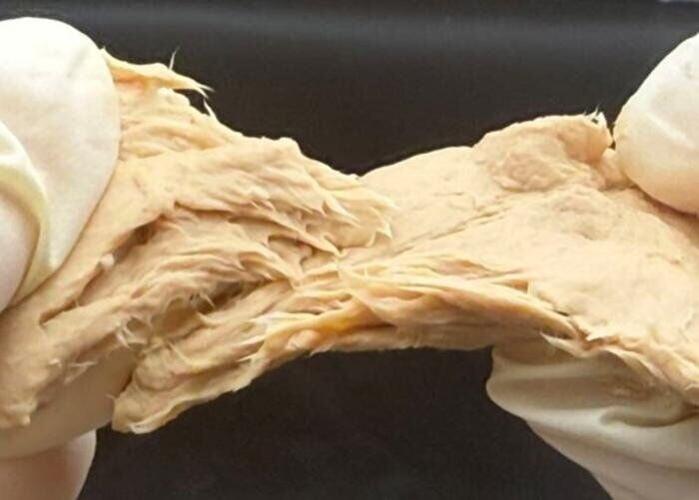



A picture of the edible fungus genetically engineered by scientists. (Xiao Liu via SWNS)
By Stephen Beech
Frankenstein fungi that tastes similar to meat and is easy to digest has been created.
The genetically engineered food is also protein packed and sustainable, say scientists.
Chinese researchers used gene-editing technology called CRISPR to increase a fungus’s production efficiency and cut its related environmental impact by up to 61% - all without adding any foreign DNA.
They say the genetically tweaked fungus tastes like meat and is easier to digest than its naturally occurring counterpart.
Study corresponding author Professor Xiao Liu, of Jiangnan University, said: “There is a popular demand for better and more sustainable protein for food.
“We successfully made a fungus not only more nutritious but also more environmentally friendly by tweaking its genes.”
He says animal agriculture is responsible for about 14% of global greenhouse gas emissions.
Raising livestock also takes up land and requires a large amount of fresh water, which is already at risk due to climate change and human influence.

(Photo by Edward Jenner via Pexels)
Microbial proteins, including those found in yeast and fungi, have emerged as a more sustainable alternative to meat.
Liu says that among the options explored so far for mycoprotein, or fungi with protein, the fungus Fusarium venenatum stands out because of its natural texture and flavor, which closely resemble those of meat.
It has been approved for food use in many countries, including the United Kingdom, the United States and China.
But Fusarium venenatum has thick cell walls that make its nutrients difficult for humans to digest.


It is also resource intensive, producing even small amounts of mycoprotein requires large amounts of resources.
The spores are raised in giant metal tanks filled with feedstock made with sugar and nutrients such as ammonium sulphate.
Liu and his team set out to explore the potential of boosting Fusarium venenatum’s digestibility and production efficiency using CRISPR - without introducing foreign DNA into the fungal genes.

(Photo by Artem Podrez via Pexels)
To do so, they removed two genes associated with the enzymes chitin synthase and pyruvate decarboxylase.
The researchers explained that eliminating the chitin synthase made the fungal cell wall thinner, allowing more protein inside the cell to become available for digestion.
Taking out the pyruvate decarboxylase gene helped to fine-tune the fungus’s metabolism so that it required less nutrient input to produce protein, according to the study published in the journal Trends in Biotechnology.
Analysis showed that the new fungal strain, dubbed FCPD, required 44% less sugar to produce the same amount of protein compared to the original strain and did so 88% faster.
First author Dr. Xiaohui Wu, of Jiangnan University, said: “A lot of people thought growing mycoprotein was more sustainable, but no one had really considered how to reduce the environmental impact of the entire production process, especially when compared to other alternative protein products."
The researchers then calculated the environmental footprint of FCPD, from spores in the laboratory to inactivated meat-like products, at an industrial scale.
They simulated FCPD production in six countries with different energy structures - including Finland, which uses mostly renewable energy, and China, which relies more heavily on coal - and found that FCPD had a lower environmental impact than traditional Fusarium venenatum production did, regardless of location.
Overall, FCPD production resulted in up to 60% less greenhouse gas emissions for the entirety of its life cycle.
The team also investigated the impact of FCPD production compared to the resources required to produce animal protein.
When compared to chicken production in China, they found that myoprotein from FCPD requires 70% less land and reduces the risk of freshwater pollution by 78%.
Liu added: “Gene-edited foods like this can meet growing food demands without the environmental costs of conventional farming."


(0) comments
Welcome to the discussion.
Log In
Keep it Clean. Please avoid obscene, vulgar, lewd, racist or sexually-oriented language.
PLEASE TURN OFF YOUR CAPS LOCK.
Don't Threaten. Threats of harming another person will not be tolerated.
Be Truthful. Don't knowingly lie about anyone or anything.
Be Nice. No racism, sexism or any sort of -ism that is degrading to another person.
Be Proactive. Use the 'Report' link on each comment to let us know of abusive posts.
Share with Us. We'd love to hear eyewitness accounts, the history behind an article.