


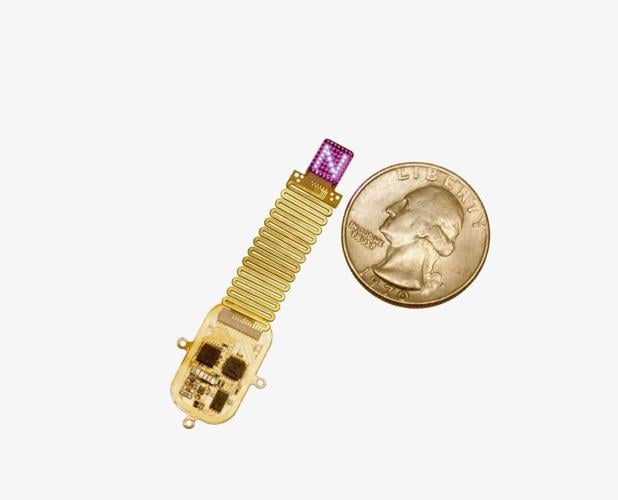
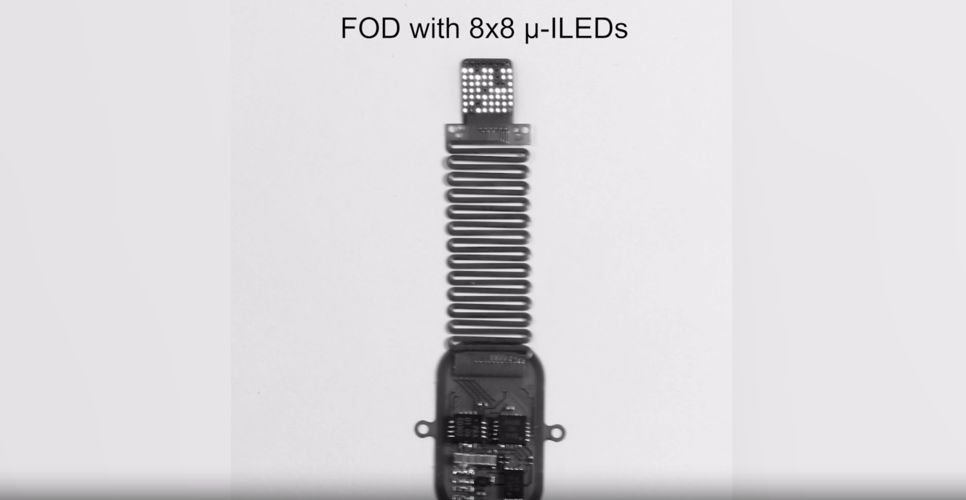



The thin, flexible, wireless device sits next to a quarter for scale. Device emits complex patterns of light (shown here as an "N") to transmit information directly to the brain. (Mingzheng Wu via SWNS)
By Stephen Beech
A wireless implant that "speaks" to the brain with light could restore lost senses, say scientists.
Around the size of a postage stamp and thinner than a credit card, the soft, flexible device sits under the scalp but on top of the skull.
It uses light to send information directly to the brain - bypassing the body’s natural sensory pathways - in what scientists are hailing at a "leap" for neurobiology and bioelectronics.
The implant delivers precise patterns of light through the bone to activate neurons across the cortex, according to the American research team.
In experiments, scientists at Northwestern University in Illinois used the device’s tiny, patterned bursts of light to activate specific groups of neurons deep inside the brains of mice.
The mice quickly learned to interpret the patterns as meaningful signals, which they could recognize and use.
Even without touch, sight or sound involved, the rodents received information to make decisions and successfully completed behavioral tasks.
The technology has immense potential for several therapeutic applications, according to a study published in the journal Nature Neuroscience.

(Northwestern University via SWNS)
The research team say these include providing sensory feedback for prosthetic limbs, delivering artificial stimuli for future vision or hearing prostheses, modulating pain perception without opioids or systemic drugs, enhancing rehabilitation after stroke or serious injury, and controlling robotic limbs with the brain.
Northwestern neurobiologist Professor Yevgenia Kozorovitskiy, who led the experimental work, said: “Our brains are constantly turning electrical activity into experiences, and this technology gives us a way to tap into that process directly.
“This platform lets us create entirely new signals and see how the brain learns to use them.
It brings us just a little bit closer to restoring lost senses after injuries or disease while offering a window into the basic principles that allow us to perceive the world."
Northwestern bioelectronics pioneer Professor John Rogers, who led the technology development, said: “Developing this device required rethinking how to deliver patterned stimulation to the brain in a format that is both minimally invasive and fully implantable.
“By integrating a soft, conformable array of micro-LEDs - each as small as a single strand of human hair - with a wirelessly powered control module, we created a system that can be programmed in real time while remaining completely beneath the skin, without any measurable effect on natural behaviors of the animals.
"It represents a significant step forward in building devices that can interface with the brain without the need for burdensome wires or bulky external hardware.

(Photo by Eren Li via Pexels)
"It’s valuable both in the immediate term for basic neuroscience research and in the longer term for addressing health challenges in humans.”
The new study builds on previous work by Northwestern scientists in which they introduced the first fully implantable, programmable, wireless, battery-free device capable of controlling neurons with light.


The previous study used a single micro-LED probe to influence social behavior in mice.
The new study takes the research a step further by enabling richer, more flexible communication with the brain.
Going beyond the ability to activate and deactivate a single region of neurons, the new device features a programmable array of up to 64 micro-LEDs.
With real-time control over each LED, scientists can send complex sequences to the brain that may resemble the distributed activity that occurs during natural sensations.
The research team explained that because real sensory experiences activate distributed cortical networks - not tiny, localized groups of neurons - the multi-region design mimics more natural patterns of brain activity.
Study first author Dr. Mingzheng Wu said: “In the first paper, we used a single micro-LED.
“Now we’re using an array of 64 micro-LEDs to control the pattern of cortical activity.
"The number of patterns we can generate with various combinations of LEDs - frequency, intensity and temporal sequence - is nearly infinite.”
He says the new device is also less invasive as, instead of extending into the brain through a tiny cranial defect, it conforms to the surface of the skull and shines light through the bone.

(Photo by Jota Shoots via Pexels)
Kozorovitskiy said: “Red light penetrates tissues quite well.
“It reaches deep enough to activate neurons through the skull.”
To test the system, the team used mice engineered to have light-responsive cortical neurons.
They trained the mice to associate a particular pattern of brain stimulation with a reward.
In a series of trials, the implant delivered a specific pattern across four cortical regions - like tapping a code directly onto neural circuits.
The mice quickly learned to recognise the target pattern among dozens of alternatives.
Using artificial signals carried by the target pattern, they chose the correct port to receive a reward.
Dr. Wu added: “By consistently selecting the correct port, the animal showed that it received the message.
“They can’t use language to tell us what they sense, so they communicate through their behavior.”
Now that the team has shown the brain can interpret patterned stimulation as meaningful signals, they plan to test more complex patterns and explore how many distinct patterns the brain can learn.


(0) comments
Welcome to the discussion.
Log In
Keep it Clean. Please avoid obscene, vulgar, lewd, racist or sexually-oriented language.
PLEASE TURN OFF YOUR CAPS LOCK.
Don't Threaten. Threats of harming another person will not be tolerated.
Be Truthful. Don't knowingly lie about anyone or anything.
Be Nice. No racism, sexism or any sort of -ism that is degrading to another person.
Be Proactive. Use the 'Report' link on each comment to let us know of abusive posts.
Share with Us. We'd love to hear eyewitness accounts, the history behind an article.