


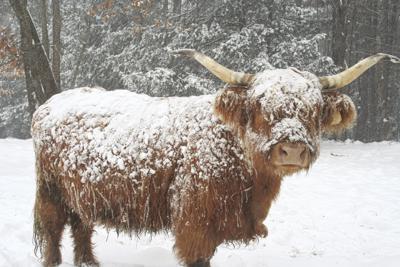
The plastic wrap on the huge hay bale was frozen, and so were my fingers. I had removed my gloves to use my knife to slice the wrap, and now my fingers hurt. Husband Bruce got out of the Bobcat (a huge tractor) to help me, the one-woman ground crew, release the 1,000-pound round bale from its plastic wrap and feed it out to the cattle. We are in a prolonged arctic blast, and the cattle need hay, lots of hay, to generate energy to stay warm.
Besides food, livestock need water to survive cold temperatures, so when we aren't feeding hay, we're checking water. Cattle don't need as much water in winter as in summer, but they must drink enough to digest the extra hay.
When the temperatures stay frigid for so long, even water heaters can't thaw freezing water. We check three troughs at least twice a day, and sometimes, after I break up the ice, I heat the water with "The Salamander." That's the brand name of our kerosene-burning heater, but it amuses me to call it by name as if an exotic creature is being called in to help my cows.
I check the cattle every day, mostly the young stock, for shivering. If a calf is shivering, it needs help. Adult cattle with plenty of food and water can handle the cold, but I still check them for shivering or odd behavior. Cows that don't show interest in food or separate themselves from the herd can be in trouble even if they are not shivering. So far this year, I haven't seen any shivering cows or calves, but I sure have felt the cold!
Encouragement is needed, and when the cold seems never-ending, here comes Groundhog Day! Feb. 2 is midway between the winter solstice and the vernal equinox. It's when groundhogs supposedly emerge from their burrows, and if the weather is sunny and they are frightened by their shadows, they dive back into their holes, and winter persists for six more weeks. It's a Pennsylvania Dutch superstition. Over the years, Punxsutawney Phil has become the celebrity groundhog, and all eyes are on him.
For farmers with critters to feed, Feb. 2 has great significance in the adage: "Half your hay by Ground Hog Day," meaning if you've used more than half your hay, you're probably going to run out. We are right on schedule.
Miles Smith Farm is surviving the winter as well as can be expected. But here's hoping Punxsutawney Phil forecasts an early spring. It'll be fun to complain about mud for a change.
•••
Carole Soule is co-owner of Miles Smith Farm in Loudon, N.H., where she raises and sells beef, pork, lamb, eggs, and other local products. She can be reached at cas@milessmithfarm.com.


(0) comments
Welcome to the discussion.
Log In
Keep it Clean. Please avoid obscene, vulgar, lewd, racist or sexually-oriented language.
PLEASE TURN OFF YOUR CAPS LOCK.
Don't Threaten. Threats of harming another person will not be tolerated.
Be Truthful. Don't knowingly lie about anyone or anything.
Be Nice. No racism, sexism or any sort of -ism that is degrading to another person.
Be Proactive. Use the 'Report' link on each comment to let us know of abusive posts.
Share with Us. We'd love to hear eyewitness accounts, the history behind an article.