


This article is the fourth in a series that focuses on properties of the Lakes Region Conservation Trust. LRCT has conserved 145 properties totaling over 25,000 acres in the Lakes Region. Many of these properties are trailed and open to the public for recreation. “The Lakes Region Conservation Trust (LRCT) is an independent, nonprofit, member-supported organization dedicated to the permanent protection, stewardship, and respectful use of lands that define the character of the region and its quality of life.” (LRCT Mission Statement).
The sun that brief December day
Rose cheerless over hills of gray,
And, darkly circled, gave at noon
A sadder light than waning moon.
Slow tracing down the thickening sky
Its mute and ominous prophecy,
A portent seeming less than threat,
It sank from sight before it set.
A chill no coat, however stout,
Of homespun stuff could quite shut out,
A hard, dull bitterness of cold,
That checked, mid-vein, the circling race
Of life-blood in the sharpened face,
The coming of the snow-storm told.
The wind blew east; we heard the roar
Of Ocean on his wintry shore,
And felt the strong pulse throbbing there
Beat with low rhythm our inland air.
John Greenleaf Whittier
The poem above, Snow-Bound: A Winter Idyl, written in 1866 by John Greenleaf Whittier, describes the onset of a winter snowstorm and seems to fit with the arrival of the winter season, when blowing snow, frigid temperatures and hoarfrost take center stage. At times we experience slivers of warm air and rain that occasionally worm their way into New England, such as last week, but for the most part cold and snow own the day. Now that we’ve entered the winter season, with the Solstice arriving on Dec. 21, we can be assured that there will be plenty of opportunities to sling on the skis or snowshoes and spend a day in the solitude of a forests draped with snow. I’m assured by The Old Farmer’s Almanac that we’ll be hunkering down in the coming weeks, bracing ourselves for the fury of a New England Nor’easter, as described in Whittier’s poem, Snow-Bound.
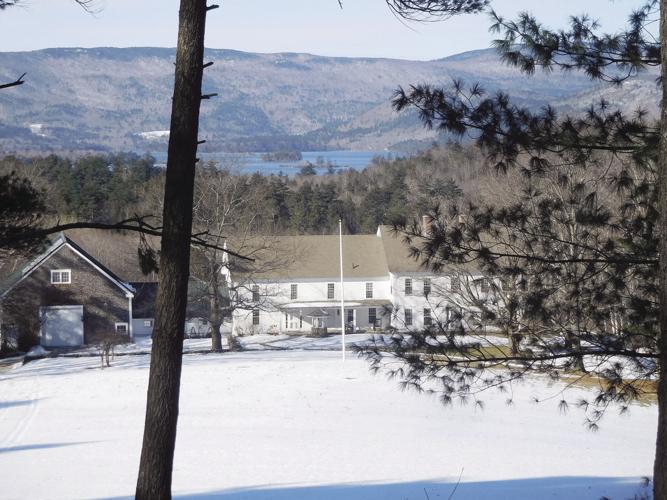
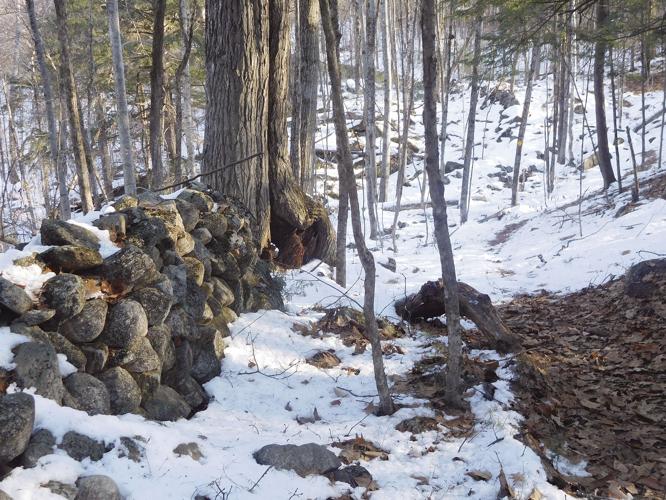
A few weeks ago (before much of our snow melted) I spent a full day of exploration, tramping along the trails in the Center Harbor Woods and Pine Hill Conservation Areas. Their combined acreage of 345 acres encompasses wetlands, vernal pools, rocky outcrops and a mix of mature hard and softwood. The undisturbed woodland provides significant wildlife habitat, where moose, deer and bear have been observed frequently and where the four-toed salamander has been documented for the first time in central New Hampshire. The conservation areas were protected in 2010 through a unique collaboration of three conservation partners – the Lakes Region Conservation Trust, which owns the land, the Squam Lakes Conservation Society and the town of Center Harbor. A network of established trails totaling close to six miles are well marked by tree blazes. In addition, Center Harbor Woods Conservation Area is linked to the 47-acre Proctor Wildlife Sanctuary, which is owned by the New Hampshire Audubon Society. Together these contiguous properties total almost 400 acres and provide plenty of opportunity for walking, skiing, snowshoeing and finding solitude by listening to the “voice” of the forested landscape.
I had wanted to hike the trails of these conservation lands for quite some time, and finally I had the chance, a free day coming between various holiday commitments. Reuben and I set out on a perfect day for a winter stroll: brilliant sun blazing above, swathed in a cobalt-blue sky. Snow was hanging from the boughs of evergreens and the trails were covered with a light snow that had fallen the previous day. The only tracks I saw were those of deer, rabbits, fox and my dog Reuben. Reuben and I had the woods to ourselves. Before departing on the trails of the Pine Hill Conservation Area I read a description of the property which was posted on the kiosk. I learned that this property was once part of an 18th-century land grant made by the Masonian Proprietors to Hosea Sturtevant, which included Pine Hill, a part of the SLCS Esker Preserve. An old road that crossed the area was part of the Plymouth stage route and a tavern was built along the stage road to accommodate travelers. Later in the 1800s a boarding house was built for summer visitors, one of them being the poet John Greenleaf Whittier. He was a frequent visitor to the area and had a great admiration for the beauty of the Lakes Region.
Whittier, the poet, journalist and social activist, was born in Haverhill, Massachusetts in 1807. At the age of 19 he submitted a poem to William Lloyd Garrison, the notable journalist, publisher and abolitionist. The two like-minded social activists bonded due to their commitment to the abolitionist movement and at that point Whittier’s life pivoted. Instead of pursuing farming as his father wished, he turned to writing. By 1843 Whittier, a devout Quaker like his parents, became an ardent advocate for social justice, tolerance and liberal humanitarianism. In 1830 he wrote extensively on abolition of slavery and gave numerous lectures in support of the cause. Shortly after giving an anti-slavery talk in Plymouth, N.H., he was attached by a mob in Concord and was pelted with rotten eggs and stones.
He had a strong affiliation throughout his life with poor, hard-working people and his poetry reflected this kinship. His writings weren’t always accepted or embraced by politically conservative New Englanders. In his later years his poetry turned more pastoral and romantic with well-known works such as: Maude Muller’s Spring, Wreck of Rivermouth,, The Barefoot Boy, My Triumph, Burning Driftwood and In School-Days. He had associations with Oliver Wendall Holmes, island poet Celia Thaxter and Maine novelist Sara Orne Jewett.
Whittier had a sincere fondness for the New Hampshire seacoast, along with the lakes and hills of central New Hampshire. He wrote a collection of poems called, “Among the Hills and Other Stories” which encapsulate his travels and forays in Holderness, Center Sandwich, Intervale, Ossipee and Tamworth. Mount Whittier in Tamworth was named in his honor. He spent many of his later years on the seacoast of New Hampshire and northern Massachusetts. It was on the New Hampshire seacoast that he wrote many of his most memorable poems, including New Hampshire, an anti-slavery poem: “GOD bless New Hampshire! From her granite peaks-/ Once more the voice of Stark and Langdon speak.” John Greenleaf died in New Hampton Falls, NH on September 7, 1892.
With the memory of Whittier on my mind, I began my walk through the beautiful woodlands of the Pine Hill Conservation Area. The trees were dappled with a few inches of fresh fallen snow. The air was still and the only sound I could hear came from a woodpecker banging away at the bark of a tree above me. I was travelling through a forest where Whittier himself may have walked. How amazing that this little known conservation area is steeped in the memory of one of American’s most beloved poets.
My walk culminated on the top of Pine Hill with views of the lakes and hills that border the area. I slowly made my way back to the parking lot following a series of woods roads that are not marked, so tread carefully. Be sure to take a map available at the kiosk. When I arrived back at the parking lot on High Haith Road I began part two of my trek, entering the Center Harbor Woods Conservation Area. The area encompasses a high ridge lying equidistant from Squam Lake and Lake Winnipesaukee. The terrain was very different from Pine Hill: more craggy, less wet, with a significant ridge to climb. I found these trails would be challenging for cross country skiing, and more conductive for snowshoeing. They were well blazed and easy to follow. If I wanted to extend my explorations I could have crossed Center Harbor Neck Road, entering the Proctor Wildlife Sanctuary and continuing my day in a cathedral of these magnificent woods, but I chose to end my day and return when the snow is sufficient for a day of cross country skiing.
These conserved properties can be accessed from High Haith Road, Center Harbor Neck Road or the Lakes Region Conservation Trust headquarters on Route 25B in Center Harbor. Maps of the area are available at the kiosk on High Haith Road or at the Offices of LRCT. I would also suggest that you acquaint yourself with John Greenleaf Whittier and his poetry before your visit to these sites. You may even want to take one of his romantic poems into the woods with you. You may come to find out why the New Hampshire Hills inspired his beautiful poetry.
For questions or comments contact Gordon at forestpd@metrocast.net


(0) comments
Welcome to the discussion.
Log In
Keep it Clean. Please avoid obscene, vulgar, lewd, racist or sexually-oriented language.
PLEASE TURN OFF YOUR CAPS LOCK.
Don't Threaten. Threats of harming another person will not be tolerated.
Be Truthful. Don't knowingly lie about anyone or anything.
Be Nice. No racism, sexism or any sort of -ism that is degrading to another person.
Be Proactive. Use the 'Report' link on each comment to let us know of abusive posts.
Share with Us. We'd love to hear eyewitness accounts, the history behind an article.