


We grew up in the White Mountains and began hiking on Appalachian trails as children. We loved the feel of the soft, green moss and the various rock formations along the trail. We experienced, at a young age, the different sense of place one experiences when you walk through dense forests and scramble up rocky cliffs.
A few years ago, I spent several weeks climbing and hiking in the Kyushu region in Southern Japan. We spent two days on the island of Yakushima and had an opportunity to see Yaku monkeys and deer. Butterflies abound in Japan, and we often would pause at the edge of a trail and watch as one, or often two, lighted on a flowering azalea bush and opened its wings in a display of pure beauty. Often, as we ascended to the top of a peak, a thick mist would come rolling in and for a few minutes the mountains would disappear. Only to come into view again when the fog would begin rolling out. The inspiration for the design of Japanese screens and scrolls was immediately apparent.
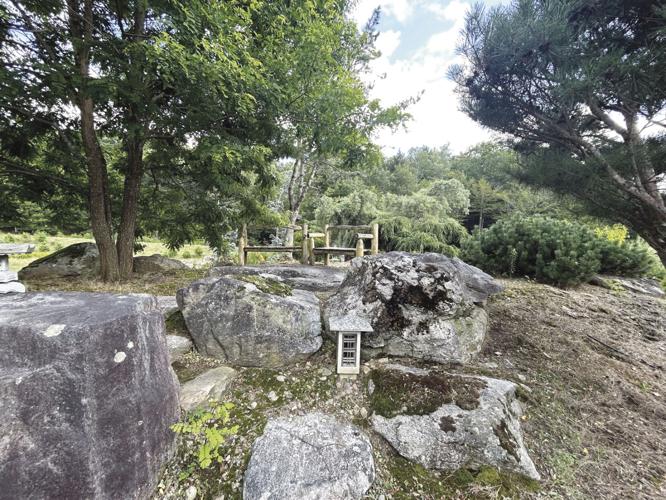
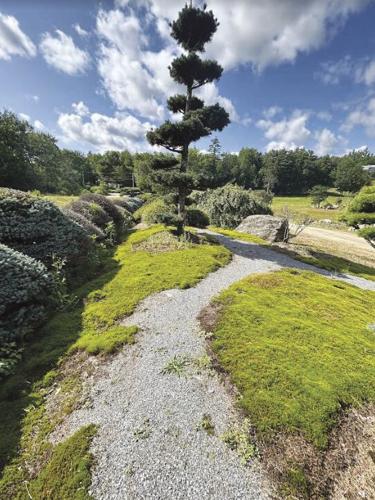
Last weekend, diving down Route 25 from Warren, we took a turn onto Beech Hill Road in Wentworth that led us to Shin-Boku. This is a nursery that can recreate Japanese gardens. It was wonderful to discover these trees and this art form in New Hampshire.
To create the experience of walking in a Japanese garden there is a “Strolling Path.” One walks across bridges, along a path marked with stone and over areas that are clearly designed to be filled with water. There are stone lanterns along the way.
I wondered about the meaning of shin-boku and with a little research learned that a shinboku is a tree or forest worshipped as a shintal — a physical object or worship at or near a Shinto shrine. “It also refers to trees that are owned by shrines or by private individuals and have a special origin in folklore. It may also refer to trees that have been specially cut down for planting or growing wild to be used as timber for the construction of shrines.” Japanese art, theater and worship is based on gratitude, fear and respect for life and nature.
On a Sunday afternoon, standing in the shadows cast by the surrounding mountains, it was lovely to take a moment and think about being in Japan.
If you visit shin-bokunursery.com you will learn that there is one of their gardens in a home in Hanover, and another around a pond in Lyme. You can find a lovely article about the Japanese garden in Lyme in a publication of the North American Japanese Garden Association titled “History of the Pochoda Residential Garden” by Phil Pochoda.
Mr. Pochoda writes that he began thinking about constructing the garden when he retired as director of the University of Michigan Press and returned to New Hampshire full-time in the fall of 2012. He was motivated toward a Japanese garden because he had lived near Japanese gardens in New York and California.
It is the awe in nature that inspires us to write, paint, compose and dance. It is the period of twilight, that special time between the end of the day and nightfall, that encourages us to reflect on all that has meaning in our lives.
By withered reeds
dimmed by clouds,
the water sleeps
— Yūgure Maeda, 1955
•••
Elizabeth Howard is the host of the Short Fuse Podcast, found on Spotify, Apple Podcasts or through the Arts Fuse. Her career intersects journalism, marketing and communications. "Ned O’Gorman: A Glance Back," a book she edited, was published in May 2016. She is the author of "A Day with Bonefish Joe," a children’s book, published by David R. Godine. You can send her a note at eh@elizabethhoward.com.


(0) comments
Welcome to the discussion.
Log In
Keep it Clean. Please avoid obscene, vulgar, lewd, racist or sexually-oriented language.
PLEASE TURN OFF YOUR CAPS LOCK.
Don't Threaten. Threats of harming another person will not be tolerated.
Be Truthful. Don't knowingly lie about anyone or anything.
Be Nice. No racism, sexism or any sort of -ism that is degrading to another person.
Be Proactive. Use the 'Report' link on each comment to let us know of abusive posts.
Share with Us. We'd love to hear eyewitness accounts, the history behind an article.