


I first started cooking with fresh ginger after moving to San Francisco and visiting the Chinatown markets, with their open bins stacked with smooth shiny skin ginger. The sight of that mound of fresh ginger reminded me of my first taste at the original King’s Chinese Restaurant across from Wyatt Park. One other thing I realized after living in San Francisco for a few years, was what an excellent Cantonese chef King was. Sadly, King’s closed after chef King died and his great culinary skills were never passed on.
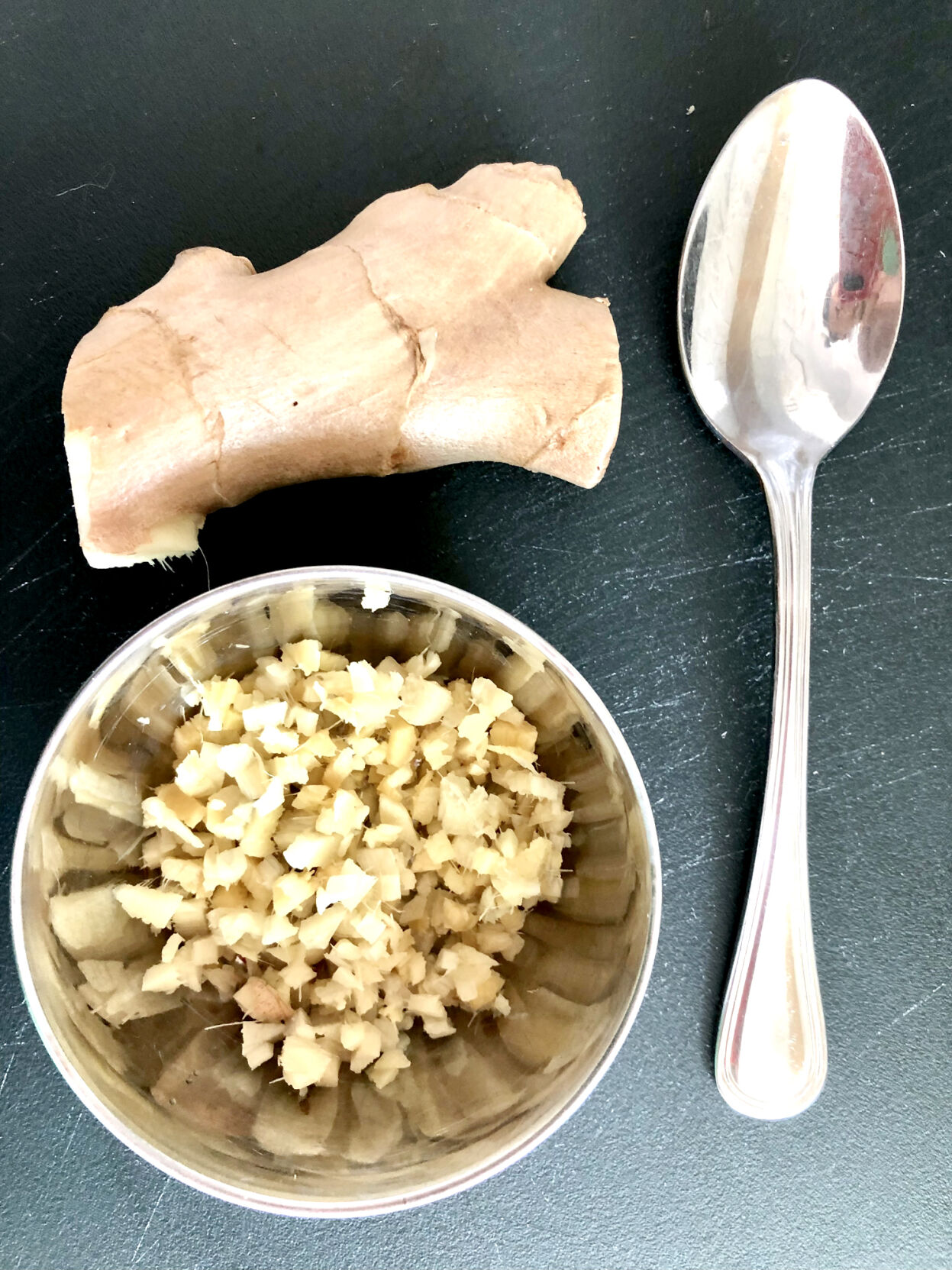
Fresh ginger is a perfect contrast and pairing with the pear because of its warmth, tangy freshness, mild spiciness and mellow sweetness. The proper name is ginger stem and not ginger root. Choose ginger that's firm to the touch, smooth, and relatively free of blemishes. Wrinkly skin is an indication it's old and dehydrated. It's fine to keep it out on the counter out of direct sunlight for a week or it should last three weeks if stored in a bag or airtight container in the refrigerator crisper drawer. For the longer storage up to three months, wrap the whole knob in plastic, place it in an airtight bag and freeze it. Then, just cut off sections as you need them. Don't peel ginger until you are ready to use it. Don’t bother using a knife or peeler to remove the skin, the edge of a thin spoon easily scrapes off the skin.
For baking pears, Anjou, Bartlett, Bosc, Comice, or Winter Nelis are the best.
A perfectly ripened pear will be fragrant and have a slight softness at the neck. Don’t worry if the fruit shows some russeting, that’s only skin-deep and doesn’t affect the flavor. Pears continue to ripen off the tree and actually they are best ripened off the tree to avoid a woody texture. So if your pears are a little green and firm, just leave them at room temperature and they usually will ripen nicely in a few days. To speed up the ripening process, put your pears in a paper bag with a ripe apple or a banana. If you are unsure about choosing ripe pears then use Bartlett, they are easier to tell when ripe since the skin turns from green to gold in color when they are ripe.
This is a very easy cake to mix and can use a hand held whisk, hand held mixer with beaters or a stand mixer with the paddle attachment. Sprinkling the tops of pear wedges with sugar helps prevent them from browning, keeps them moist and gives them a nice appealing light glaze after baking. Don’t leave out the vanilla and orange zest as they add a subtle complexity to the flavor.
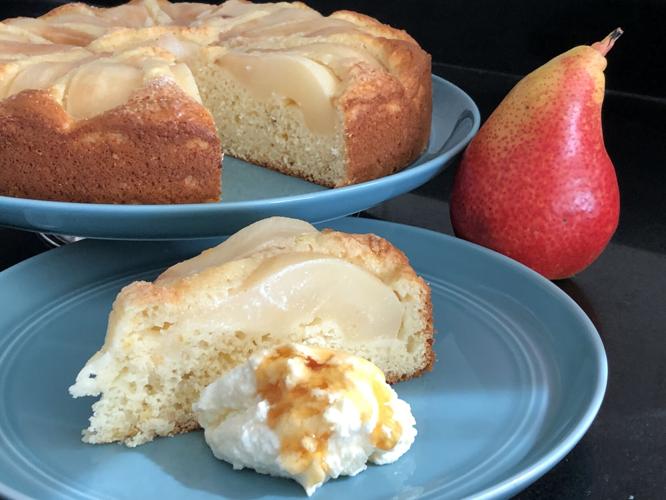
If I am serving this cake the day I bake it, then I usually just keep it covered at room temperature in a cool dark spot. This way you can enjoy the cake at its finest, when it has the best texture. Once it's refrigerated the texture firms up slightly. This is a nice moist cake and keeping it covered prevents it from drying out. Often I serve each slice with a large spoonful of fresh ricotta cheese drizzled with a local honey, or a chocolate sorbet.
3 medium ripe pears
1 ounce fresh ginger stem (about 1 1/2 inch long x 1 inch thick)
1 1/3 cup unbleached all purpose flour
3 tablespoon baking powder
3/4 cup, plus 4 teaspoons sugar
2 extra large eggs
3/4 cup whole milk ricotta cheese
1 teaspoon pure vanilla extract
1 teaspoon grated orange peel
Adjust oven rack to the lower third level and preheat oven to 350℉. Lightly butter a 9 inch round cake pan and line the bottom with parchment paper. Set aside until needed.
Peel the pears and then cut them in half from stem to the blossom ends. Core each half, remove the exterior & interior stems and cut out the hard blossom ends. Slice each half into 3 long wedges. Place on a plate and set aside until needed.
In a medium bowl stir together the flour and baking powder. Peel the ginger and cut into thin coins. Chop until you have about 1/8 - 1/4 inch square pieces. Set the flour and ginger aside until needed.
In a large mixing bowl, whisk together the eggs, ricotta, 3/4 cup sugar, orange peel and vanilla extract until evenly blended. Fold in the flour mixture until evenly incorporated, then fold in the chopped fresh ginger. The batter will be a little lumpy because of the ricotta and ginger, which is fine.
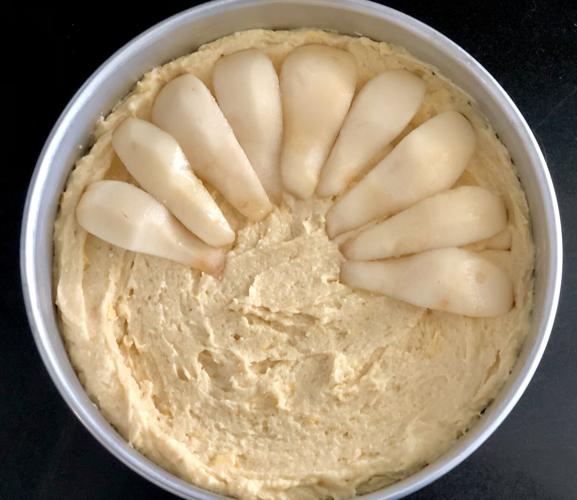
Spoon the batter into the prepared cake can and spread to level the top. Next you will gently place the pears into the batter. Start at the top about 1/4 inch from the edge and press about two-thirds into the batter. Continue around the edge for a circle. Place one or two in the center if you have room. Most likely you will have one or two wedges left over, those you can share with your kitchen helpers.
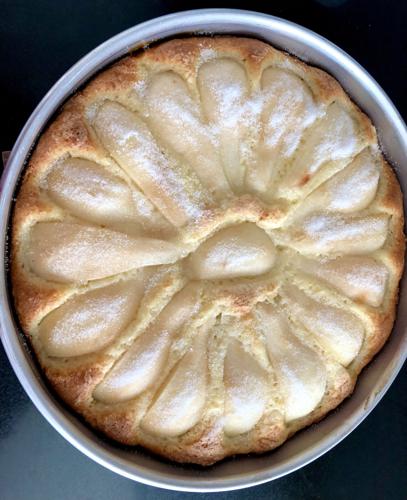
Sprinkle 3 teaspoons of sugar over the tops of the exposed pears, trying to keep the sugar from landing on the side of the pan.
Place in the preheated oven on the adjusted rack and bake for 45-50 minutes. After about 30 minutes of baking, rotate the pan from back to front for even baking and coloring. The cake is done when the top is golden brown and the top center feels set to the touch and not fluid.
Remove from the oven and place on a cooling rack. Immediately sprinkle the remaining 1 teaspoon of sugar over the pears while the cake is still hot so the sugar dissolves, giving the pears a nice shiny gloss. Let the cake cool on a wire baking rack for 40 minutes for even cooling. Turn out onto a corrugated cake circle or plate and lift the parchment paper off of the bottom, then invert onto another cake circle or platter. If the pears have browned, just dust lightly with powdered sugar before serving. Cover and refrigerate until 30 minutes before serving to allow the flavor to open up and the texture to improve.


(0) comments
Welcome to the discussion.
Log In
Keep it Clean. Please avoid obscene, vulgar, lewd, racist or sexually-oriented language.
PLEASE TURN OFF YOUR CAPS LOCK.
Don't Threaten. Threats of harming another person will not be tolerated.
Be Truthful. Don't knowingly lie about anyone or anything.
Be Nice. No racism, sexism or any sort of -ism that is degrading to another person.
Be Proactive. Use the 'Report' link on each comment to let us know of abusive posts.
Share with Us. We'd love to hear eyewitness accounts, the history behind an article.