



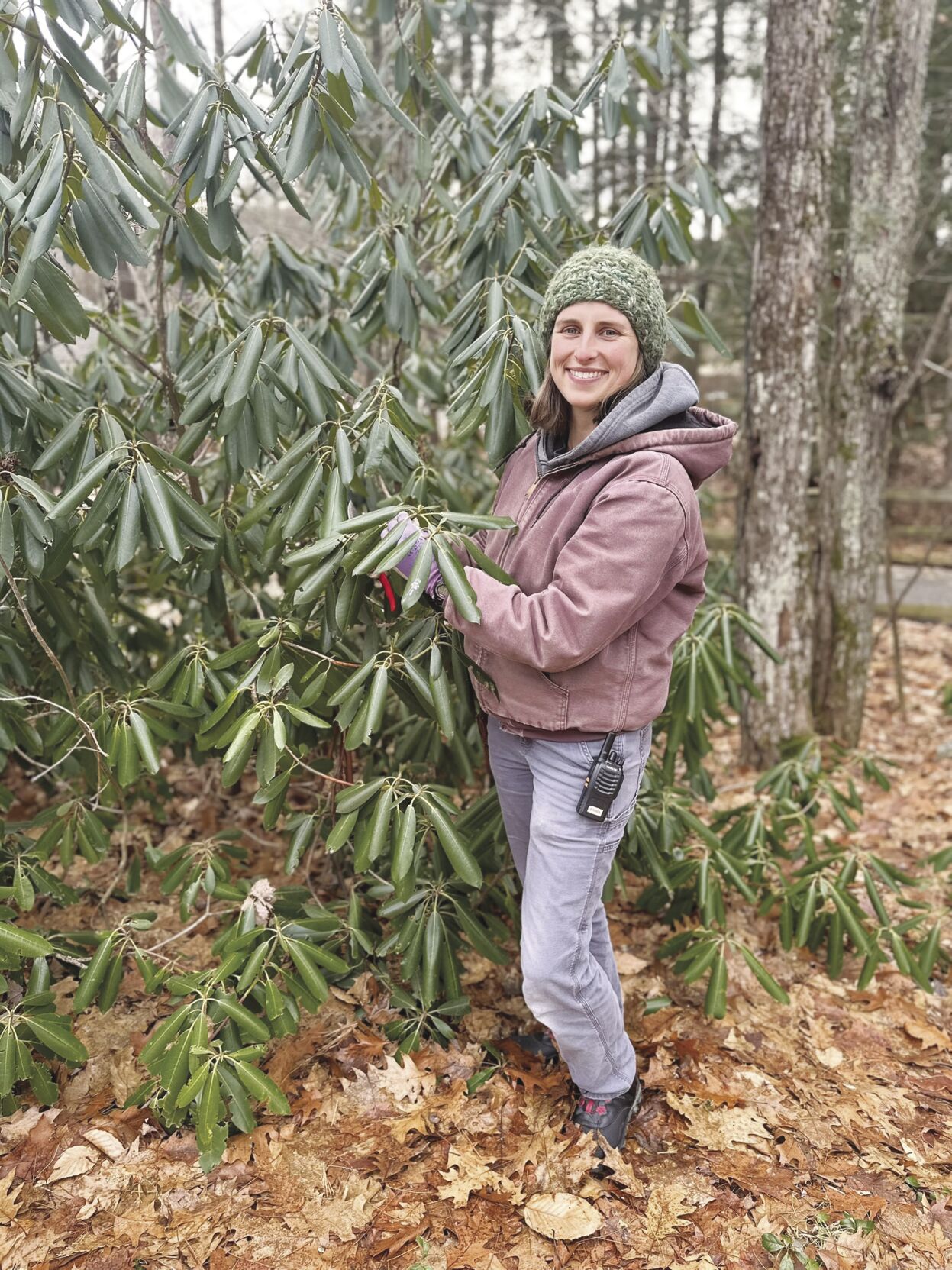
HOLDERNESS — According to Emma Erler, lead horticulturist and exhibits assistant at the Squam Lakes Natural Science Center, during the holiday season people turn to the outdoors for winter berries and branches to decorate trees and wreaths. However, some people don’t know a winterberry from a bittersweet berry found in winter forests.
“The most popular berry is probably winterberry holly (Ilex verticillata), with red berries that persist well into winter," Erler said. "You can grow winterberry in your garden; the shrubs are readily available at local garden centers in the spring and summer, or you can find wild winterberry in wetlands. I usually prefer to harvest from garden shrubs versus in the wild because winterberry fruit is an important winter food source for various songbirds. The berries aren’t edible, so if you have young children, you’ll want to make sure they don’t sample them.
"One plant you don’t want to decorate with is Oriental bittersweet (Celastrus orbiculatus), a noxious invasive plant with beautiful orange-red fruit. Using bittersweet as a decoration runs the risk of spreading it onto your property.”
Erler is an expert when it comes to plants and trees. She grew up in New Hampton. She later got an undergraduate degree in environmental orticulture (with a minor in wildlife ecology) and a master’s in education while working for the UNH Cooperative Extension.
“My mom has always been a gardener and had a decent-sized vegetable garden when I was young,” Erler recalled. “She cultivated a variety of hardy perennials, trees, shrubs, and bulbs. I have early memories of helping her start seeds for the vegetable garden and picking out annual flowers at a local garden center. At some point, she helped me build my own small garden where I grew sunflowers, gourds, and, eventually, various perennials. My mom would also bring me to Kirkwood Gardens, and I’d help with deadheading, weeding, and planting.” (Erler’s mother worked at Kirkwood Gardens at the Squam Lakes Natural Science Center.)
With her knowledge of plants, berries, and greenery and an eye for the current holiday greens/decorating season, Erler advises, “It’s fine to collect greens from the plants in your yard. There are only a few poisonous evergreens (yew and rhododendron). The most common wild-needled evergreens in New Hampshire are eastern hemlock, white pine, red spruce, and balsam fir. Fir and pine are the longest-lasting, so they are preferred for Christmas trees, swags, kissing balls, wreaths, etc. Hemlock and spruce are fine, though they may only hold their needles for a few weeks, especially if brought indoors.
"If you have a question about what sort of trees you have on your property, I recommend checking out iNaturalist or GoBotany from the Native Plant Trust (there are various plant ID apps out there, too, of varying accuracy). Don’t forget about non-evergreen decorating options, such as colorful dogwood stems, which are a wonderful addition to wreaths and swags.”
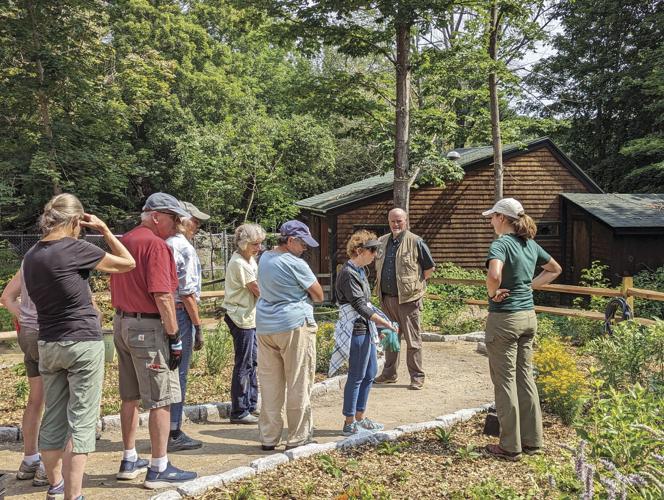
As a full-time, year-round horticulturist at the science center, Erler is working this winter on plans to create several new planting beds around Kirkwood Gardens and expand the plantings in and around the Center’s new Pollinator Garden.
“I’ll also install more native wildflowers in the science center’s fields and meadows. Hopefully, soon we will have a new ‘tree trail’ on the grounds to help interested visitors identify native trees and shrubs.”
Plants and growing things are in Erler’s blood. “Both my parents worked at the science center for most of their careers, and I spent a huge part of my childhood there. My dad was an educator for 40 years. My mom started as an educator and later transitioned to working on exhibits and managing the Kirkwood Gardens; she was at the center for over 42 years before retiring.” Erler says.
“The gardening experiences I had as a kid interested me in plants. When it came time to look at college, I knew I wanted to study plants. I went with horticulture since I liked the idea of a hands-on, practical career. I also continued to garden/landscape over summer breaks.”
Erler has a lot of experience in the field, starting with summers at Belknap Landscaping for a few years, an internship at Longwood Gardens, a yearlong horticulture internship at the Morris Arboretum of the University of Pennsylvania, a senior gardener at the Heritage Museums and gardens; a horticulturist at New England Botanic Garden at Tower Hill, and a horticultural field expert at UNH Cooperative Extension.
Emma explains how she came to her current job. “I started at the science center in April 2022 when my mother retired. My job is an expansion of her role for 30-plus years.”
For those who wonder how to protect their plants and trees in the coldest time of year, Erler says, “Most plants suited to the growing environment in New Hampshire can withstand winter weather conditions, including snow. Snow helps a lot of plants by insulating their roots from extreme cold. There is often more winter damage in gardens in years with very little snow. The only plants I protect from snow are shrubs planted near rooflines — especially under metal roofs — that may be crushed by falling snow loads. An A-frame structure made from a couple of sheets of plywood is plenty to protect most small shrubs. Also, if snow is very heavy or wet, I brush it away from needled evergreen shrubs and small trees to prevent branches from bending and breaking. This is easy to do with a broom.”
If you have not yet gotten a Christmas tree, Erler says, “Make a fresh cut at the base of the trunk when you get your tree home before putting it in the tree stand. The tree’s vascular tissue (what lets it draw up water) will dry out very quickly once a tree is cut, and if it does dry out, this will prevent the tree from taking up any water. Always make sure there is water in the tree stand. Keep the tree away from drying heat sources like vents, radiators, or wood stoves. Temperatures below 70 are ideal if possible.”
Once the holidays are over, Erler says, “I like to put my tree outside after Christmas so birds and small mammals can use it as a winter shelter. Once it has dried out in the summer, I’ll use it in the backyard fire pit. Sometimes, farmers with goats or other livestock are interested in using trees after the holidays as animal food. I work with a farmer who collects as many Christmas trees as she can yearly to feed her goats as a special treat. Otherwise, please bring your tree to the local transfer station to be composted/mulched.
“If there isn’t a lot of snow on the ground, you can use leftover greens (or Christmas tree boughs) as a mulch to protect tender perennials in your garden. Place boughs over the crowns/roots of plants and remove them once the snow has melted in the spring.”
Erler hopes to expand her role as an educator in the future. “Despite lots of demand, there are very few sources of gardening/horticulture education in New Hampshire. I would love to offer extended courses and workshops for those interested in gardening and landscaping, both as a hobby and a career.”
She continues, “I think youth education is important too. Kids need exposure to plants and horticulture to see the value in native plants and gardening/farming and consider it as a career path. I also plan to continue to focus on habitat restoration at the science center, managing invasives and cultivating native plants to provide food and shelter for native insects and wildlife.”
There are many ways to find use for holiday trees, boughs, and berries once the season has passed. Enjoy the holiday season’s greens and plan to keep things green into the winter.
For information on plants and trees, contact Emma Erler at nhnature.org or call 603-968-7194.


(0) comments
Welcome to the discussion.
Log In
Keep it Clean. Please avoid obscene, vulgar, lewd, racist or sexually-oriented language.
PLEASE TURN OFF YOUR CAPS LOCK.
Don't Threaten. Threats of harming another person will not be tolerated.
Be Truthful. Don't knowingly lie about anyone or anything.
Be Nice. No racism, sexism or any sort of -ism that is degrading to another person.
Be Proactive. Use the 'Report' link on each comment to let us know of abusive posts.
Share with Us. We'd love to hear eyewitness accounts, the history behind an article.