


GILFORD — Boats would have to slow down in Glendale Bay under a request before a state Public Safety Department public hearings administrator.
The public comment period ended Wednesday and a report with a decision on the request is to be issued within 30 days, said attorney Christopher Casko, who conducted a Sept. 22 hearing.
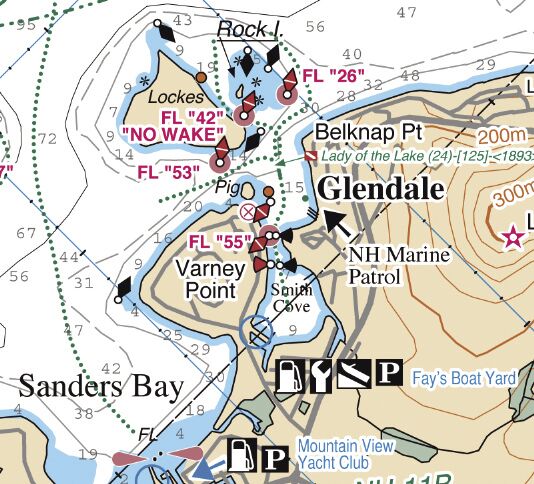
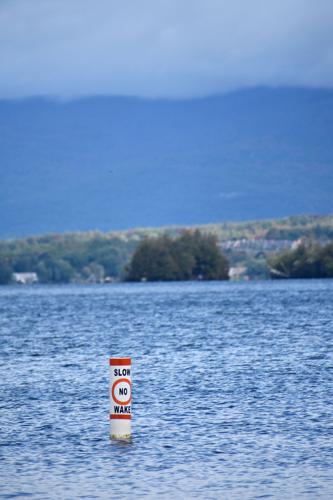
Under the proposal, a no-wake zone would be created from the lighted buoy between Pig Island and Lockes Island, extending to Belknap Point and including all the water up to the Glendale Public Docks.
Boats would be required to maintain only headway speed, or enough speed to maintain safe steerage, not to exceed 6 mph.
Joan Hinterhaeuser, of Lockes Island, presented a petition asking for the change, which was signed by about 70 people.
“The boat traffic in this area has become too dense and too varied in speed for watercraft to go more than ‘wake’ speed safely,” the petition stated. “The safety concerns due to this congestion are many.”
Boats are coming and going from the public docks and Smith Cove as well as the area of Pig Island, Lockes Island and Belknap Point.
“Over the years, there has been a huge increase in kayakers, stand-up paddlers, and jet skis, as well as two sailing classes per day during the week for the Sailing School coming out from Smith Cove,” the petition states.
Loons nest before the entrance to Smith Cove.
“Also on many weekends, there is a dive boat diving at the wreck that sank off Belknap Point in Glendale Bay many years ago,” the petition states. “There are also many boaters who are pulling children behind them at a fairly high rate of speed in between all the other boaters.”
The petition also says a no-wake zone would be appropriate here as was the case when one was approved for Meredith Bay.
Even without a no-wake zone, boaters are required to drop to headway speed if they are within 150 feet of swimmers, other vessels, rafts or floats, swimming areas, docks or the shoreline, or if they are overtaking another vessel at a distance or speed such that a wake could cause danger or damage.
“Most boat operators do not observe the 150 foot rule, and pass in an unsafe manner and in many cases, barely 50 feet from other boaters,” the petition states.
Howard Stoner, who commutes from Fay’s Boat Yard to a residence on Steamboat Island, said it would be a good idea to have a smaller no-wake zone between Lockes Island and Pig Island as opposed to the entire bay.
“Establishing a no-wake zone through the entirety of Glendale Bay would be excessive,” he said. “This isn’t a simple, ‘They want it, and they don’t.’ There are those of us who support a slowdown zone, a yellow light as it were, in this bit of water between Lockes and Pig islands.”
Such a smaller zone would also have the effect of diverting boats to a wider passage, he said.
“This would be a fine idea because it would keep these faster moving boats, with big wakes to the north, rather than take a shortcut through the cut,” Stoner said.
Hinterhaeuser’s petition states that the 565-foot passage between Pig Island and Lockes Island is an area where only two boats can pass safely.
“Yet time after time, I see three boats abreast, or a mix of jet ski and boats, all jockeying for position — all going full tilt.”
The other passage to the north between a light buoy and Belknap Point appears larger but is actually 615 feet, still only wide enough for two boats to pass each other at speed.
“Yet there are many more side by side going in both directions,” her petition states.
State Marine Patrol Capt. Tim Dunleavy said testimony from his office was not requested at the hearing and that it takes a neutral stance on the proposal. The Marine Patrol office is also located off the 34-acre bay, home to about 500 boats.
He encouraged boaters to remember the requirement for 150 feet between vessels.
“In a narrow passage, the more boats, the more difficult it is to safely pass at greater than headway speed,” he said. “When people aren't obeying the New Hampshire safe passage law, violations and dangerous waters can be created. It occurs on weekends on the lake in numerous places, and in open bays, and where congestion tends to gather and occur.”
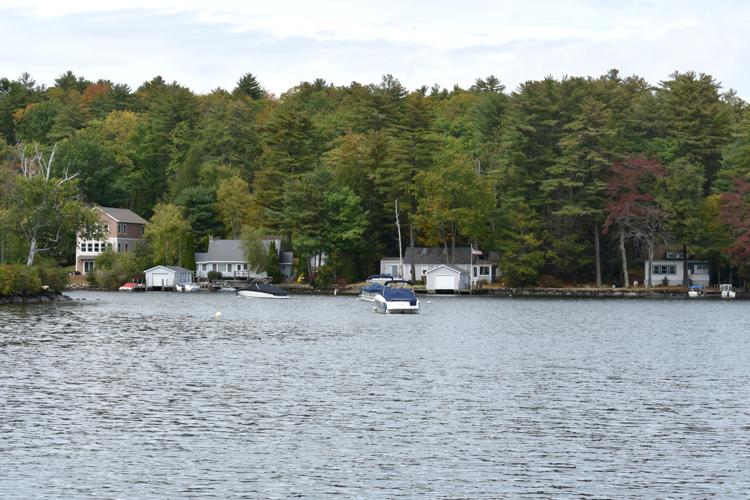
He also said there are residences along the bay and at narrow passage points. Large wakes can cause erosion or damage to docks or improperly secured boats.




(0) comments
Welcome to the discussion.
Log In
Keep it Clean. Please avoid obscene, vulgar, lewd, racist or sexually-oriented language.
PLEASE TURN OFF YOUR CAPS LOCK.
Don't Threaten. Threats of harming another person will not be tolerated.
Be Truthful. Don't knowingly lie about anyone or anything.
Be Nice. No racism, sexism or any sort of -ism that is degrading to another person.
Be Proactive. Use the 'Report' link on each comment to let us know of abusive posts.
Share with Us. We'd love to hear eyewitness accounts, the history behind an article.