



(Stéphane Granzotto via SWNS)
By Stephen Beech
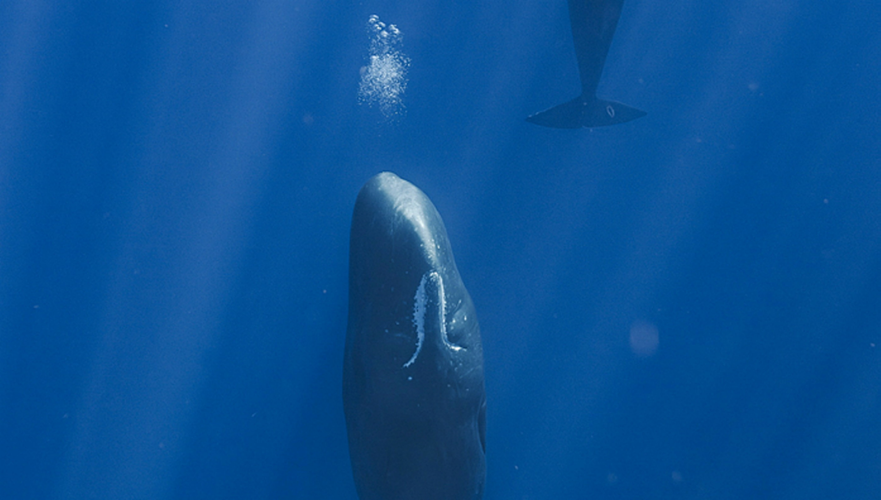
Blowing bubbles helps sperm whales sleep soundly beneath the waves, new research reveals.
It stops them from floating to the surface while they're grabbing a nap, say scientists.
While little is known about how sperm whales sleep, researchers believe that the ocean giants doze underwater for 10 to 15 minutes at a time with their heads facing upward.
They keep away from the choppy waters of the surface while still remaining close enough to get a breath of fresh air when the need arises.
However, one issue has puzzled scientists.
A sperm whale’s head is massive — taking up nearly a third of its body — and filled with oil, wax and air.
Given that all of those materials float, it was unclear until now how the species stays underwater without popping to the surface like a cork as they sleep.
Researchers from the University of St. Andrews in Scotland and the University of Neuchâtel in Switzerland were able to shed some light on the mystery by employing state-of-the-art underwater equipment.

Photo by Peter Hillocks via Pexels
They used devices that would allow them to tell whether the whales were asleep and also record the bubbles.
The equipment, suctioned to the whales, recorded the sound of the bubbles as they were released from the blowhole while also telling the researchers how deep the whales were and whether their heads were facing up or down.
After affixing the recorders on 42 sperm whales in the Lofoten Islands off the coast of northern Norway, the research team recovered the devices after they floated to the surface.
They already knew that sperm whales can rest in three different ways.


One is to put their head down and dive a bit before their buoyant heads turn up toward the surface.
They can also sink gently, tail-first, about 26 feet down, or they can rest as they ascend from deep dives over 650 feet.
The findings, published in the Journal of Experimental Biology, showed that those whales dozing closer to the surface blew more bubbles in their sleep, releasing bubbles around 11 times per power nap.
However, those drifting up from the depths only blew bubbles three or four times during their restful ascent.
The scientists explained that different resting depths require the whales to carry different amounts of oxygen and last different lengths of time.

Photo by John Arellano Riera via Pexels
Study co-author Prof. Patrick Miller, of the University of St. Andrews, said, "Deep diving means the whales need a lot of oxygen, but the pressure of the water compresses the air in their lungs causing the whales to be less buoyant.
"This means they need to blow fewer bubbles to stop themselves from floating upward.
"However, when the whales rest closer to the surface, the air in their lungs will slowly cause them to rise to the surface.
"Blowing bubbles releases some of the air, making them less buoyant in the process."
But it was still not clear if blowing bubbles is a conscious decision by the whales to release some air as they sleep.
Study lead author Noémie Freymond, from the University of Neuchâtel, said, "No one knows whether sperm whales sleep as we do, or if they sleep like dolphins and keep one half of their brain awake while the other snoozes.
"Blowing bubbles to make sure they don’t come too near the surface requires the whales to sense their environment and realize that they are coming too close to the surface."
She added, "Whether they turn out to be partially awake or fully asleep, sperm whales have definitely come up with a creative solution to ensure a restful slumber beneath the waves."


(0) comments
Welcome to the discussion.
Log In
Keep it Clean. Please avoid obscene, vulgar, lewd, racist or sexually-oriented language.
PLEASE TURN OFF YOUR CAPS LOCK.
Don't Threaten. Threats of harming another person will not be tolerated.
Be Truthful. Don't knowingly lie about anyone or anything.
Be Nice. No racism, sexism or any sort of -ism that is degrading to another person.
Be Proactive. Use the 'Report' link on each comment to let us know of abusive posts.
Share with Us. We'd love to hear eyewitness accounts, the history behind an article.