


Curious Kids is a series for children of all ages. If you have a question you’d like an expert to answer, send it to CuriousKidsUS@theconversation.com.
Why do we see snow on mountaintops that are closer to the Sun but not near the ground? – Ms. Drew’s third grade class, Beechview Elementary School, Farmington Hills, Michigan
There’s not much better than a bluebird day in the mountains – a crisp, sunny day accompanied by a fresh blanket of snow. But why doesn’t the Sun quickly melt all that high altitude snow away?
It all boils down to our atmosphere, which is what I research as a scientist in Colorado. Let’s dive in!
Our atmosphere: Earth’s armor
Earth’s atmosphere begins right at its surface and extends to outer space, and it is filled with a mixture of many different gases. Gases in the atmosphere include the oxygen we breathe and the water vapor that makes it rain and snow. They are essential to supporting life on Earth in several ways.
One of the most important jobs those gases have is to protect us from harmful things in space, including our closest star: the Sun.
The Sun’s radiation provides heat to our planet, but too much of it can be a problem. If you’ve ever gotten a sunburn, then you’re already familiar with this idea.
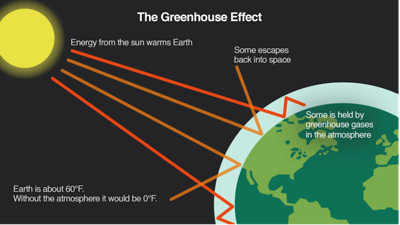
Some of our atmospheric gases limit the amount of radiation from the Sun that can reach the Earth’s surface by absorbing some of it, which prevents temperatures from being way too warm in the daytime. At night, certain atmospheric gases also trap some of the heat that the Earth’s surface releases as it cools down, protecting us from unsurvivable cold.
The way the atmosphere regulates Earth’s temperatures is known as the greenhouse effect. You’ll often hear this term used alongside climate change or global warming. That is because global warming is caused by enhancing the greenhouse effect: As people burn fossil fuels in cars and factories, the amount of greenhouse gases in the atmosphere increases. These extra gases allow the Earth’s atmosphere to trap more heat, causing an increase in temperatures.
The atmosphere likes to stay grounded
If you were to compare the Earth’s atmosphere along a Caribbean beach to that surrounding the top of Mount Everest, it would look quite different.
That is because as you go higher up in the atmosphere, it gets “thinner,” meaning that there are less gases present at higher elevations and altitudes.


Why? Blame it on gravity.
In the same way that gravity keeps people and objects from flying away to outer space, Earth’s gravitational force pulls on the gases in our atmosphere, trying to keep them as close to Earth as possible.
As a result, there are fewer gas molecules in the atmosphere as you go higher up in altitude, making the air thinner, or less dense. Humans can sometimes experience altitude sickness at high elevations because there is less oxygen present in the air as a result of this phenomenon.
Closer to the Sun, but still cold and snowy?
Our high-elevation mountains protrude into higher altitudes of the atmosphere, where the air has fewer gas molecules. While this thinner air allows more of the Sun’s radiation to pass through compared with the atmosphere at sea level, thinner air tends to be colder for two reasons:
First, collisions between gas molecules generate heat, and if you have fewer molecules available to run into each other, that heat generation is lower.
Second, a thinner atmosphere is less effective at maintaining heat because there are fewer molecules available to trap and hold on to heat.
Colder temperatures can create more opportunities for precipitation to fall in the form of snow rather than rain, which is why some mountains can be so snowy.
And if the ground is habitually covered in snow, as is the case in many mountain ranges, it can be even easier to maintain cooler temperatures. That’s because snow-covered surfaces are very reflective, making them highly effective at causing the Sun’s incoming rays to bounce back toward space instead of getting absorbed by the ground.
So if you visit the mountains to have fun in the snow, be sure to pack your jacket, but don’t forget that sunscreen too.
This article is republished from The Conversation, a nonprofit, independent news organization bringing you facts and trustworthy analysis to help you make sense of our complex world. It was written by: Allie Mazurek, Colorado State University
Read more:
- Why does gravity pull us down and not up?
- Will the Earth last forever?
- How do arctic foxes hunt in the snow?
Allie Mazurek does not work for, consult, own shares in or receive funding from any company or organization that would benefit from this article, and has disclosed no relevant affiliations beyond their academic appointment.


(0) comments
Welcome to the discussion.
Log In
Keep it Clean. Please avoid obscene, vulgar, lewd, racist or sexually-oriented language.
PLEASE TURN OFF YOUR CAPS LOCK.
Don't Threaten. Threats of harming another person will not be tolerated.
Be Truthful. Don't knowingly lie about anyone or anything.
Be Nice. No racism, sexism or any sort of -ism that is degrading to another person.
Be Proactive. Use the 'Report' link on each comment to let us know of abusive posts.
Share with Us. We'd love to hear eyewitness accounts, the history behind an article.