


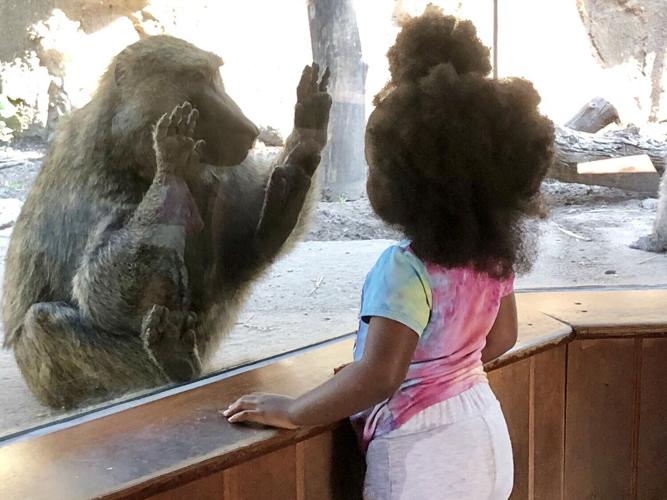
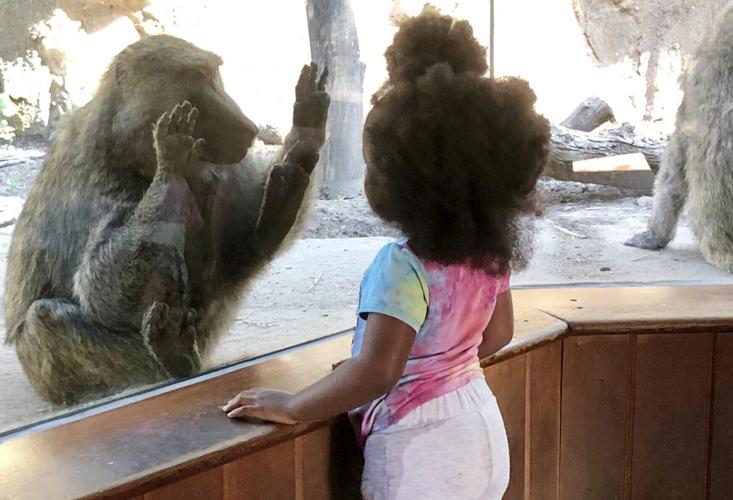

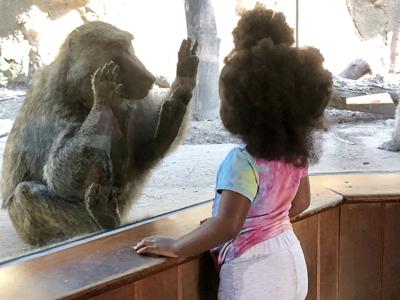

A little girl and an olive baboon interact with each other through the glass at the Seneca Park Zoo, where the Primate Portal is housed. (RIT via SWNS)
By Stephen Beech
Children share a common understanding of geometry with monkeys, reveals new research.
Scientists say the study provides the first evidence that baboons and macaques share the same geometric intuitions present in young humans, overturning previous findings.
Geometry is the branch of mathematics focused on the sizes, shapes, positions and dimensions of objects.
With their ability to use tools, remember faces and even learn how to communicate with humans through sign language, non-human primates are considered to be among the smartest creatures on earth.
But some concepts — such as geometry — have traditionally been thought of as beyond the abilities of humanity's closest cousins.
But the new study by scientists in the United States calls that prevailing notion into question.

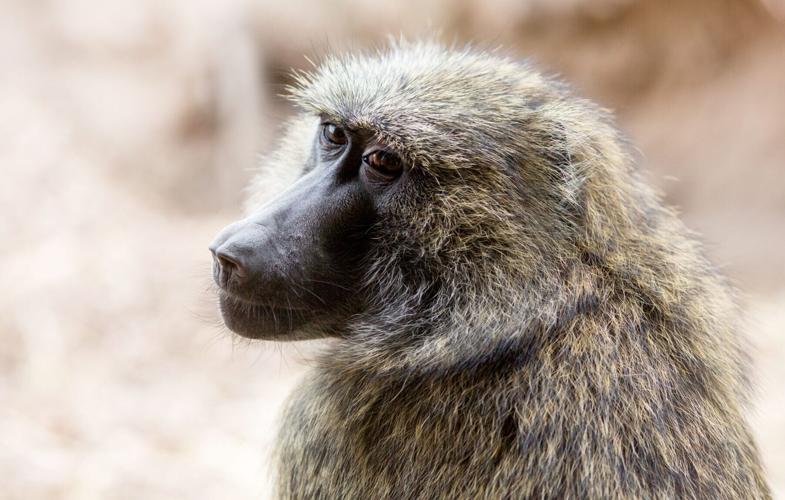
(Photo by kaboompics via Pexels)
Study senior author Jessica Cantlon said: "What surprised us wasn't just that monkeys could do the task, it was that monkeys, children and adults seemed to think about geometric relationships in fundamentally the same way.
"That suggests these intuitions are part of the basic architecture of the primate mind."
To come to that conclusion, cognitive neuroscientist Cantlon and her team at Carnegie Mellon University in Pittsburgh offered olive baboons and rhesus macaques nutritious fruit snacks in exchange for participation in a touch-screen matching game of two-dimensional geometric shapes.
Cantlon said: "That might seem easy, but it's actually pretty difficult, because there are no distinctive features among the objects, no major differences in color, or size or form."
The monkeys had to find the correct match based on geometric similarity alone.
Cantlon says adult human would "get tripped up too" completing the matching game.
The research team also performed the same experiment with dozens of American preschool children, aged 3 to 6 years old, as well as 79 adults from Bolivia's Indigenous Tsimane' people.
As a farmer-forager group, the Tsimane' do not undergo the same sort of formal schooling found in the United States.
A group of 21 American adults were also tested.

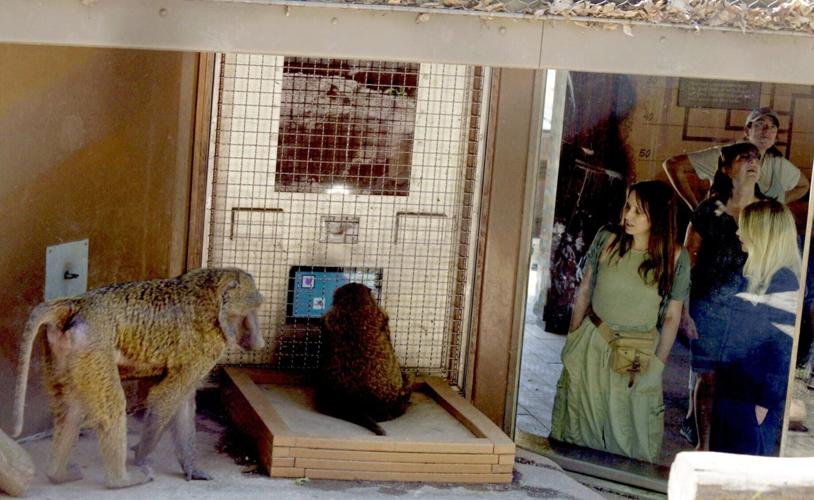
Jessica Cantlon (Carnegie Mellon University) and Caroline DeLong (Rochester Institute of Technology) watch as an olive baboon named Olivella interacts with the Primate Portal. Another baboon who frequently participates, named Kalamata, stands nearby. (RIT via SWNS)
Cantlon said: "That allowed us to sort of tease apart age and cultural experience.
"Because sometimes when you're trying to study something in children, it can be difficult to untangle whether their ability is developmental or something learned from education or experience."


The findings showed that across all of the groups — two species of non-human primates, human children and adult humans — there was "clear continuity" in terms of how primates and humans thought about basic geometry.
Cantlon said: "Geometric intuition is something humans eventually turn into mathematics and science.
"So if we want to understand how children learn geometry, we need to understand what they bring to the table before formal instruction begins.
"This study suggests that children start with deep, evolutionarily ancient intuitions about shape and space.
"Education can build on those intuitions instead of treating geometry as something that has to be taught from scratch."

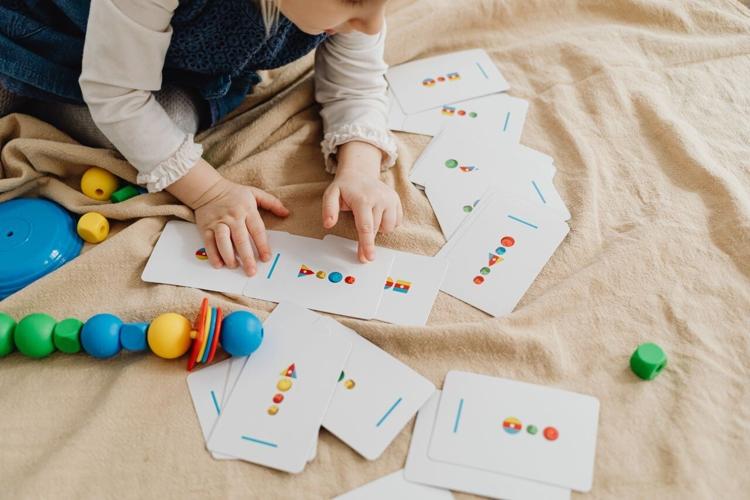
(Photo by Yan Krukau via Pexels)
The study, published in the journal Proceedings of the National Academy of Sciences (PNAS), is the most recent to come out of Cantlon's lab in conjunction with what's known as the Primate Portal.
Located at the Seneca Park Zoo in New York, the Primate Portal is a collaborative project involving a group of scientists at Carnegie Mellon University and the Rochester Institute of Technology who study the origins and nature of thought.
It features an enclosed touchscreen that captive olive baboons have the option of interacting with while going about their normal daily activities.
Lead author of the geometry study Jialin Li, a second-year Ph.D. student at Carnegie Mellon, said: "One of the baboons, named Kalamata, was the hardest working monkey that I've ever seen.
"He would come up to the screen and wait for me to turn the computer on, and then he'd just sit there for two to three hours just doing all kinds of mathematical tasks."
The Primate Portal offers open access to data, code and video of primates who are solving cognitive problems, with the goal that students everywhere can study animal minds.

An olive baboon at the Seneca Park Zoo that took place in the Primate Portal experiments. (RIT via SWNS)
Cantlon has also worked with another study co-author Caroline DeLong, at the Rochester Institute of Technology, to bring the Primate Portal concept into elementary school classrooms by teaching young children how to code.
The students then get to travel to the zoo to see the baboons play the games they have developed for them — an experience the researchers have linked with elevated math and science scores and an uptick in interest of STEM career paths.
Cantlon says it all leads back to a simple question: "How did we come to think in the way that we think?"
From a 70,000-year-old stone etched with reoccurring parallel lines to a 35,000-year-old mammoth tusk full of 88 notches organized in rows, she says archaeology tells us that humans have been sensitive to Euclidean geometry for a very long time.
Cantlon added: "It's one of the first things that humans wanted to write down.
"And those kinds of intuitions feel automatic to us, because we've encoded them so deeply.
"But even thinking about a two-dimensional shape and being able to understand the properties it shares with another object is a really abstract kind of cognition."


(0) comments
Welcome to the discussion.
Log In
Keep it Clean. Please avoid obscene, vulgar, lewd, racist or sexually-oriented language.
PLEASE TURN OFF YOUR CAPS LOCK.
Don't Threaten. Threats of harming another person will not be tolerated.
Be Truthful. Don't knowingly lie about anyone or anything.
Be Nice. No racism, sexism or any sort of -ism that is degrading to another person.
Be Proactive. Use the 'Report' link on each comment to let us know of abusive posts.
Share with Us. We'd love to hear eyewitness accounts, the history behind an article.