


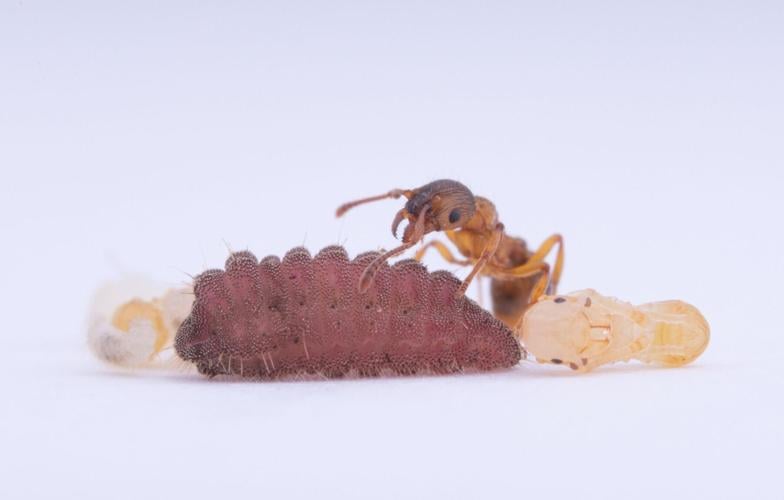
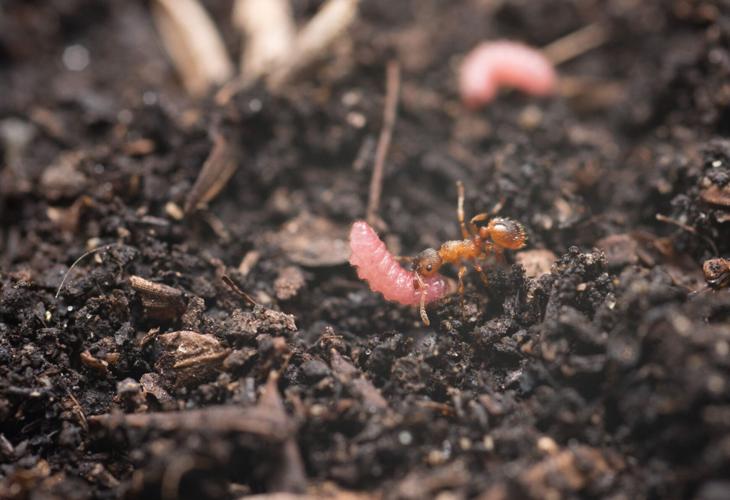

Phengaris teleius caterpillar being care for by its host ant, Myrmica scabrinodis. (Daniel Sanchez via SWNS)
By Stephen Beech
Caterpillars "drum" to communicate with ants, reveals new research.
The creepy crawlies use complex rhythmic beats to allow them to "speak the language" of the eight-legged insects and gain their trust, say scientists.
An international research team found that butterfly caterpillars use sophisticated rhythmic signals to communicate with ants - helping them gain protection, food, and access to ant nests.
The researchers explained that some butterfly species rely on ants for survival during their early life stages as caterpillars.
The ants treat the baby caterpillars like colony members - carrying them into nests, protecting them from predators, and even feeding them.
In exchange, caterpillars provide sugary secretions to ants or behave in ways that mimic ant behaviour to integrate with the colony.
While chemical mimicry was known to underpin those relationships, the new research, published in the journal Annals of the New York Academy of Sciences, shows that caterpillars also use precisely timed vibrational rhythms to attract and appease their ant hosts.

Ant carrying a Maculinea butterfly caterpillar. (Vibrant Lab, Torino via SWNS)
Dr. Chiara De Gregorio, of the University of Warwick, said: “These caterpillars are essentially speaking the ants’ language - not just chemically, but rhythmically.
"By matching the ants’ beat, they can convince them they belong.
“Rhythm is a fundamental part of human life: we dance to it, clap to it, and instantly notice when something feels out of time.
"But complex rhythmic organisation has been mainly seen in primates, so for us to find that even ants and caterpillars rely on carefully timed rhythmic signals to communicate is very exciting.


“So, the next time you tap your foot to a beat, remember that somewhere underground, caterpillars may be doing something surprisingly similar: keeping time to stay alive.”
The research team analysed vibroacoustic signals – tiny vibrations that travel through plants, soil, or the walls of ant nests - from two ant species and nine caterpillar species with varying levels of myrmecophily: a description of how strong a relationship the caterpillars have with ants.
The researchers examined rhythmic features including pulse tempo, interval timing, and pattern regularity.
The caterpillars with the strongest myrmecophily produced signals with highly regular timing and especially complex rhythmic patterns, like musical rhythms with alternating strong and weak beats.
The rhythms closely resembled those used by ants themselves.

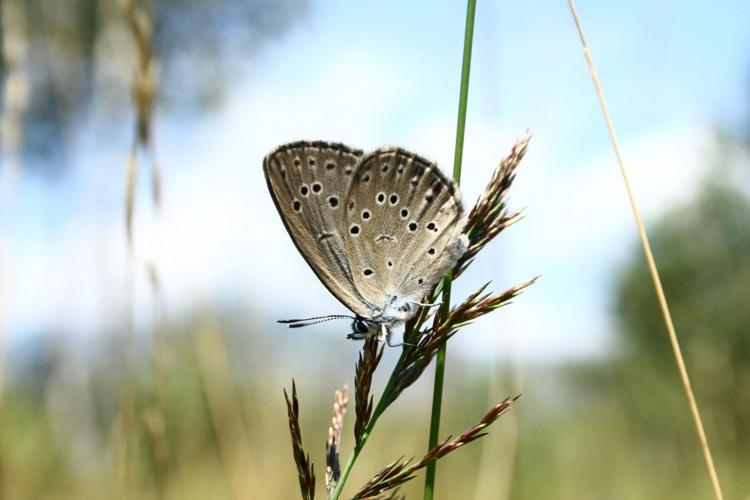
Adult Maculinea butterfly. (Vibrant Lab, Torino via SWNS)
In contrast, species with weaker or no associations with ants produced simpler or more irregular rhythms.
Professor Francesca Barbero, of the University of Turin in Italy, said: “In the dark, crowded environment of an ant nest, where constant vibrations and noise are unavoidable, precise rhythm may help signals stand out and be recognised quickly."
She added: "For caterpillars, getting the rhythm right can be vital: it may determine whether ants provide care and protection, or ignore them completely.”
Barbero says highly ant-dependent caterpillars shared two key rhythmic traits with ants: isochrony, meaning evenly spaced pulses that create a steady beat, and double meter, a more complex pattern of alternating long and short intervals.
She said this combination was only observed in ants and the most ant-dependent caterpillar species, suggesting the two species have evolved a co-ordinated rhythm pattern driven by their close ecological interaction.
Barbero added: "The findings challenge the idea that rhythm is limited to humans or animals with large brains.
"Instead, they suggest rhythm may be a fundamental feature of communication across the animal kingdom - even among tiny insects whose survival depends on cross-species cooperation."


(0) comments
Welcome to the discussion.
Log In
Keep it Clean. Please avoid obscene, vulgar, lewd, racist or sexually-oriented language.
PLEASE TURN OFF YOUR CAPS LOCK.
Don't Threaten. Threats of harming another person will not be tolerated.
Be Truthful. Don't knowingly lie about anyone or anything.
Be Nice. No racism, sexism or any sort of -ism that is degrading to another person.
Be Proactive. Use the 'Report' link on each comment to let us know of abusive posts.
Share with Us. We'd love to hear eyewitness accounts, the history behind an article.