



(NASA/ESA/CSA/STScI/Ohio St et al via SWNS)
By Dean Murray
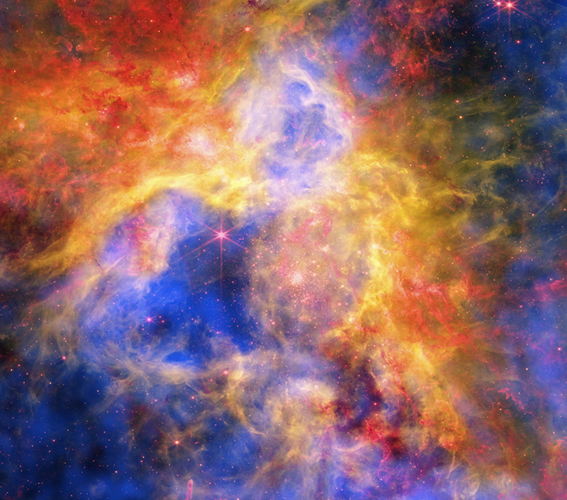
Space scientists have revealed a vibrant new image of the Tarantula Nebula.
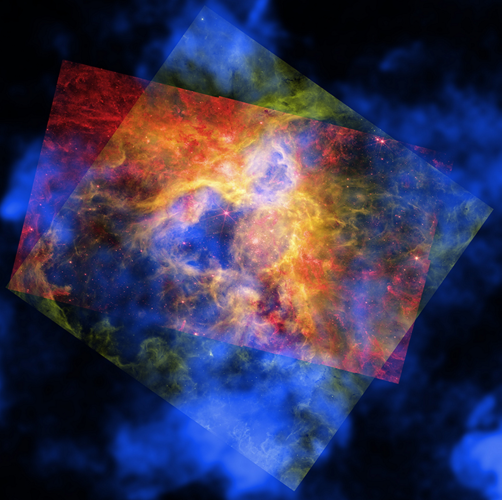
Describing the colorful observation as "like a collage made of layered sheets of colored cellophane," NASA said the resulting cosmic "craft" reveals new details about the star formation region, also known as 30 Doradus.
Located in the Large Magellanic Cloud, a small neighbor galaxy to the Milky Way about 160,000 light-years from Earth, the Tarantula has thousands of young stars embedded in a vibrant honeycomb-like structure of gas and dust.
The new composite image contains X-rays from NASA's Chandra X-ray Observatory, which has repeatedly observed the Tarantula Nebula over the course of its mission.


(NASA/ESA/CSA/STScI/Ohio St et al via SWNS)
Also featured is infrared data from NASA's James Webb Space Telescope showing thousands of young stars, plus swaths of cool dust that will provide the ingredients to form new stars and planets.
The composite image shows the full Hubble and Webb telescope images of this region, as well as a large section of the Chandra image, all recently published in a research paper in the Astrophysical Journal.
By studying the data, combined with data from NASA's retired Spitzer Space Telescope, the team concluded the Tarantula may be losing energy from several sources.
They observed that the Tarantula Nebula is losing energy as up to half of its hot gas leaks out, turbulent mixing cools the remaining gas, and thermal conduction transfers heat to cooler shell material without mixing.


(0) comments
Welcome to the discussion.
Log In
Keep it Clean. Please avoid obscene, vulgar, lewd, racist or sexually-oriented language.
PLEASE TURN OFF YOUR CAPS LOCK.
Don't Threaten. Threats of harming another person will not be tolerated.
Be Truthful. Don't knowingly lie about anyone or anything.
Be Nice. No racism, sexism or any sort of -ism that is degrading to another person.
Be Proactive. Use the 'Report' link on each comment to let us know of abusive posts.
Share with Us. We'd love to hear eyewitness accounts, the history behind an article.