



(University of Exeter via SWNS)
By Filipa Gaspar
A 19th-century estate agent created the world's first version of Rightmove 160 years ago - using "peepshow" technology to form a "digital walk-through."
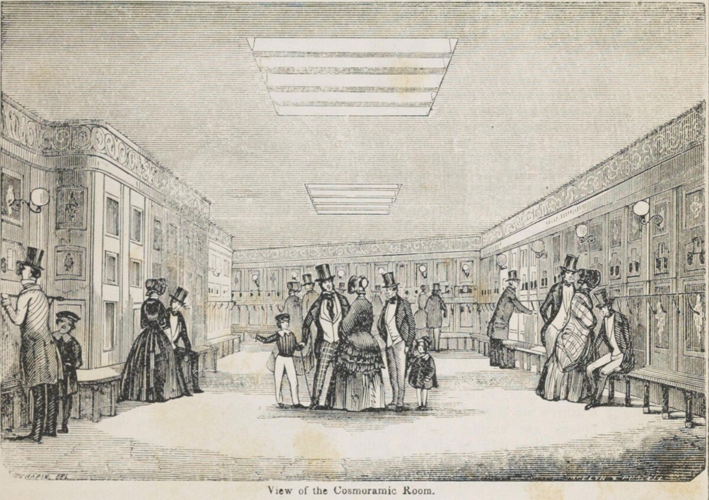
Brooks and Green, a high-end estate agent based in Old Bond Street, London, used an early form of immersive visual technology called a cosmorama to offer prospective buyers a virtual tour of the properties they were selling.
Research by the University of Exeter has discovered that for 20 years during the 1840s and '50s, decades before photography was used for advertising property, Brooks and Green had created their very own version of a "digital walk-through."
The discovery has emerged as part of a broader study of the history of the cosmorama across Europe and its contribution to the development of "show-business."
It's been published in a special themed edition of Early Popular Visual Culture.
John Plunkett, an expert in 19th-century visual media, and lead author of the paper, said: "For half a century, the cosmorama was one of the most common forms of visual show across Europe and the Americas.
"Similar in format to other types of immersive entertainment, such as the peepshow, the cosmorama offered picture galleries for the people, tapping into an era of greater travel and offering views of international tourist sites and scenes from across the British Empire.
"What we've discovered through this latest research project, however, is that its use extended beyond simple entertainment: the appeal of cosmoramas was that they sold an experience of virtual travel. This was utilized by estate agents seeking to sell luxury properties and country estates."
(University of Exeter via SWNS)
These new insights have emerged through the European research project, CURIOSITAS: Peeping Before Virtual Reality. A Media Archaeology of Immersion Through VR and the Iberian Cosmoramas led by the Universidade Lusófona in Lisbon.
Plunkett worked with the project team to investigate the history of this visual technology in the UK and Ireland.
By analyzing newspaper archives containing adverts and articles, he mapped its emerging use, particularly from the 1820s onwards.


The research project catalogued over 650 cosmoramas in Portugal, Spain, and the United Kingdom, with many others exhibited in countries as far apart as North America, Brazil, Cuba and Australia.
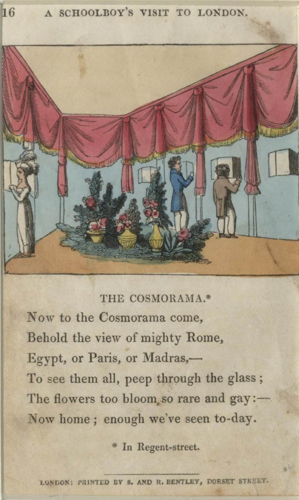
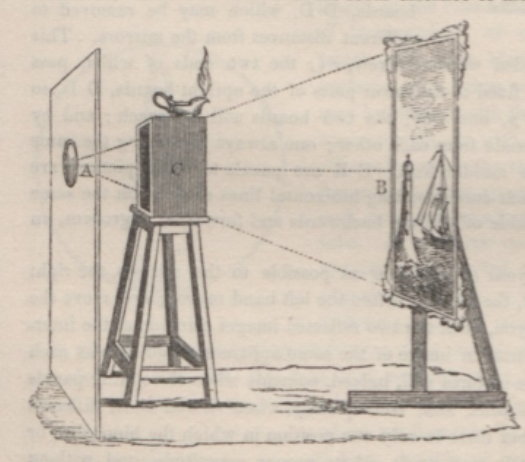
In cosmorama galleries, the paintings were not immediately visible. They were hidden behind walls and viewed through convex lenses that enlarged them and enhanced their depth effects.
With the addition of clever lighting effects, the viewer enjoyed an immersive experience. From lens to lens, the viewer would embark on a picturesque journey around the world.
Plunkett found examples of cosmorama galleries in cities across Britain and Ireland.
The paper explores how cosmorama began appearing in urban bazaars – the 19th-century equivalent of a department store – as well as becoming a popular feature of the touring shows that traveled around Britain.

(University of Exeter via SWNS)
It was during this research that Plunkett, of Exeter's Department of English and Creative Writing, found evidence that a London business was using a cosmorama in a truly innovative way.
Advertisements in London newspapers in the late 1830s revealed that auctioneer and surveyor Brooks and Hedger (later, Brooks and Green), on Old Bond Street, close to the Cosmorama Rooms of Regent Street, were offering cosmoramic views of some of the properties and estates they were selling.
The firm advertised their cosmoramic views until at least 1859. They claimed that their gallery included 'several Hundred Views of different estates' from an 'Aerial Perspective' showing the house and relevant grounds.
Plunkett said that for each view produced, an artist would have had to spend time at the property, making it a labor-intensive process likely reserved for the more exclusive sales.
He said: "In contemporary life, prospective purchasers of real estate are usually aided by a full suite of photographs and floor plans, and often an online video walk-through. Nineteenth-century buyers had no such advantages.
"But the founding of the first specialized estate agents set in motion a more professional approach to marketing property, fuelled by population growth, urbanization and improved transport links.
In that context, we can see how Brooks and Green pioneered the virtual tour, over 150 years before digital technology would fully realize this potential."


(0) comments
Welcome to the discussion.
Log In
Keep it Clean. Please avoid obscene, vulgar, lewd, racist or sexually-oriented language.
PLEASE TURN OFF YOUR CAPS LOCK.
Don't Threaten. Threats of harming another person will not be tolerated.
Be Truthful. Don't knowingly lie about anyone or anything.
Be Nice. No racism, sexism or any sort of -ism that is degrading to another person.
Be Proactive. Use the 'Report' link on each comment to let us know of abusive posts.
Share with Us. We'd love to hear eyewitness accounts, the history behind an article.