


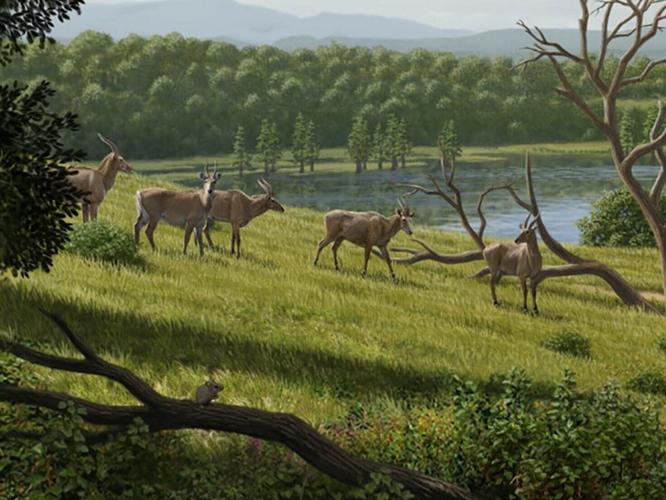
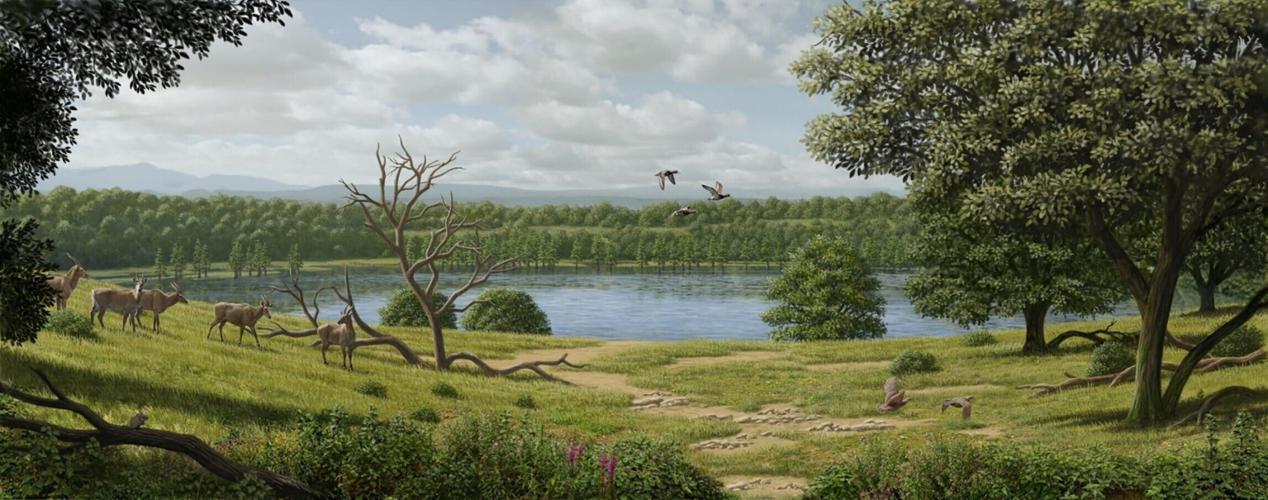
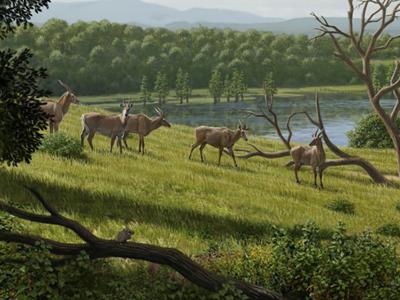

Palaeoartistic reconstruction of the environment in the surroundings of Camp dels Ninots maar lake during the early Pliocene. (Mauricio Antón via SWNS)
By Stephen Beech
Ancestors of today's cattle were roaming the grasslands of Europe over four million years ago, reveals new research.
The buffalo-like species grew up to weigh up to half a ton, scientists say.
The first large-sized bovines represent an early step toward our modern diversity of large-bodied buffalo and cattle, according to the study published in the journal PLOS One.
Research leader Leonardo Sorbelli explained that bovines are major components of many modern ecosystems as well as of human agriculture, particularly species of the tribe Bovini, which includes bison, buffalo and cattle.

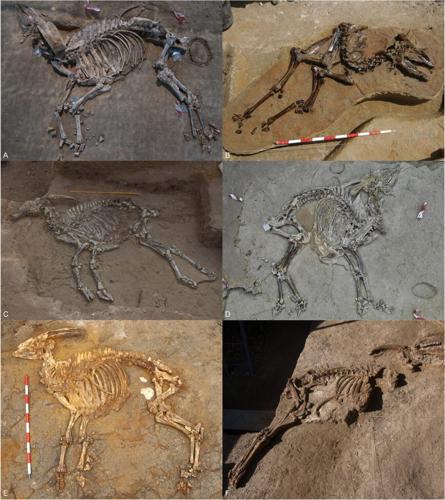
Articulated skeletons of Parabos tigneresi from Camp dels Ninots. (Sorbelli et al via SWNS)
But their evolutionary origins and their relationships with the most closely related groups have been unclear given a lack of well-preserved early fossils.
However, the discovery of several near-complete skeletons at the 4.4-million-year-old Camp de Ninots site, near Girona in Spain, prompted Sorbelli and his colleagues to re-examine early European cattle relatives.
The research team examined remains from at least 14 individuals for the study.
The researchers identified them as Parabos tigneresi, part of a group of five buffalo-like species that inhabited Europe during the Early Pliocene period.
Sorbelli said: "The largest of these specimens is estimated to have weighed nearly 500 kilograms, smaller than most living cattle species but larger than any other similar bovid of this time.


"These animals therefore represent an early stage of increasing body sizes in the bovine lineage, possibly as an adaptation to the climatic and environmental changes which characterised the European continent during the Pliocene."

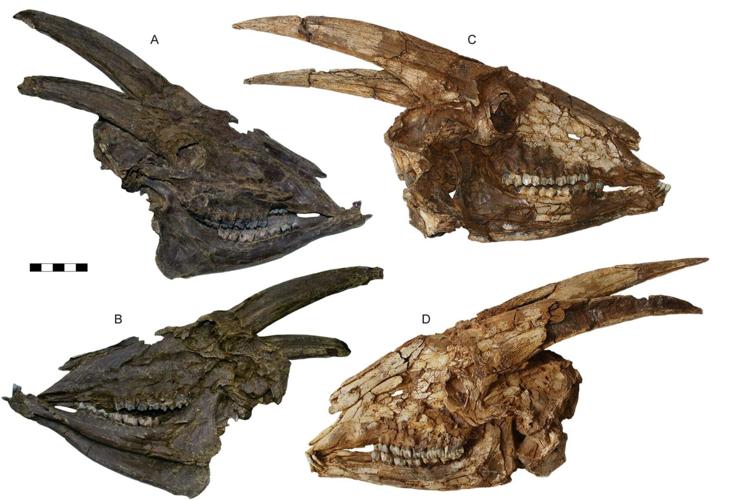
Skulls of Parabos tigneresi. (Sorbelli et al via SWNS)
He says their anatomy suggests that they predominantly inhabited a humid, vegetation-dense environment, matching the researchers' understanding of the water-rich environment that existed at the Camp de Ninots site.
This study identifies the Early Pliocene as the beginning of the age of large bovines, but the exact relationships of Parabos remain unclear.
Based on comparisons with other species, the research team concluded that Parabos either represent the earliest members of the tribe Bovini or the latest members of a related lineage, Tragoportacini, which were ultimately replaced by true buffaloes, cattle and bison.
Sorbelli, of the Leibniz Institute for Evolution and Biodiversity Science in Berlin, said: "The bovids from Camp dels Ninots are among the most exquisite fossils from the Pliocene of Europe.

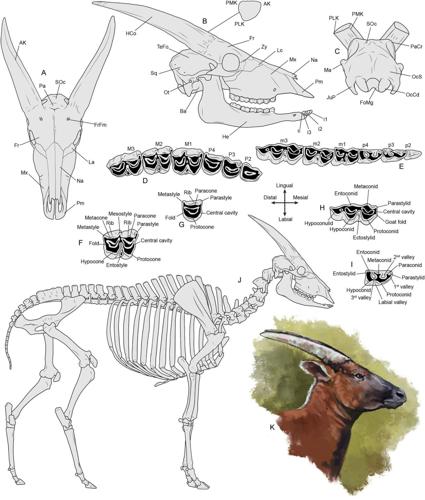
Osteology and in-life reconstruction of Parabos tigneresi based on the specimens from Camp dels Ninots. Cranium (AC), dentition (DI), skeleton (J) and life restoration of an adult male with colors based on the extant bongo (Tragelaphus euryceros) (K), with the position of the most important anatomical elements mentioned in the text. Drawings not to scale. (Sorbelli et al via SWNS)
"The exceptional preservation of these animals has allowed us to better understand their anatomy and, therefore, the ecology of the first large-sized bovids to populate the continent."
He added: "Working on these fossils has been both challenging and satisfying.
"The exceptional preservation and abundance of the remains have provided us with a large amount of data, which is unique for such ancient geological periods and opened a new window on our world before the arrival of humans."
Sorbelli says that further research into the anatomy and ecology of Parabos will help resolve precisely where the animals fit into bovine evolution.


(0) comments
Welcome to the discussion.
Log In
Keep it Clean. Please avoid obscene, vulgar, lewd, racist or sexually-oriented language.
PLEASE TURN OFF YOUR CAPS LOCK.
Don't Threaten. Threats of harming another person will not be tolerated.
Be Truthful. Don't knowingly lie about anyone or anything.
Be Nice. No racism, sexism or any sort of -ism that is degrading to another person.
Be Proactive. Use the 'Report' link on each comment to let us know of abusive posts.
Share with Us. We'd love to hear eyewitness accounts, the history behind an article.