





(Carl Knox/OzGrav, Swinburne University via SWNS)
By Stephen Beech
An "extraordinary" signal from outer space has provided new insight into the formation of the universe.
Astronomers pinpointed the source of the powerful flash of radio waves that had traveled for more than 10 billion years across the cosmos before reaching Earth.
It is the most distant fast radio burst ever detected, according to a new study published in the journal Science.
Fast radio bursts, or FRBs, are among the most mysterious objects in astronomy.
First discovered in 2007, they last only milliseconds but carry an enormous amount of energy - enough to briefly outshine entire galaxies.
Some experts have suggested they may be from an extraterrestrial lifeform trying to contact Earth.
However, the exact cause and origins of FRBs have remained unconfirmed.
Since the first one was discovered, astronomers have detected thousands of FRBs, whose locations range from within our own galaxy to as far as billions of light-years away.
The latest record-breaking discovery was led by Manisha Caleb and Themiya Nanayakkara, from the University of Sydney in Australia.
The MeerTRAP project used South Africa's MeerKAT radio telescope - one of the world's most powerful radio astronomy facilities - to detect the burst, designated FRB 20240304B, before identifying its host galaxy using observations from NASA's James Webb Space Telescope.

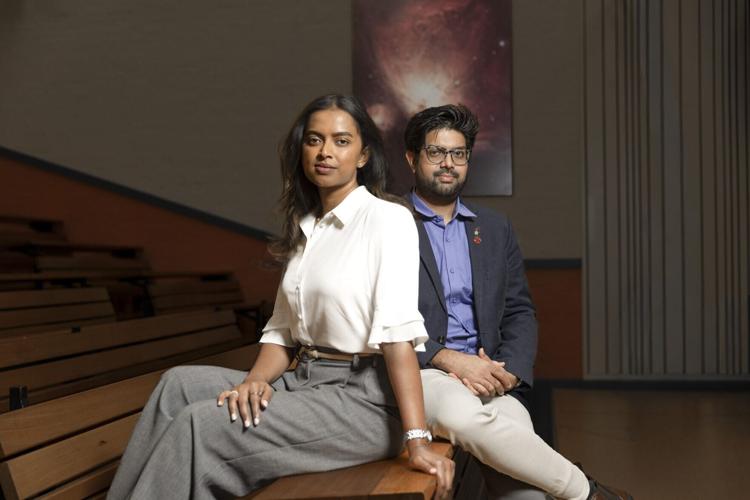
Dr. Manisha Caleb (left) and Dr Themiya Nanayakkara in a physics lecture hall at the University of Sydney. (Stefanie Zingsheim/University of Sydney via SWNS)
The burst originated when the universe was only about 3 billion years old, making it the most distant FRB yet detected - and more than doubling the previous distance record.
The research team say their discovery gives astronomers a powerful new way to study both the evolution of galaxies and the vast, otherwise invisible matter that fills the space between them.
Caleb, from the Sydney Institute for Astronomy in the School of Physics, said: "This is an extraordinary glimpse into the distant Universe.


"We have caught a fast radio burst from a time when the Universe was only about three billion years old, and we have used that brief flash of radio light to learn about the matter it has traveled through over billions of years."
By combining sensitive radio observations with powerful infrared imaging and spectroscopy, the team was able to detect not only the burst but also identify the galaxy that produced it.
The host galaxy turned out to be an unexpected source.
Study co-author Laura Driessen, from the University of Sydney, said: "The galaxy hosting this burst is surprisingly small, metal-poor and undergoing a very active episode of star formation.
"That gives us an important clue about the environments in which FRBs are born and shows that these brief radio flashes can tell us not only about the distant Universe, but also about how galaxies and their stellar populations evolve."
The research provides fresh evidence that at least some FRBs may originate from young magnetars, highly magnetized neutron stars formed when massive stars explode in a supernova.

Dr. Themiya Nanayakkara (left) and Dr. Manisha Caleb in the School of Physics offices at the University of Sydney. (Stefanie Zingsheim/University of Sydney via SWNS)
The researchers say that the newly discovered host galaxy is "young and vigorously forming stars" - characteristics more consistent with magnetar formation than alternative theories involving the merger of older neutron stars.
The result pushes the boundaries of how far astronomers can use FRBs.
Co-author Kavya Shaji, a PhD student in the School of Physics, said: "In principle, sufficiently powerful bursts could be detectable from the very early Universe."
Caleb added: "What is particularly exciting about our result is that we've now demonstrated that we can identify and study an FRB from when the Universe was young."
Co-author Ben Stappers, of Manchester University, who is also principal investigator of the MeerTRAP project, said: "The next step is to push this frontier further and see how close we can get to the first generations of stars."
The host galaxy was invisible to the largest ground-based telescopes, requiring the unique capabilities of the James Webb Space Telescope to pinpoint it and measure its distance.
Nanayakkara said: "Our results further show the amazing capability of the Webb space telescope where we can push boundaries beyond what was previously possible."
Beyond setting a new distance record, he says the burst acted as a "cosmic beacon" - illuminating the vast reservoirs of gas and matter between galaxies.
Nanayakkara added: "As the radio signal traveled across most of cosmic history, it carried information about the material it encountered along the way."


(0) comments
Welcome to the discussion.
Log In
Keep it Clean. Please avoid obscene, vulgar, lewd, racist or sexually-oriented language.
PLEASE TURN OFF YOUR CAPS LOCK.
Don't Threaten. Threats of harming another person will not be tolerated.
Be Truthful. Don't knowingly lie about anyone or anything.
Be Nice. No racism, sexism or any sort of -ism that is degrading to another person.
Be Proactive. Use the 'Report' link on each comment to let us know of abusive posts.
Share with Us. We'd love to hear eyewitness accounts, the history behind an article.