



Photo by Pixabay via Pexels
By Stephen Beech
Bumblebees are the brainboxes of the insect world, suggests new research.
The garden pollinators are able to solve puzzles spontaneously — despite having tiny brains, scientists say.
Bumblebees were able to complete several new object-manipulation tasks in a series of groundbreaking experiments.
Researchers say that what made the bees' behavior "especially remarkable" is that they had never been trained.
The findings, published in the journal Science, challenge the long-standing assumption that spontaneous problem-solving is restricted to humans and other large-brained vertebrates.
More than 100 years ago, psychologist Wolfgang Köhler first showed that chimps could solve novel problems by suddenly combining objects in new ways, such as stacking boxes to reach an out-of-reach banana.
The experiments became some of the earliest and most influential demonstrations of insight and spontaneous problem-solving in animals.
Now, researchers in Finland have reported "strikingly similar" problem-solving abilities in bumblebees.

(SWNS)
The bees solved a completely novel object-manipulation task without being trained on the solution itself.
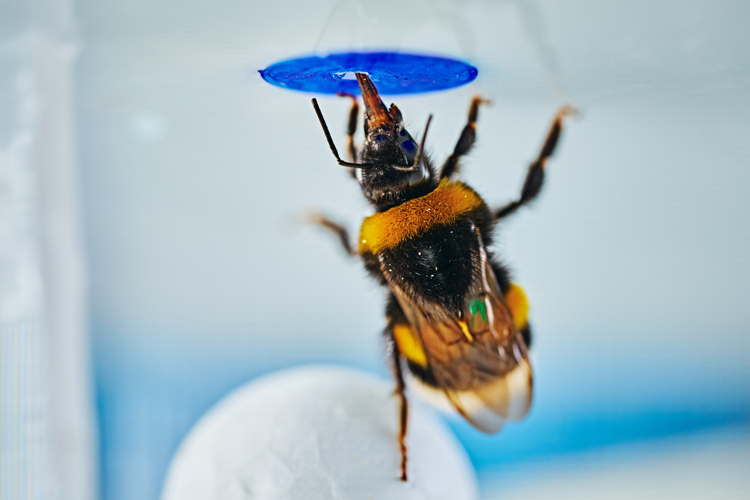
The bees first learned that a blue artificial flower signaled reward.
During the test, the flower was moved to the ceiling of a transparent arena, out of reach.
To access it, the bees had to spontaneously generate a new solution by moving a ball underneath the flower and climbing onto it, a behavioral sequence they had never previously encountered or been trained to perform.
Study senior author Dr. Olli Loukola said: “This is essentially an insect version of the classic ‘box-and-banana’ problem.
“The animal must realize that an object can be repositioned and then used as a tool to reach an otherwise inaccessible goal.
"What stands out about the result is that this kind of spontaneous problem-solving is now demonstrated in an insect.”
Study lead author Akshaye Bhambore said: “What makes this behavior especially remarkable is that the bees had never been trained to roll the ball.
This was a completely new challenge.
"Their behavior appeared goal-directed with successful individuals showing more directed movement patterns."

Photo by Markus Spiske via Pexels


He said the bees were not trained to move the ball underneath the flower.
Instead, they only learned two separate pieces of information beforehand: that the blue artificial flower contained reward, and that the ball was a movable, nonthreatening object.
When tested in a completely new situation, many bees used their prior experience with the flower and the movable ball in a way that went beyond the behaviors they had been trained to perform.
Loukola said: “Another important aspect is that our bees were fully naive.
“In many previous studies of insight-like problem-solving, the animals have had extensive experience with objects, test environments, or other problem-solving tasks.
"Here, the bees had never been trained to use the ball to reach the flower, and they had no previous experience with this kind of solution.
"We also designed the experiments to rule out simpler explanations such as accidental success, play behavior, trial-and-error learning, or direct visual guidance.”
The Finnish research team designed several control experiments to rule out simpler explanations based on accidental solve or direct visual guidance.
In the more demanding tasks, the flower was hidden from the bees while they moved the ball, stopping them from simply steering toward a visible target.
Even under those conditions, bees still successfully moved the ball to the correct location.
Bhambore, a doctoral researcher at the University of Oulu, said: “By analyzing the bees’ behavior across unusually stringent control experiments, we could show that they were not simply reacting to visual stimuli or moving the ball randomly."

Photo by Vaidas Vaiciulis via Pexels
Study co-author Ece Nur AkmeÅe, from the University of Helsinki, said: “One moment the animal is exploring seemingly without direction, and the next it performs a highly efficient sequence of actions leading directly to the solution.
“Watching the bees solving the task was genuinely fascinating.”
The study builds on growing evidence that bees possess surprisingly sophisticated cognitive abilities despite their tiny brains.
Previous research has shown that bees can socially learn tool use, solve puzzle-like tasks, cooperate with one another, and flexibly adapt their behavior.
However, the researchers say that their findings don't imply human-like reasoning or consciousness in insects.
Loukola, currently working as a senior researcher at the University of Turku, said: “We are not claiming that bees think like humans.
“But our findings show that miniature brains can generate flexible solutions to novel problems in ways we are only beginning to understand.”
He says the latest findings suggest that spontaneous, goal-directed problem-solving can emerge in animals with brains vastly smaller than those of vertebrates traditionally studied in insight research.
Loukola added: “For over a century, spontaneous object-based problem-solving has mostly been studied in vertebrates.
“Our study suggests insects may belong in that conversation too.”


(0) comments
Welcome to the discussion.
Log In
Keep it Clean. Please avoid obscene, vulgar, lewd, racist or sexually-oriented language.
PLEASE TURN OFF YOUR CAPS LOCK.
Don't Threaten. Threats of harming another person will not be tolerated.
Be Truthful. Don't knowingly lie about anyone or anything.
Be Nice. No racism, sexism or any sort of -ism that is degrading to another person.
Be Proactive. Use the 'Report' link on each comment to let us know of abusive posts.
Share with Us. We'd love to hear eyewitness accounts, the history behind an article.