


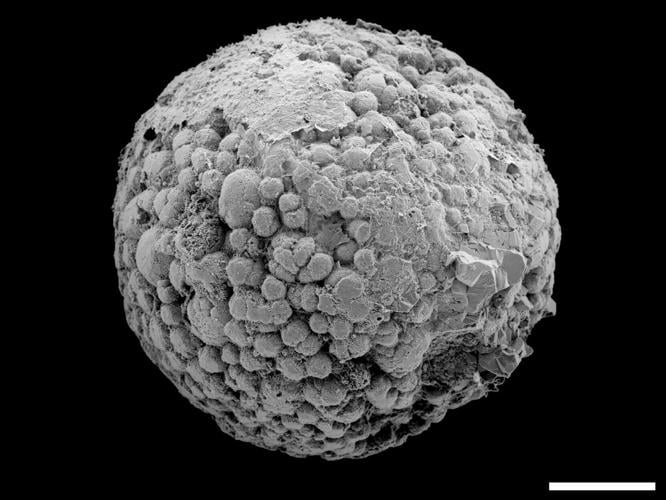


Knollisphaeridium maximum, Kheseen Formation, latest Ediacaran/early Cambrian. Scale bar: 0.1 mm. (Derek Briggs via SWNS)
By Stephen Beech
Animals may have evolved up to 200 million years earlier than fossil evidence suggests, according to new research.
The Oxford University-led study challenges key assumptions scientists have used to date the origins of the earliest animal life.
The research, published in the journal Science Advances, suggests animals may have originated deep in the Neoproterozoic Era — even before some of Earth's most extreme ice ages.
The research team says their findings could transform understanding of one of evolution's greatest mysteries: why animals seem to appear "relatively suddenly" in the fossil record just before the Cambrian Period, 539 to 487 million years ago.
They explained that at the center of the new study is a problem with the way scientists have recently used the fossil record to set a maximum age for the origin of animals.

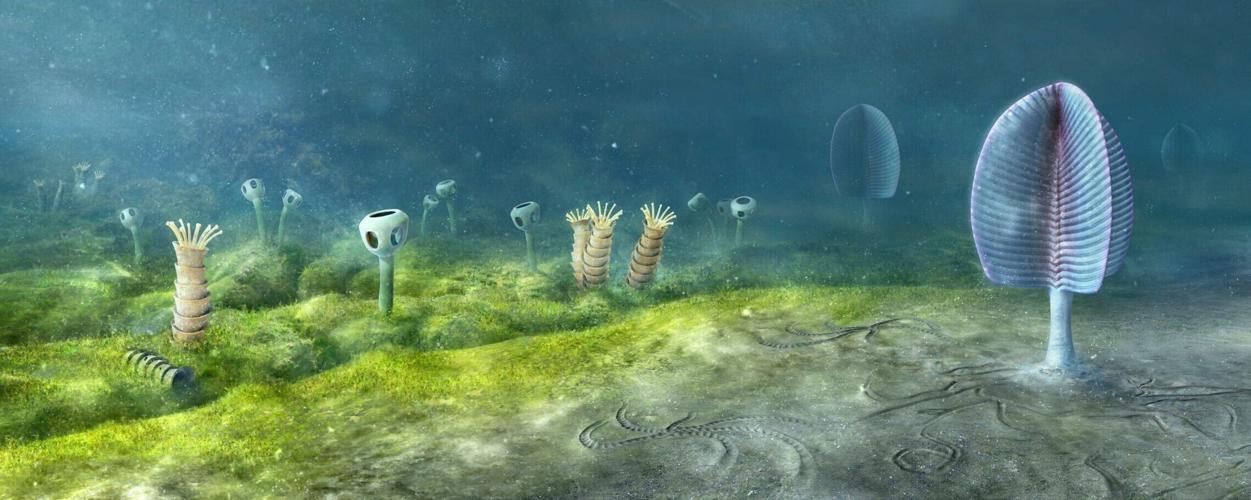
Ediacaran sea floor, Namibia, Southwest Africa - 543 million years ago. (University of Oxford via SWNS)
A roughly 590-million-year-old fossil deposit, known as the Weng'an Biota in rocks of Ediacaran age in China, preserves microscopic organisms in extraordinary detail, none of which are definitive animals.
Scientists have therefore inferred that the first animals must have originated after Weng'an, assuming that the "exceptional" fossil deposit would have preserved them if they existed at that time.
The international research team conducted a comprehensive survey of exceptionally well-preserved microfossils from the Kheseen Biota in Mongolia.
The Kheseen Biota is more than 40 million years younger than Weng'an, even though they share some species.

Study author Associate Professor Ross Anderson (University of Oxford) in the mountains to the west of Lake Khuvsgul, Mongolia during fieldwork in summer 2017. (Ross Anderson via SWNS)
By that time animal fossils are known from sites elsewhere around the world, including in Namibia and southern China.
The research team studied more than 140 samples, including some from previously undocumented localities, and examined them using scanning electron microscopy.
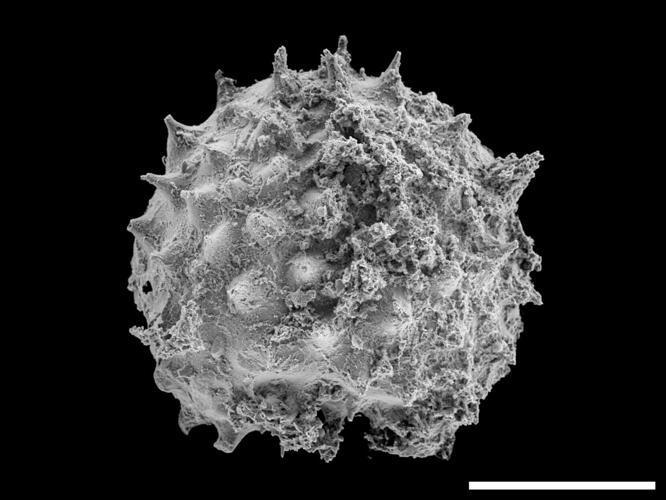
The analysis revealed "exquisite" new microfossil species, including acritarchs — tiny spherical organisms with spines and branching projections — as well as embryolike fossils containing internal cells.
But, despite the remarkable level of preservation, none can be confidently identified as an animal.
Study senior author Ross Anderson, from Oxford University's Museum of Natural History, said: "The Kheseen Biota breaks the argument that the exceptional microfossils of Weng'an mean we would have seen animal fossils in the assemblage had they existed at the time.

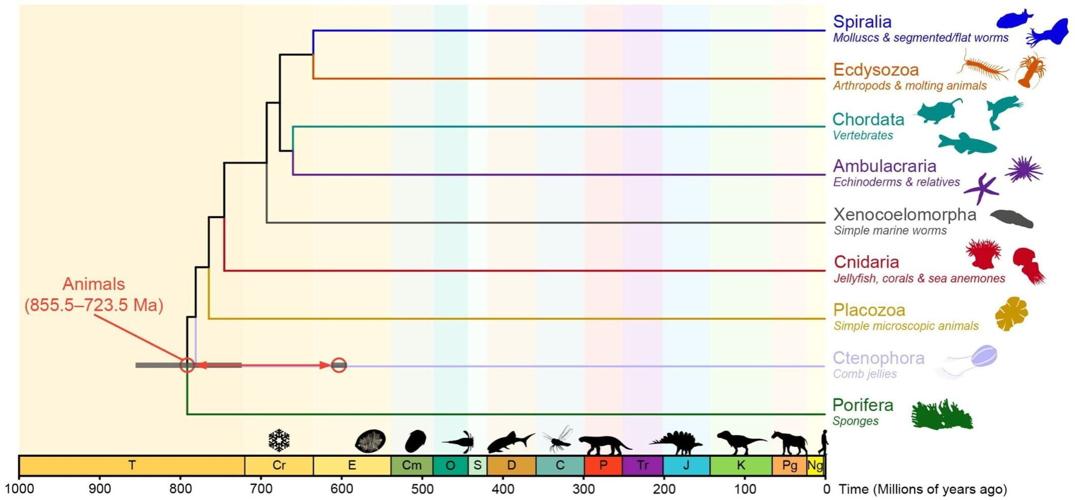
Estimated timeline for the origin of animals based on molecular clock analyses. The grey bar on the right of the image is the origin of animals based on an Ediacaran upper calibration. The grey bar to the left is the origin based on older deposits in the Tonian period, as suggested by the new study. (Orin Lole Durbin via SWNS)
"The Kheseen microfossils are just as well-preserved, yet animals continue to be absent — despite the fact we know at that point they existed."
He says animals must have lived in different environments from those that preserved the fossils in the Kheseen Biota, or the chemical conditions there failed to preserve animal remains.


Given that the Kheseen Biota was preserved when animals were present but they are nonetheless not preserved as fossils, the research team argues that Weng'an doesn't automatically qualify as evidence that no animals existed at that time and only appeared later than 590 million years ago.
Instead, they looked much further back, to several deposits dating from roughly 850 to 730 million years ago.
These included the Svanbergfjellet Formation in Norway, Bitter Springs Group in Australia and the Chuar Group in Arizona, U.S.
All are fossil-rich deposits with the potential to preserve animals, even though they have eluded discovery.
Anderson said the deposits have previously been used as maximum dates for the origin of animals.

Asterocapsoides wenganensis, Kheseen Formation, latest Ediacaran/early Cambrian. Scale bar: 0.1 mm. (Derek Briggs via SWNS)
Using the older geological constraints, the research team used a technique called molecular clock analysis.
The method compares genetic differences between living species and, using dates from the fossil record as reference points combined with rates of evolution, works backwards to estimate when their ancestors lived.
Compared with analysis constrained by the younger Ediacaran Weng'an deposit, the fresh approach shifted the estimated origin of animals backwards by around 200 million years, to between 800 and 700 million years ago.
Anderson said there are already clues that such a hidden history exists.
Chemical fossils, or biomarkers, preserved in ancient rocks provide evidence consistent with sponges living at least 650 million years ago, tens of millions of years before the oldest definitive macroscopic animal fossils.
The researchers said those early animals would have been small and soft-bodied, without the shells, bones or other hard structures that make later animals easier to preserve.
Whether such creatures were fossilized depended on their environment and on an unusual combination of chemical conditions after death.
Anderson said an origin between 800 and 700 million years ago raises "striking possibilities" that animals may already have evolved before Earth entered some of the most extreme ice ages in its history or even appeared during that inhospitable interval.
During the Cryogenian Period, which began around 720 million years ago, enormous glaciers spread across the planet in episodes commonly known as Snowball Earth.
The new study reopens questions about whether the conditions associated with Snowball Earth played a role in the origin and early evolution of animal life.
Study first author Orin Lole Durbin, an Oxford graduate now a Ph.D. student at Virginia Tech in the U.S., said: "Pre-Ediacaran animal body fossils still elude us, and this analysis does not prove that animals existed 800 million years ago.
"However, our new fossil evidence from Mongolia undermines one of the main arguments for restricting animal origins to the Ediacaran interval.
"Meanwhile, our molecular-clock analyses show how much further back their evolutionary history could extend."
The researchers say that future work should explore fossil deposits from different regions, representing different environments and modes of fossilization, in the search for early animals.
Anderson added: "Until that evidence becomes available, the precise birth date of the animal kingdom remains uncertain."


(0) comments
Welcome to the discussion.
Log In
Keep it Clean. Please avoid obscene, vulgar, lewd, racist or sexually-oriented language.
PLEASE TURN OFF YOUR CAPS LOCK.
Don't Threaten. Threats of harming another person will not be tolerated.
Be Truthful. Don't knowingly lie about anyone or anything.
Be Nice. No racism, sexism or any sort of -ism that is degrading to another person.
Be Proactive. Use the 'Report' link on each comment to let us know of abusive posts.
Share with Us. We'd love to hear eyewitness accounts, the history behind an article.