



Photo by Tim Samuel via Pexels)
By Stephen Beech
The "ideal" burger for taste, health, and saving the planet has been created using AI technology.
The resulting mushroom-based patty recipe was designed by American scientists using more than 2,200 recipes to achieve an environmental impact much lower than a popular fast food burger.
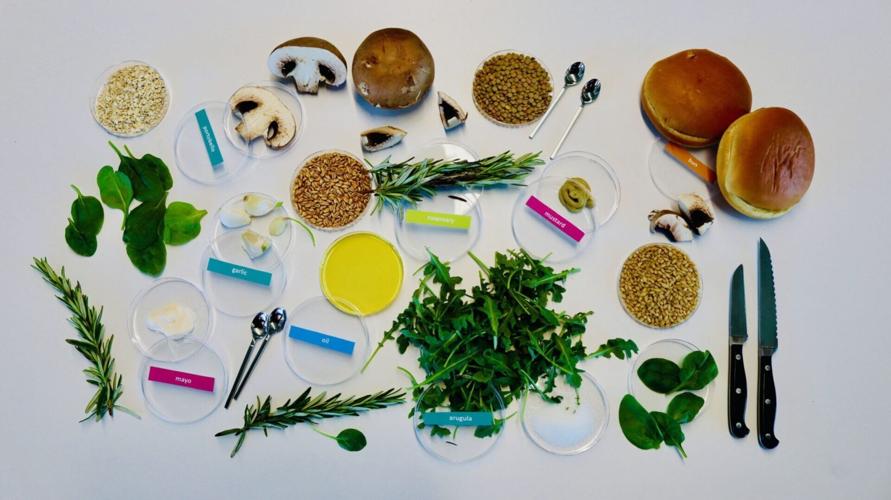
It combines portobello mushrooms, arugula, rosemary, grains, and condiments.
And the recipe can now be personalized to suit every palate using state of the art AI technology.
Ellen Kuhl estimates that there are more than 1,000 potential burger recipes in the world.
And using BurgerAI — a tool developed in her lab at Stanford University in California — artificial intelligence can now design personalized patties that best suit your age, taste, nutritional need, and even your sustainability goal.
But Kuhl explained that BurgerAI's ability to suggest a great-tasting, nutritionally complex, sustainably produced burger is only part of the story.
She says that, more broadly, the innovation heralds a shift for AI itself: moving it from prediction to design.
Kuhl, who directs Stanford Bio-X — an interdisciplinary life sciences institute that brings together researchers across medicine, said: "Most AI systems are trained to predict what already exists.
"We wanted AI to invent what should exist next.

AI-designed sustainable burger ingredients: BurgerAI selected these ingredients by optimizing for environmental sustainability while maintaining consumer appeal. The resulting mushroom-based recipe combines portobello mushrooms, arugula, rosemary, grains, and condiments to achieve an environmental impact more than an order of magnitude lower than a popular fast food burger. (Living Matter Lab via SWNS)
"BurgerAI does not ask, 'What burger is most likely?' It asks, 'What burger best satisfies these important and complex objectives?'"
Kuhl says food is the "next big thing" in biosciences — a focus that combines elements of human experience and culture, health and nutrition, and environmental impact.
Vahidullah Tac, a postdoctoral fellow in Kuhl's lab, said: "Food choices are some of the most consequential decisions humans make every day.
"Food was an easy motivator.
"With one arrow, you can hit two targets — planetary health and personal health. It's a great and impactful research area."
Kuhl's team has just published two papers on BurgerAI, of which Tac is the first author.
The first introduces BurgerAI while the second paper reveals that the same mathematical principles that drive BurgerAI also underpin diffusion-based generative AI more broadly and create connections to technical fields such as materials design, physics, and engineering.
Kuhl said: "For centuries, food design has been a matter of intuition, experience, and trial and error.


(Photo by Pavel Danilyuk via Pexels)
"We are beginning to show that AI can transform food design into a quantitative science with applications in other important fields."
Using 2,216 burger recipes from Food.com as a data source, she explained that BurgerAI learns patterns in ingredient combinations and quantities and then generates new burger recipes from scratch.
The AI then matches those characterizations against human flavor and textural preference profiles.
The results are entirely new recipes optimized for deliciousness, sustainability, and nutrition, and personalized based on gender, age, and physical activity.
Kuhl said the ultimate test was not computational but culinary.
The research team served five professionally prepared, AI-designed burgers to more than 100 diners in a blinded taste test at a San Francisco restaurant.
In a side-by-side comparison to a popular fast-food burger, BurgerAI's two variations of its Delicious Burger scored the same or better in overall liking, flavor, and texture.
Its Mushroom Burger reduced environmental impact by more than an order of magnitude, and its Bean Burger achieved around twice the nutritional score of the fast-food burger.
Kuhl said: "AI did not just generate plausible burger recipes — it created burgers that real people enjoy.
"That may sound simple, but it means the model learned what makes food appealing to the human palate and was able to navigate a design space with near-infinite possible burger combinations to find real-world solutions."

(Photo by Szabó Viktor via Pexels)
Tac was genuinely surprised by how well the sustainable burgers performed.
He said: "We expected some trade-off between sustainability and consumer acceptance.
"But we found a burger with dramatically lower environmental impact could still compete with one of the world's most successful burgers."
The research team say the same generative design framework used to develop BurgerAI could have implications in other fields, such as pharmaceuticals, materials and biomolecules.
As with food, which requires a balance of taste, nutrition, cost, and sustainability, Kuhl says many of society's biggest challenges must balance competing objectives.
If AI can help navigate trade-offs in recipe design, she said it could also help discover new medicines, engineer advanced materials, and create more sustainable products.
Kuhl added: "The burger is just the beginning.
"We see food as a model system for a much larger vision: AI as a partner in scientific and engineering discovery."




(0) comments
Welcome to the discussion.
Log In
Keep it Clean. Please avoid obscene, vulgar, lewd, racist or sexually-oriented language.
PLEASE TURN OFF YOUR CAPS LOCK.
Don't Threaten. Threats of harming another person will not be tolerated.
Be Truthful. Don't knowingly lie about anyone or anything.
Be Nice. No racism, sexism or any sort of -ism that is degrading to another person.
Be Proactive. Use the 'Report' link on each comment to let us know of abusive posts.
Share with Us. We'd love to hear eyewitness accounts, the history behind an article.