


Picture this: you’ve packed up for a day on the lake with friends and family. The sun is shining, the kids and cooler are loaded up with plenty of snacks, and it looks like it’s going to be a perfect day. But then, you jump in for a refreshing swim and notice that slimy greenish-brown scum accumulating just below the waterline on your boat. It’s the lake equivalent of a car with the words “wash me” scrawled on the dirty windshield, and you don’t want to pull up to the docks with a dirty vessel. You want to clean your boat until it’s shining again, and it’s almost too easy — it’s already in the water, just add soap, right? Wrong. The time and effort you save by cleaning your boat in the lake comes at a cost that you might not immediately see.
It might seem harmless to scrub off your boat while anchored on the water, or even at your own dock, but as convenient as this may seem, washing your boat in the lake can have a significant impact on water quality.
When you scrub down your boat, you’re not just removing dirt — you’re also potentially introducing harmful chemicals, oils, and invasive species into different areas of the lake. Boat soaps, detergents, and waxes can contain phosphates, surfactants, chlorinated compounds, solvents, and dyes, which, when washed into the lake, can accelerate algal and plant growth.
In 2009, the Boat U.S. Foundation put “green” cleaners to the test. They tested 20 boat soaps with labels that claimed to be “green,” sending each cleaner to a leading university with laboratory facilities to evaluate its effect on aquatic life. They discovered that “green” labeled cleaning products appeared to be some of the most harmful products tested. There are no federal requirements or specific standards that manufacturers must follow to claim a product is “biodegradable” or “environmentally safe.” Even products with the Environmental Protection Agency’s Safer Choice logo
contain ingredients that have been screened by the EPA, but not tested.
The EPA and New Hampshire Department of Environmental Services regulate discharges of pollution. NHDES’s authority to enforce discharges into state waters is provided by RSA 485-A:13 I. (a): "It shall be unlawful for any person or persons to discharge or dispose of any sewage or waste [wash water, antifreeze, and detergents] to the surface water or groundwater of the state without first obtaining a written permit from the Department of Environmental Services."
This means that careful measures must be taken by marina facilities and boat owners to prevent discharges from boating-related activities, including boat washing and maintenance. Additionally, a bilge sock is a quick, inexpensive option that soaks up any oil leaks in the bilge before it gets pumped into the lake.
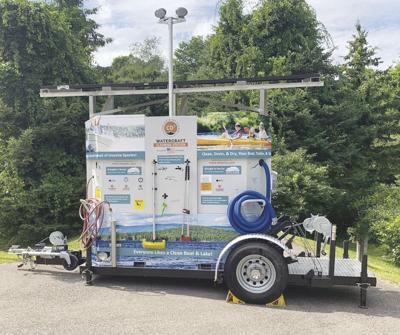
Marinas should provide a boat wash location where the water can be contained and treated. If you bring your boat to a local marina to be washed, ask them about their setup and whether they have a pollution prevention program in place. Or, take it to a car wash at the end of the season so that the soap and detergents are contained. If you decide to wash it yourself, please don’t do it in the lake or any area that drains directly to surface waters.
These tips don’t just apply to washing your boat in the lake but also to washing your pets and yourself. We urge you to do a little research into the products you’re using and remind yourself that a “green” label may increase the odds of a green lake. Do all your washing away from the lake, and use clean, drain, dry practices so we can Keep Winni Blue.
•••
Bree Rossiter is the conservation program manager for the Lake Winnipesaukee Association. She manages the water quality monitoring program, cyanobacteria monitoring initiatives, the Winni Blue/LakeSmart program, and assists with watershed management planning efforts. Bree can be reached at brossiter@winnipesaukee.org. The Lake Winnipesaukee Association is a nonprofit dedicated to protecting the water quality and natural resources of the lake and its watershed. To learn more, visit winnipesaukee.org.


(1) comment
Out of staters have already ruined all the lakes here, as well as the state itself.
Welcome to the discussion.
Log In
Keep it Clean. Please avoid obscene, vulgar, lewd, racist or sexually-oriented language.
PLEASE TURN OFF YOUR CAPS LOCK.
Don't Threaten. Threats of harming another person will not be tolerated.
Be Truthful. Don't knowingly lie about anyone or anything.
Be Nice. No racism, sexism or any sort of -ism that is degrading to another person.
Be Proactive. Use the 'Report' link on each comment to let us know of abusive posts.
Share with Us. We'd love to hear eyewitness accounts, the history behind an article.