




I am on a return flight from celebrating my son's 10th wedding anniversary in Lake Orta, Italy. We had a large family gathering to renew their vows and enjoy an extended vacation at Lake Orta and Lake Como in Italy, and then off to tour Austria, travel through Switzerland, and head back home.
On the plane back home, I started drawing comparisons between Lake Winnipesaukee, Winnisquam, and Newfound Lake and some of the lakes we visited in Europe, plus other lakes noted for their sheer size, surface area, and depth worldwide. It gave me something to do on a long plane ride.
We stayed in the charming lakefront town of Orta San Giulio on Lake Orta, where Chris and Kim were married 10 years ago. This beautiful historical town is framed by mountains and is slightly larger in size than Lake Winnisquam at 4,482 acres. Its maximum depth reaches 469 feet, quite a bit deeper than Winnisquam's maximum depth of 173 feet. The swimming in the hot weather was refreshing, and the lake traffic was much more subdued than back home. While we were there, forestry planes were scooping up water from the lake to fight a major forest fire on the other side of the mountain, a result of the dry summer heat. The quality of the village hotels and B&Bs was amazing, having lasted 300 to 400 years on the lake with rugged stone and granite exteriors. Their riverstone and granite roadways have been preserved for centuries.
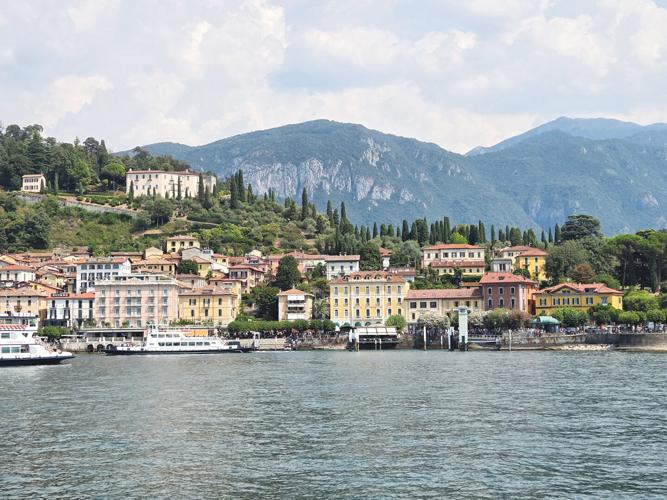
We took a day's excursion over to Lake Como, which we had visited in years past. This time, we took a boat trip to several ports, visiting Villa del Balbianello near Lenno and the famous village of Bellagio. Lake Como is framed the entire distance by towering mountains that reach 8,500 feet and drop sharply into the 56-square-mile lake, making it a bit smaller than Lake Winnipesaukee's 72 square miles of water. It measures 29 miles in length by 2.5 miles wide — a bit longer than Winnipesaukee's 21-mile length; however, it is a narrower lake compared to the "broads" of Winnipesaukee that stretch up to 9 miles wide. The maximum depth of the lake startled me at 1,394 feet, compared to Winnipesaukee's 213 feet. Como is the deepest lake in Italy and the third largest. Bellagio featured beautiful historical architecture; however, the town was overrun with hordes of tourists and classic boats pulling into the town's multiple docking facilities. We are so fortunate that Lake Winnipesaukee has not experienced this magnitude of people, because development has had a major impact on the water quality in the southern part of Lake Como. Lake Maggiore is another lake in the region, the largest in Italy at 82 square miles, 10 square miles larger than Winnipesaukee. This narrow lake is 40 miles long and reaches a maximum depth of 1,220 feet.
On the way to Austria, we passed through Lake Lugano in Switzerland. It is a smaller lake at 18.8 square miles with a maximum depth of 945 feet. The aqua color was more pristine than Como's, because of its less dense population and minimal development. We arrived in Lech, Austria, and I was so impressed with this exclusive, world-famous mountain village and ski resort in the Arlberg region. The storybook setting was exceptionally picturesque, and we enjoyed four days of hiking, sightseeing, and fine dining. It reminded me of a smaller version of Grindelwald, Switzerland.
Two other lakes in Switzerland that I have visited a number of times in the Jungfrau region are Lake Thun, at 18.6 square miles with a maximum depth of 712 feet, and Lake Brienz, which connects to Thun, with a maximum depth of 850 feet. These alpine lakes are separated by the town of Interlaken, and the scenic ski villages of Grindelwald, Wengen, and Mürren are just up the road as the majestic Jungfrau towers above the lakes and towns in the region. These places bring back favorite memories from when I visited after I graduated from college on a Eurail pass 55 years ago, and we have returned several times since. It truly is my happy place.
During my plane ride, I started thinking about which lakes are the largest, deepest, and cleanest in the United States and the world. Here is what my research came up with: The deepest lake in the world is Lake Baikal in Siberia, Russia. This massive lake at 12,248 square miles plunges to a depth of 5,387 feet. I don’t think many of us will be visiting this place soon. The largest freshwater lake by surface area in the world is Lake Superior, covering 31,700 square miles of water. Years ago, I traveled the Trans-Canada Highway toward Lake Superior and stopped at an undeveloped section of the lake without a house in sight. The beach was a beautiful collection of black, pink, and gray polished rocks with stunning crystal-clear water and endless water views. The lake has a maximum depth of 1,332 feet. The deepest freshwater lake in the USA is Crater Lake in Oregon, which reaches a maximum depth of 1,949 feet. It’s the ninth deepest in the world and is fed almost entirely by rain and snowmelt, with no rivers flowing in or out. The lake features exceptionally clear blue water. Lake Tahoe in California and Nevada is the second deepest lake in the USA, with a maximum depth of 1,645 feet. It’s 22 miles long and 12 miles wide with 72 miles of shoreline. There is only one small island on the lake, compared to Lake Winnipesaukee's 258 islands and 288 miles of shoreline, including the islands. A friend of mine owned a house on Tahoe, and when I visited, I can tell you the water was cold; however, the water was crystal clear, 99.9% pure where visibility goes from 60 to 70 feet.
The cleanest freshwater lake in the world is Blue Lake in New Zealand, where underwater visibility reaches up to 262 feet, matching the purity of distilled water. Swimming or entering the water is prohibited because the lake is deeply sacred. Newfound Lake in New Hampshire is ranked as the eighth cleanest lake in the USA, fed by multiple natural springs. This 4,451-acre lake reaches maximum depths of 183 feet and is New Hampshire’s third-largest lake.
We are blessed to have so many natural freshwater lakes in New Hampshire’s Lakes Region to enjoy. The choices are numerous, each with its own character. Size and maximum depth vary, as they do in other parts of the world. None of us will be venturing down to a 5,387-foot depth as in Lake Baikal. When you compare the lakes to the average depth of the global ocean at 12,080 feet, or over 2 miles, our lakes look small. The oceans cover roughly 71% of the Earth's surface, and the deepest part of the ocean, recorded with Challenger Deep in the western Pacific Ocean, was a whopping 35,876 feet deep. I still prefer our natural, spring-fed lakes right here in the New Hampshire Lakes Region. It is also interesting to note that Travel + Leisure, on Aug. 18, just named Laconia as the best small lake town in America for 2026.
Congratulations, Lakes Region.
•••
This article was written by Frank Roche, the president of Roche Realty Group, located in Meredith. He can be reached at 603-279-7046. Visit rocherealty.com to learn more about the Lakes Region and its real estate market.


(0) comments
Welcome to the discussion.
Log In
Keep it Clean. Please avoid obscene, vulgar, lewd, racist or sexually-oriented language.
PLEASE TURN OFF YOUR CAPS LOCK.
Don't Threaten. Threats of harming another person will not be tolerated.
Be Truthful. Don't knowingly lie about anyone or anything.
Be Nice. No racism, sexism or any sort of -ism that is degrading to another person.
Be Proactive. Use the 'Report' link on each comment to let us know of abusive posts.
Share with Us. We'd love to hear eyewitness accounts, the history behind an article.