


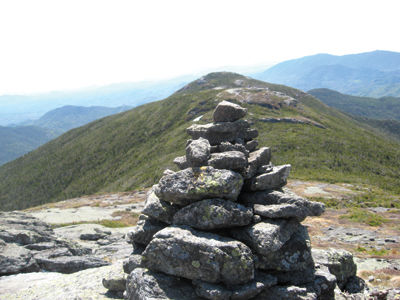
Rock cairn at summit of Iroquois Peak, looking toward Algonquin Peak
By Gordon DuBois
The following article is the fifth in a series on hiking excursions that you may want to consider as you make plans for your summer backpacking adventures. I hope this series has inspired you to take advantage of the many trails that await you, not only in New Hampshire, but throughout the Northeast and beyond.
When I was a young boy I spent many summers with my aunt and uncle in the Adirondack Mountains at their home on Raquette Lake, which is centrally located in the Adirondack Park. During those lazy days of summer I wallowed away my time by fishing and exploring the woods around their home. My uncle Harry would take me and my cousin deep into the woods to fish for brook trout on his "secret" streams and ponds. When I became a teen I landed a job working at The Hedges, a resort on Blue Mountain Lake. On my days off I would canoe, sail, water ski, fish and swim in the clear, deep waters of Blue Mountain Lake. I also loved to climb Blue Mountain and other mountains in the area. Later in my life, after moving to New Hampshire and starting a family, I would occasionally join my brother to hike the high peaks of the Adirondacks. Later, I became more focused on climbing in the Whites of New Hampshire and other mountains in northern New England. The Adirondacks went off my radar. Then, last year, a hiking partner from Vermont, Mike LaRoss, invited me to join him on a backpacking trip to the "Dacks" and to climb several of the high peaks. I jumped at the opportunity. I remembered the beauty of these mountains and saw it as a return to my hiking roots.
The Adirondack Mountains are not geologically part of the Appalachian chain, but much older, the southern appendage of the Canadian Shield. The bedrock of this shield is over a billion years old. Over millions of years, upward doming of this bedrock and younger rock above created the mountain mass we know today. The Ice Age enveloped the mountains with glaciers thousands of feet thick that sculpted the mountain peaks and valleys. Unlike the Whites, the Adirondacks were mostly unknown until the 1840s. The source of the Hudson River was not discovered until the mid-1800s. After the Civil War, people found the Adirondacks to be an ideal location for summer vacations, away from the crowded cities of the east coast. Some of the wealthiest families in the world built their summer homes, or "great camps" here: The Vanderbilts, Morgans, Durants, Carnegies and Huntingtons. The Prospect House built on the shores of Blue Mountain Lake in 1882 became the first hotel in the world to have electric lighting in all 300 of the hotel's guest rooms. Thomas Edison was the head electrician. In 1892, the New York Legislature created the Adirondack Preserve. Today the Preserve (land owned by the people of New York through a constitutional amendment) totals 2.5 million acres and lies within the Adirondack Park of 6 million acres, making it the largest park in the nation outside of Alaska.
I met Mike at the start of the Calamity Brook Trail, which lies at the end of Upper Works Road, a remote side road off Route 28N. On this road lies the remains of the abandoned community of Tahawus and the McIntyre Mines. Still standing is the remnants of the 60-foot tall blast furnace. It was here in Tahawus, while on a hunting excursion, that Vice President Teddy Roosevelt was notified of the death of President William McKinley. From Tahawus he rushed off to Washington and on September 14, 1901 he was sworn in as the 26th President of the United States.
Mike and I spent our first day hiking into an area called Flowed Lands and found a campsite near the water. The large tract of water was created in the mid-nineteenth century by the owners of the McIntyre Iron Works in an effort to channel more water to their blast furnaces. From here we could access a number of the high peaks, including Mount Marcy, 5,344 feet, the highest summit in New York. Having arrived late in the day, we decided to make camp and climb Algonquin (5,114 feet), Wright (4,580 feet) and Iroquois (4,840 feet) peaks the following day. All three of these mountains have well-established trails leading to their summits. However, many of the other high peaks are trail-less and can only be climbed by following "herd paths" to the summits.
We began the next day in crisp, cool temperatures, hiking along the shores of Flowed Lands and Lake Colden. Just beyond Interior Outpost we found the trail that led to all three summits we intended to climb. The 2.1-mile trail climbed steeply 2,350 feet to the trail intersection near Boundary Peak. At this point we turned left and headed out to Iroquois Peak, following a well-established herd path. Iroquois offered us fine views of the high peaks to the east, with Mount Colden in the foreground with its impressive slides and unique large dike.
We then turned back and made out way up the summit of Algonquin Peak. After a very vigorous and exhausting climb, we rested for quite some time, taking in the magnificent views and considering whether to continue to Wright, another mile ahead.
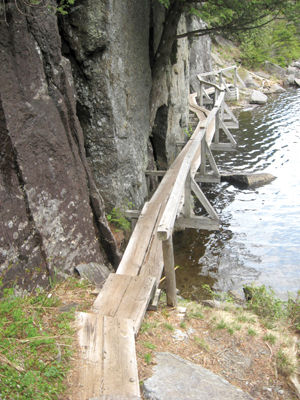
With much hemming and hawing we decided to turn back and summit Wright another day. The decision was a good one as we were burnt from our climb and this would give us time to hike into Avalanche Lake, a picturesque mountain lake situated between Algonquin and Colden Peaks. The trail to the lake was strewn with large boulders, and a number of ladders and catwalks along the face of the cliff have been built to make passage along the lake possible. The view of this lake and the cliffs rising hundreds of feet above are impressive and most likely one of the most extraordinary views in the northeast. With evening approaching, we returned to our campsite and made plans to climb Mount Marshall (4,360 feet) the following day.
The hike to Mt. Marshall followed a herd path route, which climbed steeply to the peak with no views. We lingered for a few moments at the summit and then made our way back to our campsite, packed up and hiked out to our waiting vehicles. This three-day excursion whetted our appetites for more climbing in the Adirondacks. So I returned two more times to hike Colden, Cliff, Redfield, Skylight, Marcy, Gray, Haystack, Jo, Nye and Street. I plan to return to the Adirondacks this summer to continue on my quest to become a"46er". I look forward to returning to the mountains that got me started in my hiking adventures more than fifty years ago.
If you are looking for remoteness and mountain splendor, try backpacking in the "Dacks". It's about a six hour drive from the Lakes Region to most of the trail heads. There are plenty of motels and restaurants in the Lake Placid, Saranac Lake area for your hedonistic desires. You may also choose to visit the Winter Olympic training sites in Lake Placid. Trail guides and maps are available from the Adirondack Mountain Club, online or contacting them at their Lake George headquarters, 518-668-4447 (8:30 a.m. to 5 p.m., Monday-Saturday) or send an email to info@adk.org. Mailing/physical address: 814 Goggins Rd., Lake George, NY 12845.
Gordon has hiked extensively in Northern New England and the Adirondacks of New York State. In 2011 he completed the Appalachian Trail (2,285 miles). He has also hiked the Long Trail in Vermont, The International AT in Quebec, Canada, Cohos Trail in northern New Hampshire and the John Muir Trail in California. Gordon has summited the New Hampshire Hundred Highest peaks, and the New England Hundred Highest in winter. He spends much of his time hiking locally and in the White Mountains with his dog Reuben and especially enjoys hiking in the Lakes Region due to the proximity to his home in New Hampton. He is also a trail maintainer for the BRATTS (Belknap Range Trail Tenders) and can be found often exploring the many hiking trails in the area. He can be reached at forestpd@metrocast.net
Boardwalk along cliffs of Avalanche Lake


(0) comments
Welcome to the discussion.
Log In
Keep it Clean. Please avoid obscene, vulgar, lewd, racist or sexually-oriented language.
PLEASE TURN OFF YOUR CAPS LOCK.
Don't Threaten. Threats of harming another person will not be tolerated.
Be Truthful. Don't knowingly lie about anyone or anything.
Be Nice. No racism, sexism or any sort of -ism that is degrading to another person.
Be Proactive. Use the 'Report' link on each comment to let us know of abusive posts.
Share with Us. We'd love to hear eyewitness accounts, the history behind an article.