




There are numerous animal disturbances easily tolerated in a New England village. A barking dog? Not a big deal. A black bear lumbering across the highway in the middle of town? Photo op!
But some animals can be a threat to country decorum — and even a sign to some people that mayhem and evil lurk in our midst. This is a story about an infestation of pigeons.
In the late 1970s, Gilmanton’s postmistress, Ginny Stanley, owned a barn on Currier Hill Road, and in the rafters there was a resident colony of pigeons. Roosting a half-mile from the center of town, on a large farm, these pigeons were not exactly beloved, but they were not a problem to anyone either. They were just part of the rustic landscape. But then in about 1980 Ginny tore the barn down.
Pigeons like to live in high places, where they can see predators and gaze down on their food source, so when they lost their barn home and needed another nearby residence, the birds chose the belfry of what is now the Gilmanton Community Church. Yes, the very structure where our town’s most pious citizens gather to worship their god. And right next to the majestic Gilmanton Academy, built in 1894. The birds were so unappreciated that when I interviewed Gilmanton historian J.R. Stockwell about them, he resorted, uncharacteristically, to delicate language. “As I remember,” J.R. said, “they were defecating on the church’s green shutters.”
Did the church elders form a guano committee? It’s likely.
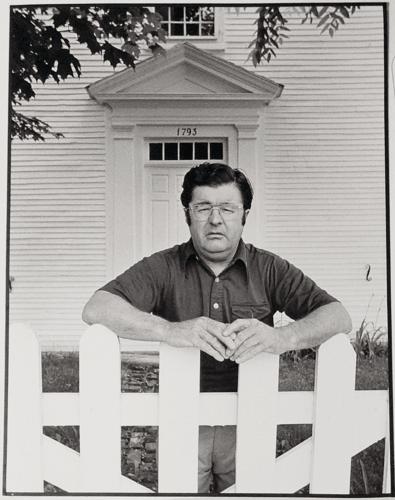
But the pigeons’ arrival caused the most uproar across the street from the church, where a retired Army pilot, John Collins, bought the Temperance Tavern, the vast white clapboard building that was until recently home to the Gilmanton Pub.
Collins lived from 1925 to 2008. He served in World War II and later flew missions over Vietnam. Working as a spotter pilot, he flew perilously low — at about 1,000 feet over the ground — as he scouted for enemy targets. He bought the Tavern in 1966 after it had stood vacant for decades. As he and wife, Lucille, fastidiously renovated it, he became a virulent defender of the town’s historic district code. In 1977, when the New Hampshire Times interviewed him, he called Gilmanton a “Colonial gem” and decried the telephone wires and street signs littering the Corners. He took umbrage at the garish presence of a metal phone booth outside the Corner Store, arguing, “I think you could design some kind of nice wooden booth to minimize impact.”
The New Hampshire Times story focused on one the fiercest conflicts in Gilmanton history. Collins was endeavoring to stop the proprietor of the Corner Store from installing a picture window — doing so was in violation of the historic district code. One Collins detractor, Gilmanton woodworker William Gray, said that, in the face of Collins’ defense of the code, he felt as though he was living in a “dictatorship.”
The pigeons gave new life to an old question that’s still relevant: Is Gilmanton a “Colonial gem” whose singular charm should be nurtured and curated? Or is it instead a raw rural town where all residents should just learn to live with backwoods hardships like dirt roads, nuisance birds and neighbors who store their ATV parts in the front yard?
I’m not going to take sides of this vexing issue, but I will come clean and say that my grandmother, Jane Cumming (1904-1998), was the grand dame of the “Colonial gem” crowd. She was the host of our town’s most lavish cocktail parties, and her still-popular 1994 book "Gilmanton Summers" is a fond remembrance of her early 20th century girlhood when, as she writes, “Every evening at dusk, old Mr. Valpey stood on a little ladder to light the lantern.”
Collins yearned to bring Gilmanton back to the Eden my grandmother evoked. He was intent on eradicating all local blemishes on Colonial charm, so when the pigeons began congregating (and crapping) on his lawn, he grabbed his shotgun. He aimed. He fired — and, well, Collins wasn’t much of a hunter. He never hit a single bird. But somehow a dead pigeon ended up on the lawn of my grandmother’s house, now my house, 200 yards up the hill from the Academy.
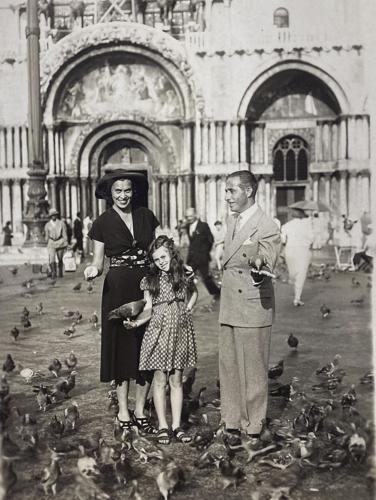
My grandmother was distraught that something so unkind as a shooting had transpired in our village — within the boundaries of the historic district, no less. To her, that square mile of turf was less a physical place than a romantic ideal. It was a golden zone where harmony always prevailed. And beyond that, she was an animal lover. A 1937 photo captures her communing with pigeons in Venice, Italy, along with her beau, Rinaldo Arese, and my mother.
For over four decades, the identity of the pigeon killer was uncertain. But then a few weeks ago, I received a confessional email. “What I really wanted to tell you,” my correspondent wrote, “is that I was the one who shot that pigeon.”
The killer requested anonymity. I will call them Robert Baxter. He lived here in town, but his home was far less impressive than Collins’, and while he was included on the cocktail circuit, he attended as a reluctant outsider, always dubious, he says, of the guests’ burbling chatter about “picking blueberries or some new book that everyone must read.” He was significantly younger than Collins, and more physically agile, and he knew his way around guns, having grown up in the country and shot pheasants and partridges.
Baxter lived near Collins, and one afternoon while the two men were outside, Baxter says, “John asked me if I had a gun.” Within minutes, Collins was raving about the pigeons, arguing that Baxter needed to kill them. “He really pressured me to do that,” Baxter says. “He kept giving me reasons to do it. ‘They shit everywhere,’ he said. ‘They’re ruining the church steeple with shit streaks.’”
Collins had a force about him. He’d been involved for decades in the serious business of killing people, so in his presence it was pretty easy to feel cowed. As Collins implored Baxter to grab his gun, Baxter thought to himself, “Shooting these pigeons doesn’t make any sense. Even if you kill dozens of them, they’re going to come back. This is their home.” But Collins kept after him that afternoon and eventually, Baxter says, “I just wanted to get it over with. Maybe it was a macho thing. I was proud of my gun. It was a 12 gauge over-and-under.”
Standing on Collins’ lawn, Baxter hit two birds right away, with two shots. “They were clearly hit,” he says, “but they kept flying.” They glided over the Academy and continued north.
Watching them, Baxter knew they would die, and he felt glum. “I didn’t feel terrible about shooting birds — I’d done that before — but I felt embarrassed. Shooting right here in town was against the law. It was against propriety. I never owned up to it.”
My grandmother had her ear to the ground, though. She had connections, and she had an inkling of who the killer was. It’s possible she even heard the fatal shots. But she was cut from a different cloth than John Collins. He was an absolutist who embraced strict rules and manly action. My grandmother was, in contrast, an enthusiast, a believer, and when she shaped the invite lists for her cocktail parties, a heedless optimism reigned. Basically, everyone she knew was in, no matter their age, their political inclinations or even, well, their criminal record.
After the killing, Baxter kept coming to my grandmother’s parties, and gradually the heinousness of his crime faded. My grandmother came around to liking him once again. The pigeons left town. The how and the when of that exodus was forgotten, and eventually the whole episode became a case study in how, in a small town — if we are gentle, if we have patience — every shakeup and outrage, whether tiny or large, can be absorbed. We can go on without turning the pigeons (or whatever or whoever is bedeviling us) into the enemy.
I’m friends with Baxter these days. I’m not going to reveal where he lives, except to say that it’s far from Gilmanton, in the countryside. He’s an old man now, and at night he sleeps well. Pigeons do not haunt his dreams.
•••
Bill Donahue has written for Outside, Harper's, The Atlantic and The Washington Post Magazine. He lives in Gilmanton, and his book, "Unbound: Unforgettable True Stories From The World of Endurance Sports," will be published by Rowman & Littlefield in June. This column is adapted from his online newsletter Up The Creek.


(0) comments
Welcome to the discussion.
Log In
Keep it Clean. Please avoid obscene, vulgar, lewd, racist or sexually-oriented language.
PLEASE TURN OFF YOUR CAPS LOCK.
Don't Threaten. Threats of harming another person will not be tolerated.
Be Truthful. Don't knowingly lie about anyone or anything.
Be Nice. No racism, sexism or any sort of -ism that is degrading to another person.
Be Proactive. Use the 'Report' link on each comment to let us know of abusive posts.
Share with Us. We'd love to hear eyewitness accounts, the history behind an article.