


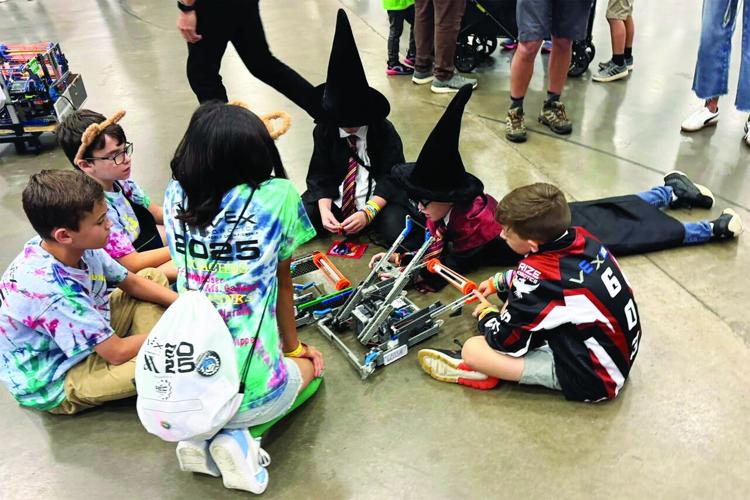

Elementary school students from Hill and Canterbury teamed up this year for robotics team building activities, becoming the first two public elementary schools in New Hampshire history to qualify for the VEX IQ World Championships, an international robotics event in Dallas, Texas.
“Two small elementary schools won the state title, which gave us an invitation to go to Dallas for the world competition, which was extraordinary,” said Hill Superintendent Brian Connelly.
The students from the Jennie D. Blake Elementary School in Hill and Canterbury Elementary School in the Shaker Regional School District qualified for the world championships by achieving the highest scores in the 2025 NH/VT VEX IQ State Championship in Manchester on March 9. There they competed with nearly 50 teams in the “Rapid Relay” challenge.
Caleb White, a sixth grader on Team 3243C — one of two teams qualifying from Hill — said, “It was really exciting to see the 43 points on the board, and know that we have the chance to go to Worlds.”
Team 3243C, alongside the Canterbury team (playfully named “Harry Botter and the Mechanical Stone”), earned the Teamwork Challenge Award to secure a “ticket” to the VEX IQ World Championship.
Hill students have been involved in robotics for almost a decade, but this was the first year for the Canterbury Elementary students to participate in the program.
Tim Slayton said his brother was involved in robotics at Belmont Middle School and, while watching a competition, one of the coaches gave him a kit.lo
“Then I made a robot,” he said, “and then they said, ‘Well, since you can make a robot, then you should probably be able to compete.’”
The Canterbury team came together midway through the season but, despite the late start, the team quickly solidified its skills and chemistry.
“Their collaborative spirit and fast learning curve helped them deliver a solid performance with Jennie D. Blake, and secure their place on the world stage,” Connelly said.
Hill has only 65 students and Canterbury 90, so their strong performance in Manchester surprised both the teams and the crowd.
The competitions involve creativity and problem-solving, and the students said meeting other teams from around the world was thrilling. They had to work with some students whose English language skills posed a challenge, but by referring to maps and diagrams of what they needed to accomplish, they were able to convey the information necessary to solve the challenge.
Students had to design, build and program robots based on specific engineering challenges to perform a task. Coding is part of the skills challenge, and the VEX website teaches computer coding so participants will have the skills needed to compete.
Many schools have used FIRST Robotics as a way to promote science, technology, engineering and mathematics, but VEX places more emphasis on critical thinking, collaboration, perseverance and project management. It also is a less expensive option.
The late David Kelly introduced VEX Robotics at Jennie D. Blake after retiring from Pembroke Academy, where he taught science for 33 years. His wife, Pam, who took over the program after David died from complications of ALS, said, as a recipient of a Christa McAuliffe Sabbatical, David promoted robotics to schools around the Granite State. He switched from FIRST Robotics to VEX, both because of the price and because VEX puts more emphasis on collaboration than competition. The students plan, design, build and document everything themselves, leaving the coaches to act as facilitators, not directors.
Jenn Flood and Jessie Bell also coached this year’s teams. Flood said, “The VEX program is such an amazing opportunity for young kids. It teaches them problem-solving, communication, teamwork and life skills that will stay with them for the rest of their lives. The amount of growth I’ve seen in these young students is inspiring.”
Canterbury Elementary Principal Erin Chubb is likewise proud of the students and the robotics program, and of the broad community support and grant funding that allowed the team to participate.
Connelly said Hill also relied on parents and the community to support its robotics program, and also received a $9,000 grant from the New Hampshire Department of Education that covered the lion’s share of the approximately $14,000 cost of the trip to Dallas.
The world championship event brought together competitors from more than 65 countries, and the opening ceremonies included a parade of domestic and international students carrying their nation’s colorful flags.
Students said upon their return that every match takes place on a field, with two robots working together to earn as many points as they can within 1 minute, giving each driver 30 seconds to score by sending a ball through a set of circles.
Belmont Coach Matt Friend said, “These kids now know what it feels like to set a goal, work hard, and see it through — and to know their community and their state are behind them.”
Dan Hughes, director of Technology and Training at the World Academy and coach of the VEX-RAYS, said New Hampshire teams “shine at VEX world championships for all the right reasons. What robots can do is amazing, and in the hands of dedicated, hard-working students, they are able to master the most challenging of tasks.
“While points are important, and trophies are great, there are coaches in the NH region who focus on the real successes behind robotics. What are these, you may ask? Great question! [They] see robotics as a way to teach critical skills that transcend the game field. It is their goal to teach the kids how to design and engineer solutions, but also how to be open-minded to new ideas and new ways of thinking. How to be respectful when they compete and cheer on others’ success while trying to do the best they can.
“This year, New Hampshire sent three first-year teams to the VEX IQ World championships and, while the point scores weren’t where we hoped they would be, the learning was off the chart. The kids focused more on doing the best they could in each match than where they landed on the scoreboard.
“Our kids used this opportunity to learn what the best teams in the world do to prepare each season. They will take these ideas back and try to be better next year.”


(0) comments
Welcome to the discussion.
Log In
Keep it Clean. Please avoid obscene, vulgar, lewd, racist or sexually-oriented language.
PLEASE TURN OFF YOUR CAPS LOCK.
Don't Threaten. Threats of harming another person will not be tolerated.
Be Truthful. Don't knowingly lie about anyone or anything.
Be Nice. No racism, sexism or any sort of -ism that is degrading to another person.
Be Proactive. Use the 'Report' link on each comment to let us know of abusive posts.
Share with Us. We'd love to hear eyewitness accounts, the history behind an article.