


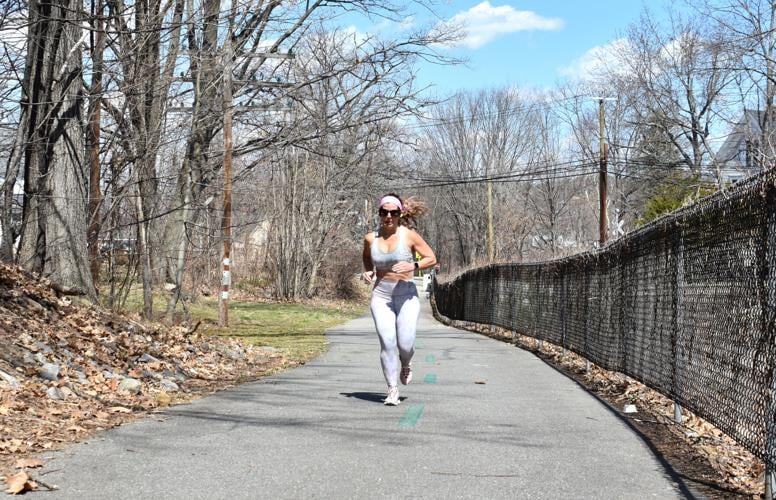
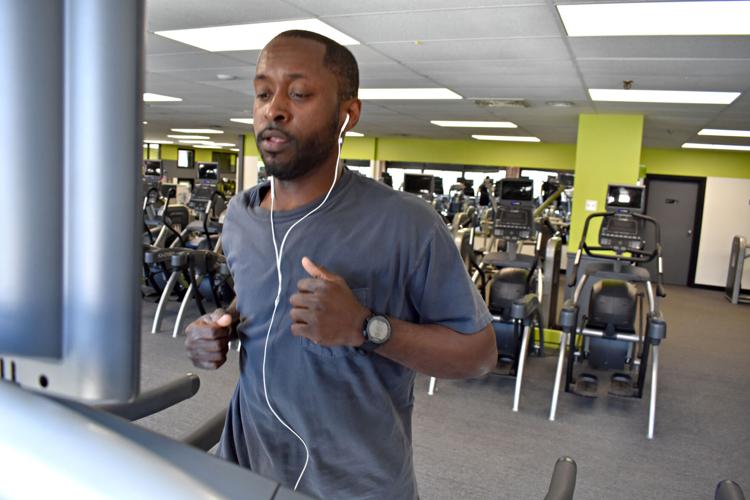
LACONIA — It's funny how things learned years ago can come back when least expected. That's one thing that has struck Antonio Coates, one of the two members of The Daily Sun's Timberman Rookies — first-time triathletes training to compete in the local IRONMAN 70.3 race in September.
Coates knows how to run and ride a bike, but he's started to learn proper swimming form, which he'll need to employ for 1.2 miles as the first leg of the event.
"The technical learning of it all is wild," Coates said. Every motion of the body needs to be considered in order for efficient movement through the water. Triathlon coach Colin Cook, with Peak Triathlon Coaching, has been helping him learn when, and how, to take breaths, so that the change in buoyancy doesn't disrupt his form.
"It's just like in a sub, when you take on air, you float," Coates said, relating the lesson to his days in the U.S. Navy.
For Melissa Aupperle, the other rookie, learning to maintain her composure is a first step in keeping her swimming form consistent. Cook has taught her to hum while her face is in the water to prevent water from entering her mouth, which induces a feeling of panic for her.
Aupperle has encountered another challenge in measuring her exertion. It's not how fast she swims, bikes or runs that matters, really, it's how long she can keep doing it. Her mantra, she said, is, "Slow pace, slow pace, especially in running."
Aupperle and Coates represent the inaugural Laconia Daily Sun Rookie Class. This is the first year the newspaper has partnered with IRONMAN and several other local businesses in order to give two Lakes Region residents the chance to put themselves to a test. If MC Cycle gave them access to a bike, if Fit Focus and The Wellness Complex gave them memberships to a gym and a pool, if Bootlegger's gave them shoes, and if IRONMAN covered the cost of registration, could two regular people get themselves across the finish line of a 70.3-mile, three-sport race?
Cook, representing another business partnering with the Rookie program, thinks Coates and Aupperle have a good chance to succeed.
"I am very impressed with our rookies so far. They both encompass a strong mindset, which will help them throughout their training immensely," said Cook, whose coaching company helps clients both near and far, from beginners to elite triathletes. Aupperle and Coates have some ground to cover, both in terms of technique and general fitness, but he said he has already seen improvement and he is "very confident" they will go the distance.
One of the reasons Cook has this perspective is because of the way Coates and Aupperle think about their own potential. The biggest mistake people make when considering a triathlon, he said, is counting themselves out before they begin to try.
"A lot of people say to themselves, 'I could never do that,' when they hear about someone doing a triathlon or they say, 'I'd love to, but I'd never be able to do the swim.' While there is no doubt triathlons are hard and they take a lot of dedication, I strongly disagree with most people who hold this mindset. They're allowing their minds to limit them," Cook said, and that is one reason why pursuits such as an IRONMAN triathlon can be life-changing journeys, he added. "They figure out that they are capable of far more than they thought they were prior to their training. This can end up going far beyond physical capabilities and achievements as well."
New triathletes will have a lot of gear to consider, and one item Cook strongly recommends putting on the list is a multisport watch, which can help track and measure training. It's important to train at an appropriate level to advance performance, but not so much as to invite injury, he said. They can also be used to share data with a coach, or to garner support on social media.
As part of his intake routine for new athletes, Cook asks a lot of questions. Some of those are expected, such as athletic history or current training, but some are surprising. Cook wants to know how they feel at home, and how often they engage in activities such as massages.
"There should always be more to life than just triathlon," Cook said. As a coach, he wants to see the "complete picture of the athlete," including sources of stress, whether that's from over-training, or family or work. He also wants to know how committed his athletes are to recovery as well as training.
It's easy for people to be intimidated by triathlons, whether it's the swimming in particular, the training needed, or the overall distance. But, he said, a triathlon is just one big thing that can be broken down into lots of different components. Learn proper technique, practice that technique, build a nutrition and training plan, then just follow that plan.
"It's very important to remember that you're doing a triathlon in training every day. The vast majority of the workouts done in preparation for the race will be much shorter and it's the accumulation of those workouts that builds the fitness needed to complete their goal triathlon," Cook said. "As a result, remembering to take it one day at a time throughout the training journey is essential."


(0) comments
Welcome to the discussion.
Log In
Keep it Clean. Please avoid obscene, vulgar, lewd, racist or sexually-oriented language.
PLEASE TURN OFF YOUR CAPS LOCK.
Don't Threaten. Threats of harming another person will not be tolerated.
Be Truthful. Don't knowingly lie about anyone or anything.
Be Nice. No racism, sexism or any sort of -ism that is degrading to another person.
Be Proactive. Use the 'Report' link on each comment to let us know of abusive posts.
Share with Us. We'd love to hear eyewitness accounts, the history behind an article.