


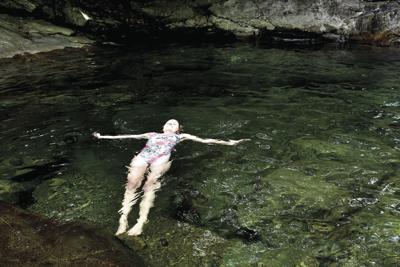
LAKE WINNIPESAUKEE — As anyone who has spent time near a boat ramp recently probably knows, the Lakes Region has become a popular refuge for people looking to escape the stresses of life. For people who care about the lakes, that added traffic brings increased concern – will increased human activity mean degradation of the natural resource?
Jim Raimondi is one of those with concerns. He’s been worried since last September, when he took his granddaughter to their usual snorkeling spot near Stonedam Island in Meredith.
“I go to this area all the time. I’ve been going there for years,” Raimondi said, adding that they had been there the week prior. “We dropped (anchor) there, and my granddaughter said, ‘what’s all the shiny things down there?’”
The shiny things turned out to be beer cans, and a lot of them.
“We put our masks on and went in, and they were everywhere,” Raimondi said. He and his 8-year-old granddaughter started diving down to the bottom and retrieving them, using an inflated water chair to ferry their collection back to their boat. They removed 77 cans from the bottom, each one of which had a hole ripped in its side, as if to ensure that they’d sink.
“There were more, but they were too deep, I couldn’t get all of them,” Raimondi said. “I’ve never, in all my years, seen more than one or two beer cans together in the water. It really bothered me.”
30% increase
It’s clear to Andrea LaMoreaux, president of the NH Lakes Association, that activity is significantly increased on the state’s water bodies. The association, among other things, operates the Lake Host Program, which is aimed at preventing the spread of invasive plant and animal species by educating boaters as they arrive at boat ramps.
“We have lake hosts at about one hundred of the busiest boat ramps in the state. We saw, last year, an increase overall of 30% of boats being launched,” she said, as compared to 2019. She said that increase presents a threat and an opportunity. Each time a boat is moved from one water body to another, there’s a chance it could be carrying an invasive plant or animal into an uninfested habitat. However, also thanks to that increase, Lake Host volunteers were able to make contact with a total of 130,000 boaters last year, to ensure that they were informed of how to clean, drain and dry their boats to prevent the transfer of species such as variable milfoil or Chinese mystery snail.
The Lake Hosts can stop problems before boats are launched, but they can’t control what happens once the boaters motor away from shore.
“We would hope that people maintain their boats properly and not litter, but unfortunately that comes with the territory,” LaMoreaux said. “With more boats, you have more leaky boats and more trash.”
There’s another concern that many boaters might not consider – boat wakes. The waves caused by a boat as its hull pushes through the water can disturb the lake bottom and cause erosion on the shoreline. In fact, that’s one reason why boaters are limited to headway speed – as slow as possible while still maintaining control – in many lake areas, including within 150 feet of the shore.
“Hopefully folks that are boaters out there understand the rules of the road when it comes to staying offshore and headway speed and all of that,” LaMoreaux said.
A jewel in NH’s crown
Clean, clear water is one of things that continue to attract people to visit and reside in the state.
“New Hampshire has really excellent water quality. Across the board, our water quality is better than most of the other states in the country, and our lakes have particularly good quality,” said Ted Diers, administrator of the Watershed Management Bureau, part of the state’s Department of Environmental Services. “The reason why so many people are here is because we have such a beautiful resource for people to enjoy.”
While things like beer cans can detract from human enjoyment of the environment, Diers said it’s management of things not visible to the naked eye that have resulted in better quality water.
“When you really look at what’s affecting our lakes, it’s not the people hanging out on the water, it’s the activity on the land around the lakes,” Diers said. Are there native woodlands and shrubs on the shoreline, or are there lawns kept green with fertilizers? Are dirt roads near the shore eroding into the streams that flow into the lakes? Are boaters misusing access points by opening their throttles near the shore? Are nearby septic systems being properly maintained?
“The biggest thing from the lake perspective is just controlling phosphorus. The more development there is around a lake, the harder it is to control phosphorus, and the more people have to work at it,” Diers said. “This is not that sexy, but it’s what really drives lake water quality.”
Water as therapy
LaMoreau said Lake Hosts tend to make a common observance: Boaters preparing to launch for the day are tense and stressed, and when they return after hours on the water, “they’re a totally different person.”
Dr. Wallace J. Nichols, a marine biologist, has devoted his career to studying the therapeutic effects that humans experience when spending time in, on or near water. He calls the effect “Blue Mind.” He has written a book and gives talks about his findings, and he said it’s not surprising that Lake Winnipesaukee, and other lakes in the region, attract people stressed out by the pandemic.
“There are lots of people in need of Blue Mind,” Nichols said. He added that his findings, backed by neuroscientific research he cites in his book, titled “Blue Mind,” could be useful in promoting broader environmental conservation.
“We need to tell a better story about lakes, rivers, our waters, so that people better understand their value,” Nichols said. Not everyone is motivated purely by appreciation of the environment, but some can be moved to protect a therapeutic resource.
“When we get the value of a lake right, then it can be regenerative for both us and the lake,” Nichols said. “Help us take care of the lakes so the next doctor, nurse, therapist, police officer, or just frazzled, burned-out mom or dad can use it, or the person struggling with depression and anxiety… That’s a different way to ask people to take care of the natural world. The environmental movement has depended on guilt and fear. There’s a higher road to take. We’ve been leaving this out of the story, the science that has accumulated over the years has shown that spending time on and in the water is really good for our mental health.”
People who live near water tend to understand that instinctively, and are often the first to act when their local waters need help. The worse actors tend to be people who are visiting from afar.
Nichols, who lives in California, sees this happen around this time of year in his own neighborhood. His local beach is kept clean by the residents of the neighborhood, but on the Fourth of July, crowds arrive for the holiday and leave heaps of things behind.
“It looks like a Costco exploded on the beach,” Nichols said, and the local residents shake their heads and get to work. “That’s not the best way to do it. So, one year, we assigned volunteers to the trailheads that lead to the beach.” The volunteers greeted the visitors, welcomed them to the beach, thanked them in advance for taking out their trash and maybe a little more, and gifted them with a blue marble and, if they needed one, a trash bag.
“That year, the cleanup from that weekend was significantly better than years prior,” Nichols said. It’s easy to get angry when someone treats a resource carelessly, he said, but a little preventative outreach works.
“There’s a preemptive piece. Anybody who cares, have a plan for July 3rd and the first half of the 4th, so people coming to the lake get the memo, and understand that part of the responsibility of being on the lake is to leave it better than they found it, so the nurses that have been working their butts off can go to the lake and renew.”
Even if people don’t have compassion for wildlife, they likely do for their fellow humans, Nichols said. That compassion will make them see the lake differently. As not just important for the environment, but as a resource to protect the health of their community.
“If you see a shiny thing on the bottom, dive down there and get it,” Nichols said. “Don’t add one to the mess.”


(0) comments
Welcome to the discussion.
Log In
Keep it Clean. Please avoid obscene, vulgar, lewd, racist or sexually-oriented language.
PLEASE TURN OFF YOUR CAPS LOCK.
Don't Threaten. Threats of harming another person will not be tolerated.
Be Truthful. Don't knowingly lie about anyone or anything.
Be Nice. No racism, sexism or any sort of -ism that is degrading to another person.
Be Proactive. Use the 'Report' link on each comment to let us know of abusive posts.
Share with Us. We'd love to hear eyewitness accounts, the history behind an article.