


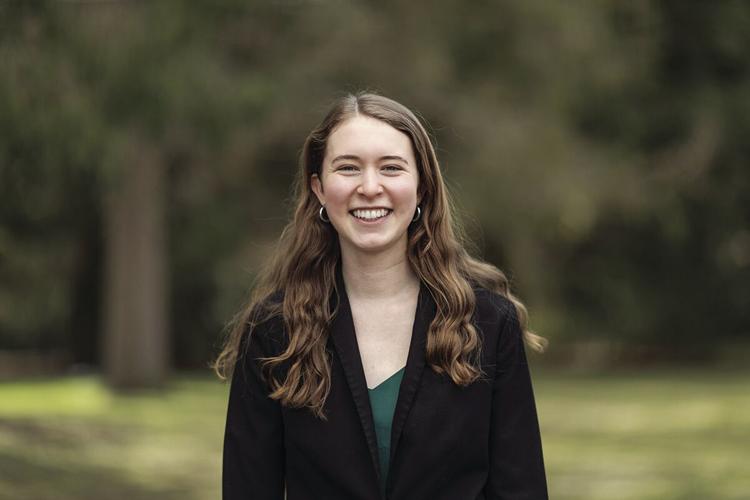

Beatrice Burack, a junior at Dartmouth College, has been writing articles seen by readers across the state. After interning with the New Hampshire Bulletin, Burack wrote a five-part series about skiing in New Hampshire, from how it was once the capital of alpine skiing in North America to the present state of skiing in low-snow winters as well as a peek into what the future might bring.
This article has been edited lightly for length and clarity.
Adam Drapcho: Could you tell us when, how and why you became interested in journalism?
Beatrice Burack: I guess it was last year, my sophomore year of college. I was trying to figure out what I wanted to do for my spring off-term, because Dartmouth has a unique schedule where we take a term off — a term that's not the summer term. And we're told to go out and do something. I really wanted to learn more about how state politics worked and how the Statehouse worked and more about state policy. That sort of led me into looking at the New Hampshire Bulletin, and it seems like a really wonderful organization. I know that it's so important right now for local news outlets to be continuing that work of getting out important information about what's going on in our local political world. So I ended up emailing them and just sending them my resume saying that I have zero experience in this, but I'm really interested in the work that you do. I was able to get an internship, which was just a really incredible experience. So that was basically how it all started. While working there, it was a very hands-on internship. I got to publish articles and work alongside really incredible journalists and learn from them as I went. So when I left there, I ended up being able to do some freelance work in the area. That's sort of how I got started.
Adam Drapcho: Tell me about idea for the series. How did it come about? And when did you realize that you had tapped into a five-parter?
Beatrice Burack: It was going to be sort of a historical research project. I'm a history major at Dartmouth, so that's sort of how my brain usually takes a new project: Can I look at the history of this and see how it came about? I started planning this project and talking to some professors about working on it and trying to get some funding. That was around the time that I was finishing up my internship at the Bulletin, and I started to get some opportunities to do freelance writing. I just realized that's how I should be doing this — this should become a freelance journalism project. I knew that it was more than just a single article, because I had already been thinking about it sort of in terms of an exhibit, like a historical document exhibit that was going to go up at the library, and that's what ended up happening, and it's up now at Dartmouth library. I was thinking about it in sort of six parts, because there are six cases in the exhibit section of the library. So I already had it sort of blocked out that way in my mind. So that naturally flowed into five articles, and then sort of an opening case to the exhibit.
Julie Hirshan Hart: One thing that made your series particularly interesting was that you found people for whom skiing isn't just an economic activity. People like Tim Morrill, who's part of the third generation of his family to help run Veterans Ski Area in Franklin, or Ed Warren, a recorder holder for the fastest time hiking up and skiing down Mount Washington. What's at stake here in terms of culture and identity?
Beatrice Burack: Those were two really, really interesting people to talk to. Because, as you said, skiing is such a big part of their lives. It's such a big part also of why they live in New Hampshire. That was really interesting for me to think about. Because as we move into an era of warmer winters in New Hampshire, I think that becomes an open question of are people who are really interested in skiing going to choose to live here, or they're going to chose to live somewhere out west, or maybe further north in Vermont, where there's more consistent snow cover. I think that a lot of the people that I've talked to said that that's starting to become a factor, but most of them said, “I've been here in New Hampshire for so long.” For instance, Tim Morrill’s family grew up here. So there is somewhat a sense of, let's keep this going. Things aren't the same as they used to be, but we really value what New Hampshire does have to offer in terms of skiing. There is also that sense, if you talk to skiers in New England more broadly, but I think especially New Hampshire — it’s definitely you have to be a little bit willing to brave difficult, difficult weather and poor snow conditions. That's always been the case in New Hampshire. I mean, things have not always been prime for skiing, but there is a sense of being ready and willing to get out there and go no matter what the conditions are. So I think that also keeps people going here and keeps people a little bit more resilient, despite warming winters.
Adam Drapcho: If there were to be a difficult winter, particularly one that had low snow with perhaps some other combining factor that would put additional pressure on the industry, it wouldn't be the larger well-funded ski areas, it would be the smaller ones that really take it the hardest — the community ones. What would be the danger to the industry if those smaller places were to go away?
Beatrice Burack: You're absolutely right, Adam. Those are the areas that seem primed to be the most at risk. We have seen some small areas close down in the last couple years just because they're not able to open without snowmaking, and it's really expensive for them to have snowmaking. Veterans Memorial was able to open for a very short period of time this winter. They have snow guns but even having that, there's so much cost that goes into the energy to run those and the water costs. So it really is those areas that are struggling the most, and going forward, there's funding that they can get. There's support that they can get locally. We've seen some of those places, like Veterans Memorial, getting government funding to be able to to keep running and especially to put up snowmaking, but I think that it's a really tough spot for them to be in because in order to ski you need snow and to get snow in this climate, you're starting to need a heck of a lot of money.
Adam Drapcho: What have you learned about journalism through this reporting project? Is there anything that you think you'd do differently if you could go back and do it again?
Beatrice Burack: I think that the main thing that I learned was just the art of reaching out to someone that you have never met, have pretty much no connection with, and convincing them that it would be worth their while to to take a couple of minutes or an hour or so to tell a little bit about their life. I think that that's such a powerful part of journalism.
I think that the more that I do that, the better that I get at making those connections and really having the kind of in-depth conversation with someone that gets to the core of why they really care about an issue or what's really hurting them right now. So that was, I think, the biggest takeaway that I had.
In terms of what I would do differently, it was very tough to balance this project with a lot else that I'm doing. I mean, obviously, I'm a full-time student — I was actually out of the country in the fall on a study abroad program — so it was a lot of sort of balancing, scheduling interviews from afar. A lot of when I was able to get out and go to mountains was really when I had time before break. Of course, this was a very wonky winter. Right now I'm looking out the window and a ton of snow that just showed up here at our doorstep, of course, after I'd already published this piece. There were a lot of really tough, low-snow weeks toward the end of the winter, or what we thought was the end of the winter anyway.
So I think that if I were to do this again, I would just have more time throughout the winter to be able to get out there instead of just a couple of truncated weeks of reporting. But those weeks, that being said, were really interesting because that was when we got a ton of flooding in the state. I was able to go out and see how that was affecting ski areas.
Julie Hirshan Hart: What do you think is next for you in terms of journalism? Is this where you're going to turn back and focus on history, or do you see journalism being a part of your career?
Beatrice Burack: To be totally honest, I'm trying to figure that all out. I'm a junior in college, that feels like the time where you try to take a step back and figure out what it is that you want to be doing for the foreseeable future, as much as you can predict that in college.
Right now, I'm definitely taking a step back from journalism to focus on my classes this term. I'm also getting ready to write a history thesis. so that's all something that's probably going to take up a lot of my time going forward. But I know that no matter what I do, the skills that I've been able to practice as a journalist have just been immeasurably helpful to me. I talked about the interviewing piece — I think that's so important to just have the skills to be able to have a conversation with someone and learn more about their life, even when you might not have a whole lot in common with them. Also, just writing — being able to meet deadlines and sort of writing on command and writing in a way that people can understand what you're trying to get across — I think is so important. So to answer your question, I'm still trying to figure it out. But I know that no matter what, all the work that I've done in journalism will absolutely inform what I do next.
Julie Hirshan Hart: What advice would you give someone, perhaps a fellow student who's interested in journalism, but doesn't know where to start?
Beatrice Burack: I think if you can get an internship with a newspaper, or even just a journalist or freelance journalist who you can shadow, that is just so helpful. When I came into this field, I didn't know a lot about journalism. I knew that I read journalism all the time, and it totally informs how I view the world, but I didn't really know the behind the scenes pieces of how it all works. That's why interning at the Bulletin was just so wonderful. Ethan DeWitt, Annemarie Timmins and Hadley Barndollar are just such great reporters. It was so cool to be able to follow along in their day and see how their brains work and see how they come up with a story and think about it. If you can get an opportunity like that, you should go for it. I think the Bulletin is still offering internships, so definitely look on their website and look into that if you can.
•••
This article is from The Granite Beat, a project of The Laconia Daily Sun and the Granite State News Collaborative, of which The Sun is a partner. Each episode Adam Drapcho and Julie Hirshan Hart will explore with local reporters how they got some of the most impactful stories in our state and why they matter. This project is being shared with partners in The Granite State News Collaborative. For more information, visit collaborativenh.org


(0) comments
Welcome to the discussion.
Log In
Keep it Clean. Please avoid obscene, vulgar, lewd, racist or sexually-oriented language.
PLEASE TURN OFF YOUR CAPS LOCK.
Don't Threaten. Threats of harming another person will not be tolerated.
Be Truthful. Don't knowingly lie about anyone or anything.
Be Nice. No racism, sexism or any sort of -ism that is degrading to another person.
Be Proactive. Use the 'Report' link on each comment to let us know of abusive posts.
Share with Us. We'd love to hear eyewitness accounts, the history behind an article.