


LACONIA — For professional photographer Ian Raymond, the rescue of his vintage 1915 camera came in the form of Thomas Dalton, a Belmont cabinetmaker who specializes in nothing in particular and whatever comes his way.
His mission: Repair the unexpected — and surmount challenges that get in the way.
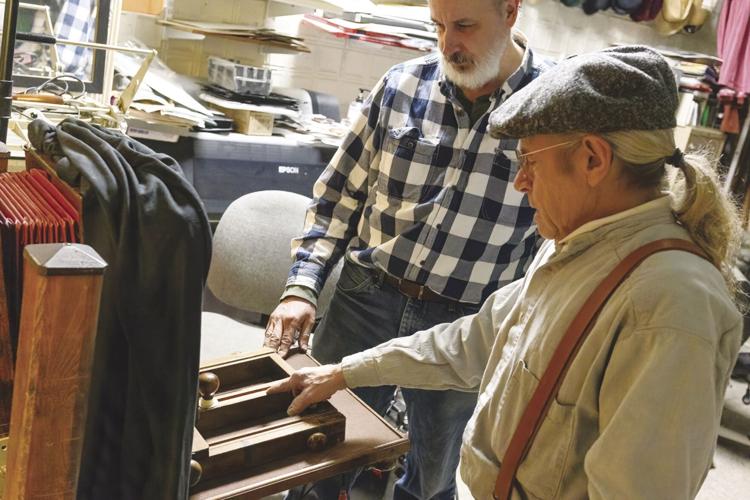
When the height adjustment mechanism — a wooden track with a wooden knob on the platform that supports Raymond’s camera — failed after more than 100 years, Raymond lost the ability to aim it or take pictures without wobbling. It was a highly unusual problem, and a pernicious one for any photographer.
Then Raymond discovered Dalton on Facebook through their mutual friendship with photographer Alan MacRae, who lives in Belmont.
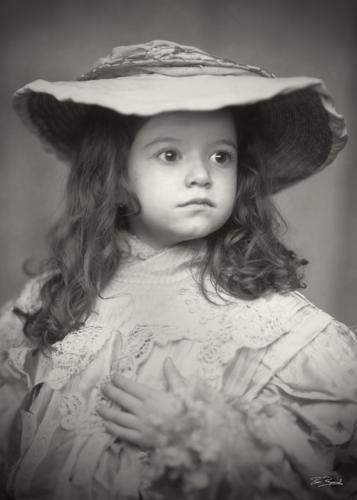
It was a match that only serendipity could arrange. Dalton and Raymond share a zeal for solving puzzles and an artist’s attention to detail. Now Raymond’s Century Studio camera, a flashback to yesteryear that captures faces and emotions in soft focus, is soldiering on as the equipment Raymond is using to create a show of portraits at the Belknap Mill in October.
“You have no idea how much easier my life is with that fixed. It doesn’t creep. It stays put,” said Raymond.
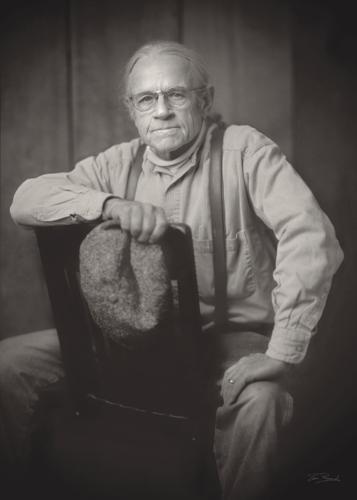
One of the photos in the exhibit will be of Dalton, 70, a craftsman also honed by experience.
“I like being part of a bigger story. I was born and raised here,” said Dalton. “This camera belonged to a family in Laconia” — specifically to Sam Achber, who opened a photography studio on Canal Street in 1927. The Century View portrait camera that Dalton repaired was also used by Chet Brickett, Raymond’s partner, a World War II veteran who passed away in 2001.
Brickett, a locally renowned photographer, was a nationally known activist during the Vietnam War. “It’s good to meet people who have a history you can identify with,” said Dalton.
On Tuesday, Raymond’s Main Street studio — itself a walk back in time, with original tin walls and ceilings — became setting for a real-time photo shoot.
It was also a visual feast.
One wall features black and white, sepia and color portraits of family members and area residents made with cameras from different eras. Shelves hold props for snapping pictures of restless children who’d rather do anything but sit still. There’s a Raggedy Ann doll, small toys and a stuffed Husky dog for wigglers to hold, plus a velveteen settee and a Victorian chair in miniature for youngsters to pose in.
The lineup of cameras, each with a particular purpose and effect from a different period, forms an unorthodox museum of image-capturing technology spanning 11 decades. Raymond’s personal collection contains 30 to 40, including the oldest — a Kodak from around 1900 that uses dry glass plates instead of film — and current digital models linked to computers with visual enhancement software.
An R.R. Roberston camera from the 1920s, used to make printing plates, consists of a four-foot bellows sandwiched between wooden ends that hold the lens and the film. It resembles a section of duct work.
When local photographer Harold Achber passed away in 2004, the 1915 Century Studio camera went into storage. Raymond had used it the 1980s, and he asked the family if he could borrow it. The inside was covered with mold. Restoration amounted to cleaning with disinfectant. “The workmanship in these is great,” he said. “The cabinetry work is superior.”
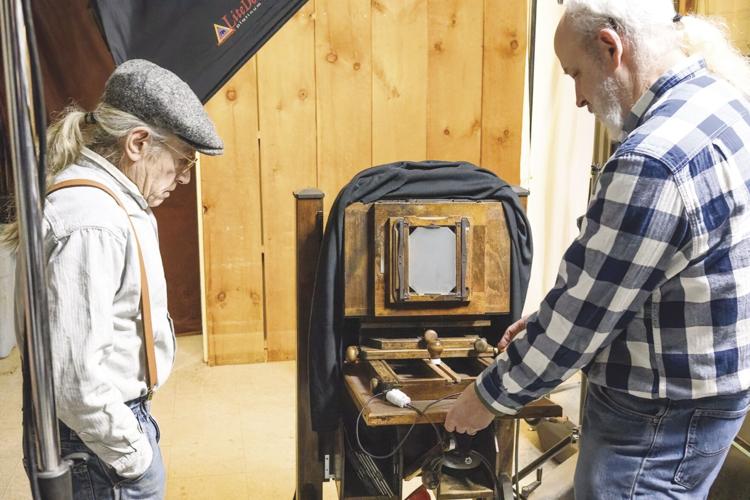
The camera, mostly wood except for an accordion-like bellows and glass lenses and film plates, is attached to a table with knobs, compartments and a tripod — almost everything made of wood and glistening like a museum piece — including the old-fashioned rubber bulb Raymond squeezed on Tuesday to take Dalton’s picture — partly as a thank-you, but also for his photography show.
Dalton wore work boots and pants with suspenders, and a wool cap jauntily positioned in reverse. His silver ponytail dangled in back. “You probably don’t want me to blink when you pull the trigger,” he said.
Feet from his face, an enormous “soft box” light fixture on a swiveling pole helped to blur the lines between light and shadow. Raymond craned forward like a movie cameraman as he adjusted the camera angle by turning the crank on a wooden table. It was an odd contrast to the computer screens staring blankly behind him.
To Dalton and Raymond, their collaboration is proof that this is a small world with endless possibilities — even in Laconia.
The sign outside Dalton’s shop on Middle Road off Route 107 in Belmont reads “By Chance or Appointment 524-8628.” Another proclaims, “Saving Houses and Marriages since 1976.”
“The only thing I don’t do is turnings” — which include spindles and chair legs made on lathes, he said. “I started out building houses. It’s allowed me to make repairs for most of my career.”
In that time Dalton has fixed tall clocks and pianos and fabricated island camps and kitchens for cooks —“not filling a space but a need,” he said. “I find enjoyment in the mundane, including glazing windows.”
“Now look right at the lens,” Raymond said. “Now hold your hat, with your hand on the chair. And don’t move. From this point I’ll process the paper negatives,” said Raymond, standing and smiling. “Then I’ll scan them and make a digital print.”


(0) comments
Welcome to the discussion.
Log In
Keep it Clean. Please avoid obscene, vulgar, lewd, racist or sexually-oriented language.
PLEASE TURN OFF YOUR CAPS LOCK.
Don't Threaten. Threats of harming another person will not be tolerated.
Be Truthful. Don't knowingly lie about anyone or anything.
Be Nice. No racism, sexism or any sort of -ism that is degrading to another person.
Be Proactive. Use the 'Report' link on each comment to let us know of abusive posts.
Share with Us. We'd love to hear eyewitness accounts, the history behind an article.