


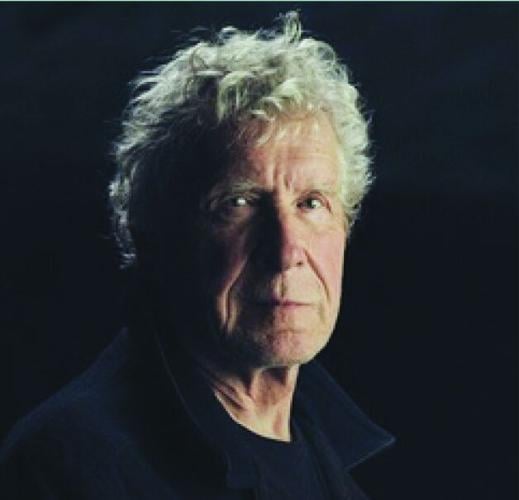
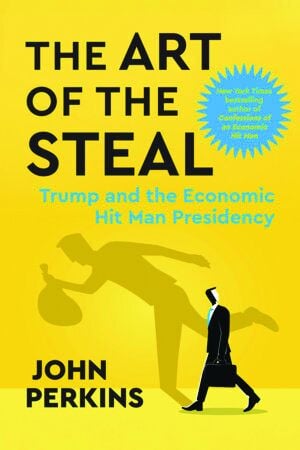

John Perkins, a Tilton native and author best known for his book “Confessions of an Economic Hitman,” is back with a sequel — “The Art of the Steal” — on Sept. 8.
Perkins grew up in Tilton, in the 1950s, when it was a town struggling as most of its local mills went under. Up until the eighth grade, he attended public school with students whose parents were mill workers, or farmers. Very early on, Perkins was aware of the large gap in wealth between the “townies” and the “preppies,” after he transitioned to Tilton School for high school, an all-boys boarding and day school at the time.
Perkins lived “up on the hill” on campus, as his father was a teacher at the school, and money was scarce. Tilton School provided Perkins and his family with housing and food. From the time he was 4 years old, Perkins recalls eating in the dining hall, surrounded by 200 boys.
At the prep school, Perkins said he had nothing to do but excel. He threw himself into sports, the school newspaper, and even won a short-story prize.
“I loved writing, and I had an English teacher and a history teacher who I just adored. And they shaped my life, between the two of them,” Perkins said. “They really taught me that the pen is mightier than the sword. If you want to change history, write about it.”
Funny enough, as Perkins was giving a speech, in New York City, for his first book, his Tilton School history teacher, Jack Woodbury, and his daughter, Sarah, were in the audience. He gushed about the tremendous impact teachers can have on their students.
Perkins’ first edition of “Confessions of an Economic Hitman” was published in 2004, recounting his work for the Boston engineering firm, Chas. T. Main, as a chief economist, or “economic hitman,” as he coined it. Throughout the book, Perkins describes being charged to persuade developing countries to borrow large sums of money to pay for debatable infrastructure investments.
As an economist, Perkins advised and worked directly with heads of major companies such as the World Bank, the United Nations and IMF, Fortune 500 corporations, the U.S. Treasury, and countries across Africa, Latin America, Asia, and the Middle East. The experiences detailed in “Confessions of an Economic Hitman” were expanded in the 2016 edition, “New Confessions of an Economic Hitman,” with 15 new chapters, and “Confessions of an Economic Hitman, 3rd Edition,” expanded focus to China, international corruption, and ways to challenge the system.
Despite the success of this part exposé, part memoir, it was almost never written. Initially, Perkins wanted to include his story along with others with similar experiences in an exposé on Chas. T. Main. After making a few phone calls, Perkins began receiving threats.
“I immediately got life-threatening, anonymous phone calls, strange muffled voices threatening my life and that of my infant daughter,” Perkins said. “And I'd been in that business for 10 years, and I took these calls seriously, because I'd seen these guys do what they did.”
Knowing his background, the president of Stone and Webster Engineering Company, of Boston, asked Perkins to dinner. Perkins said the president wanted to hire him for his name recognition, not an uncommon practice for consulting firms. “I'm prepared to write you a check tomorrow morning for half a million dollars, $500,000. Just don't write that book. We can't have you writing that book and working for us,” the president said, according to Perkins.
Perkins said this was a moment he was “getting what he dished out” to others. He took the money and donated it to causes in the Amazon rainforest, where he worked in the Peace Corps, from 1968 to 1970. He wrote five books, on topics from indigenous people and shamanism, to the need to protect the environment.
When the terrorist attacks on 9/11 happened, Perkins was in the Amazon. When he returned to New York, he went to see Ground Zero. “I stood there looking at that pit, and I knew I had to write this book. I had to expose what I knew about that business.”
“The Art of the Steal: Trump and the Economic Hitman Presidency,” Perkins said, serves as a blueprint and a warning about economic hitman strategies seeping into American life. Although U.S. presidents have used these strategies before, Donald Trump is the first to “turn economic hit man strategies into a personal brand and governing style.”
Although Perkins’ first book stayed on the New York Times bestseller list for over 70 weeks, many called him a conspiracy theorist. That did not deter him from continuing to write.
“The Art of the Steal” describes, in great detail, the four strategies economic hit men use to gain and keep control in what Perkins calls “the playbook”:
- Fear: Economic hit men use fear as leverage to get third-world countries’ leaders to sign deals exploiting them to this system
- Debt: “A person in debt is a person controlled”
- Anxiety over insufficiency: Economic hit men convince nations they lack enough, and offer to “rescue them”
- Divide and conquer: When a population is united, it asks questions and organizes resistance; when a population is divided, it creates dependency
The idea for the book came in winter 2025, when Perkins was standing on a street corner for a “No Kings” protest.
“I'm thinking to myself, 'I'm concerned about where this country is going, but I don't think coming here every day, or every week, and holding a placard is going to accomplish much in this small community where I live. So, what can I do?'” Perkins said. “And it suddenly occurred to me that Trump's an economic hitman and a jackal, and that's my brand.”
Perkins went home and wrote the first four chapters of “The Art of the Steal” in two days.
“I knew that the problem is Trump, but it's also the system. It's the system that’s been going on. Every president in my lifetime has used economic hitman strategies. Trump is the first to really bring us out into the open, and be one himself,” Perkins said. “But I think he's given us a gift, because he's woken us up.”
After finishing the first chapters, Perkins was hesitant to pitch the book to his publisher, fearing it was “too radical” for Berrett-Koehler. His long-term partner, Kiman Lucas, an attorney, pushed him to at least think about pitching the idea.
Two hours later, Perkins’ editor at Berrett-Koehler told him he spoke with the editor-in-chief, and was wondering if Perkins wanted to write a book about Trump as an economic hitman. “It seemed like the universe was speaking.”
Perkins wrote “The Art of the Steal” in two months, so it could be rushed to publication for the summer. “I wrote it, and put in a tremendous amount of time. It's very intense.”
The book concludes by emphasizing everyone has a role to play in shifting society from a “death economy” to a “life economy,” from prioritizing short-term corporate profits to measuring success with long-term social well-being. Perkins ends with five questions: “What do I most want to do with the rest of my life? How can I do this in a way that will make the world a better place? What is stopping me or standing in my way? How can I change the perception that is holding me back? What actions do I take immediately?”
Perkins said in his travels, he keeps hearing the question, “Can we ever trust the United States again?”
“I think that's a very legitimate question for other countries to ask. But we've been through a lot of difficult times in our history before, and we've had good presidents pull us out of depressions, out of a civil war, World War I, World War II. So I have faith that we do have the ability to do that, and hopefully we will have the will and the guidance to get us back on track,” Perkins said. “But that's going to take all of us to make that happen. We can't be passive. And that's part of our problem these days, I think, is there's too much passivity. There's too much lack of courage.”
For more information about “The Art of the Steal,” visit johnperkins.org prior to its Sept. 8 release.


(0) comments
Welcome to the discussion.
Log In
Keep it Clean. Please avoid obscene, vulgar, lewd, racist or sexually-oriented language.
PLEASE TURN OFF YOUR CAPS LOCK.
Don't Threaten. Threats of harming another person will not be tolerated.
Be Truthful. Don't knowingly lie about anyone or anything.
Be Nice. No racism, sexism or any sort of -ism that is degrading to another person.
Be Proactive. Use the 'Report' link on each comment to let us know of abusive posts.
Share with Us. We'd love to hear eyewitness accounts, the history behind an article.