


LACONIA — For Pam Clark, watching the planning unfold for the destruction of Saint Joseph Church brought back bad memories.
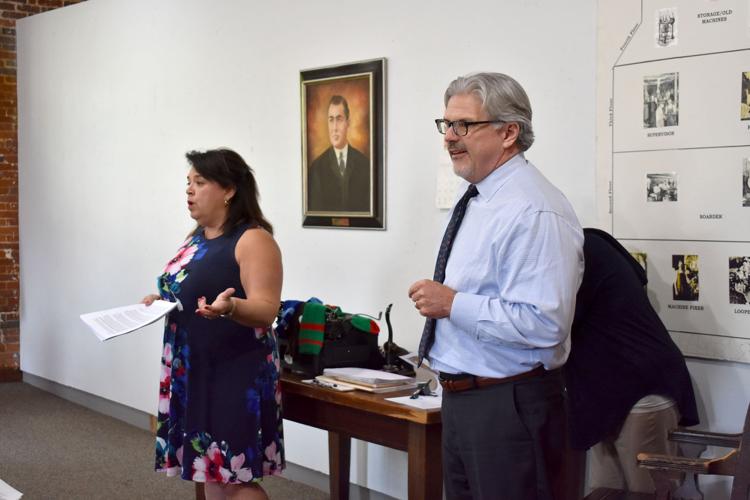
“Hearing this is reminding me of past mistakes, by council, by zoning, when we had the Hathaway House torn down,” Clark, chair of the Laconia Historical and Museum Society, said at a gathering on Monday evening. “History is repeating itself here, I’m really concerned.”
The Hathaway House, a historic building on Union Avenue, was torn down in 2014 despite a verbal agreement a developer made with the city to preserve the structure.
“What I see is a repeat of history from Peter Karagianis, from Norman Weeks, from Esther Peters,” replied Tara Shore, referring to three pillars of a previous era of city leadership, who were able to save the historic Belknap Mill from a planned demolition a half-century ago.
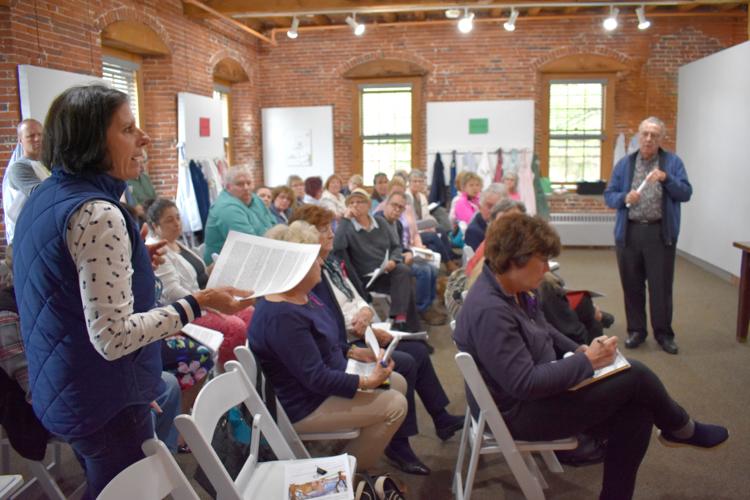
Shore called the meeting on Monday, held at the Belknap Mill, as a call-to-arms for people who were interested in steering the history of Saint Joseph Church – currently planned to be demolished this summer to pave way for a sale of the 2.5-acre parcel at the corner of Church and Messer streets – away from the fate of the Hathaway House and toward that of the Belknap Mill.
More than 40 people filled the meeting room. There were city residents and people from neighboring towns, people who had been baptized at Saint Joseph and sent their children to the Catholic school on the property, as well as people from other faith traditions. By the end of the meeting they had hatched a strategy to keep the church standing. Or, if the building is to be torn down, they’ll know it happened despite their best efforts.
“I can’t know that that building is being torn down without knowing that I’ve done everything in my power to stop it from happening,” Shore said, eliciting applause from the room.
The group planned to address the problem on two fronts. The first is to lobby the city to establish a historic district commission, which would preserve the buildings within defined sections of the city, preserving the buildings that make up what Shore called the “historic character” of the city.
“I really believe that if this were to be demolished,” said Andrew Hosmer, one of two city councilors in attendance, “what it would leave is a gaping wound in this city.”
The second front is for a team of people pressure the Diocese of Manchester to reveal the identity of the party that signed a purchase-and-sale agreement with the local parish. Church officials are keeping silent on that question, saying only that the buyer wishes to come forward on his or her own terms and timeline.
Donna Hosmer, Andrew’s wife and a member of the family that owns the AutoServ family of dealerships, said that the diocese needs to be held accountable for how this process has unfolded. She passed out copies of a newspaper article from February 2017, which stated that the property would be listed on the real estate market and, if it didn’t sell for six months, that only then would the church be razed. But the property, which contains the church, the historic Busiel mansion and the Holy Trinity School building, was never listed. Parishioners didn’t know about a possible sale until May 5, when the Rev. Marc Drouin announced that a sale had been negotiated and that Bishop Peter Libasci was ordering that the church be demolished this summer prior to the closing of the deal.
“I don’t think the process was fair to the community,” Donna Hosmer said. “Promises made need to be promises kept.”
“I think we could have had a solution,” had the community been given a chance to save the church, she continued. “There are angel investors that could come up with a solution. All we are asking for is a conversation.”
One of those “angel investors” is Bob Smith, who was instrumental in the campaign to help the Boys and Girls Club purchase its building, a former Episcopal church, on North Main Street – and who helped establish the endowment fund for Holy Trinity School.
Smith said that he would like to meet with the buyer to find a solution that would allow the sale to go through, yet keep the building intact. The church building could be purchased from the buyer, for example, and operated as a seasonal prayer room, or donated to the city as an annex to the library, or perhaps another use could be found that would be similarly appropriate for what the Vatican has defined as acceptable uses for former churches.
“There’s a lot of things that could be done with that property that would meet the needs of the Catholic Church,” Smith said.
And, Smith and Donna Hosmer said, they’re not opposed to playing a little hard ball. In that newspaper article she passed around, the pastor of Grace Capital Church was quoted as saying that they inquired about the property but were turned away. If they were denied on religious grounds, that would be discrimination, Hosmer said, and could be grounds for a lawsuit.
“We might need to use that as leverage,” she said. “My hope is, if this community speaks loudly enough and forcefully enough, we do have arrows in our quiver, we need to get back to the negotiating table.”
Smith said, “We’ve got to put pressure on the bishop; we’ve got to let him know he’s not living in New York City any more, he’s dealing with New Hampshire people.”


(0) comments
Welcome to the discussion.
Log In
Keep it Clean. Please avoid obscene, vulgar, lewd, racist or sexually-oriented language.
PLEASE TURN OFF YOUR CAPS LOCK.
Don't Threaten. Threats of harming another person will not be tolerated.
Be Truthful. Don't knowingly lie about anyone or anything.
Be Nice. No racism, sexism or any sort of -ism that is degrading to another person.
Be Proactive. Use the 'Report' link on each comment to let us know of abusive posts.
Share with Us. We'd love to hear eyewitness accounts, the history behind an article.