


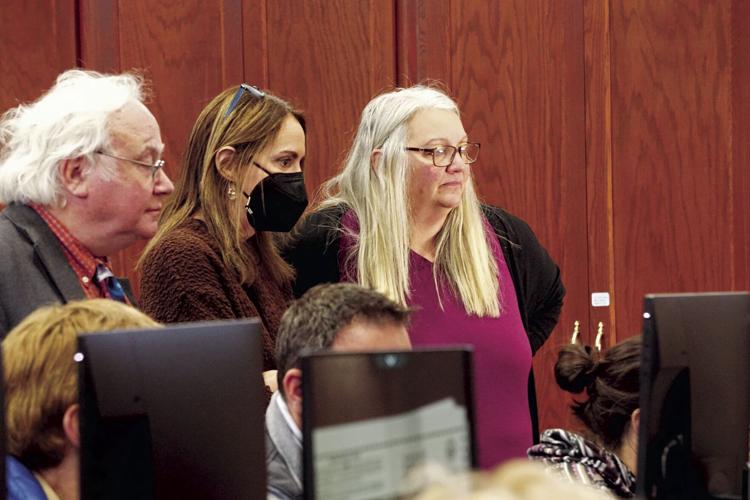
CONCORD — Midday Monday, hours into a recount for the Belknap Statehouse District 6 recount, Senior Deputy Secretary of State Patricia Lovejoy told the small crowd of candidates, lawyers, party officials and other observers that teams were running “a bit behind schedule.” The recount, however, did not change the outcome of the Nov. 8 election.
The unusually high level of split-ticket voting in the race was to blame, Lovejoy said. First on the schedule for the day, teams of two began meticulously thumbing through, sorting and tallying the more than 7,000 ballots cast in the race around 9 a.m. They weren't finished until just before 5 p.m. Observers, including the candidate who had requested the recount, said they had expected it to last about three hours.
In the contest for four seats, voters in Gilford, Gilmanton and Laconia Ward 2 had a choice of nine candidates: four Republicans, four Democrats and an independent. The election-night results declared that the GOP narrowly swept the district, seating incumbent Rep. Harry Bean (Gilford) as well as Russell Dumais, Richard Beaudoin, and David Nagel. Democrat and former Rep. Lisa DiMartino took fifth behind another former representative, Beaudoin, by just 17 votes. DiMartino became one of 28 Statehouse candidates who filed with the Secretary of State’s Office for a recount.
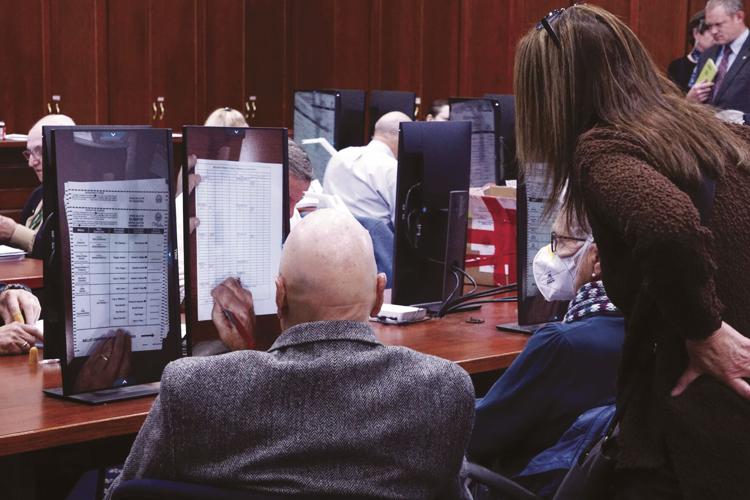
Recount staff received stacks of ballots retrieved from boxes sealed with red tape. The ballots were sorted into three piles: those who, in this race, voted for the four Democrats, those who voted for the four Republicans, and those who had a mixed vote or fewer than four votes.
Teams counted the straight party ballots in increments of 25 and allotted the totals from each party to its respective candidates. Then they tabulated votes from the third pile. One team member would count the votes on the ballot while the other would place tally marks beside the corresponding candidate or, if the voter voted fewer than four times, in the “under-vote” column. If a voter selected more than four candidates, called an “overvote,” all their selections were invalid in the race.
“Bean, Nagel, Hackett and one under-vote,” the reader would say.
“Bean, Nagel, Hackett and one under-vote,” the tallier would repeat.
Whether due to the number of incumbents upset in the Republican primary in this race, the presence of an independent on the ballot, there being former representatives with name recognition as candidates for both parties, the influence of a bipartisan local political action committee or simply the independent-mindedness Granite State voters are famous for, voters split their tickets every way imaginable. Many voters selected candidates from all three columns. Many others voted for just one or two candidates instead of four; if “under-vote” had been a candidate, they would have placed sixth.
Observers, largely party members, organizers and Statehouse representatives, sat in chairs across from recount staff, whose work was filmed by desk cameras and appeared on screens. DiMartino attended the recount, as well as fellow Democratic candidate Dana Hackett.
Observers and candidates can flag a ballot for further review for any reason, and they often did. Maybe a voter made a stray mark, neglected to fill a bubble all the way or used a check to mark their votes.
At the end of a stack of ballots, Lovejoy or another state department official was called over to rule on those flagged, examining the full ballot to interpret the voter’s intentions.
“Now, this is a voter who should have requested a new ballot,” Lovejoy said throughout the day. Voters often crossed out a name they voted next to, either marking by mistake or changing their mind. They put Xs through entire boxes or scribbles next to names instead of darkening the circles. Some voters figured out the correct way to mark their ballot halfway through finishing it.
As Lovejoy ruled on the flagged ballots, counsel from both parties looked on and could challenge her ruling. Those ballots, though counted, were set aside.
“No matter what I decide here, one of you is going to challenge it,” Lovejoy said, chuckling to the lawyers over her shoulder on many occasions. They would, in turn, nod and subsequently challenge her ruling.
After the tabulation, the results were announced: there was no change in outcome. DiMartino lost to Beaudoin by just four votes.
As the recount schedule nears its end, Democrats who had hoped to decisively reclaim the Statehouse by flipping enough narrowly-won Republican seats are running out of opportunities. The house currently stands at 200-199, with the GOP edging Democrats. One seat remains tied and another, flipped by Democrats in the initial recount, will see its recount “continued” after the decision of a judge Tuesday.
The lack of change in outcome in Belknap 6 belies the significant change in vote tally. All candidates had more votes in their column after the recount — DiMartino’s total jumped by 40 votes, while Beaudoin gained 27, narrowing their difference to just four votes.
Based on the totals, this is largely due to the number of ballots deemed under- or over-votes in the initial count that were included when examined by state officials, a common occurrence in recounts.
Candidates can take ballot challenges to the Ballot Law Commission, which meets Monday, Nov. 28 and whose decisions are final. DiMartino said Tuesday that she does not plan to appeal.
“The process works,” she said. “That’s all there is to it.”


(0) comments
Welcome to the discussion.
Log In
Keep it Clean. Please avoid obscene, vulgar, lewd, racist or sexually-oriented language.
PLEASE TURN OFF YOUR CAPS LOCK.
Don't Threaten. Threats of harming another person will not be tolerated.
Be Truthful. Don't knowingly lie about anyone or anything.
Be Nice. No racism, sexism or any sort of -ism that is degrading to another person.
Be Proactive. Use the 'Report' link on each comment to let us know of abusive posts.
Share with Us. We'd love to hear eyewitness accounts, the history behind an article.