


LACONIA — Richard Laflamme had just finished an intense workout that would have put many other 66-year-olds to shame.
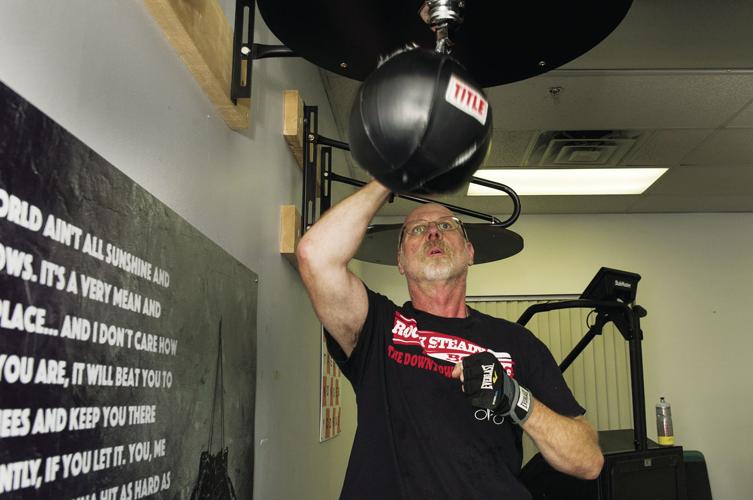
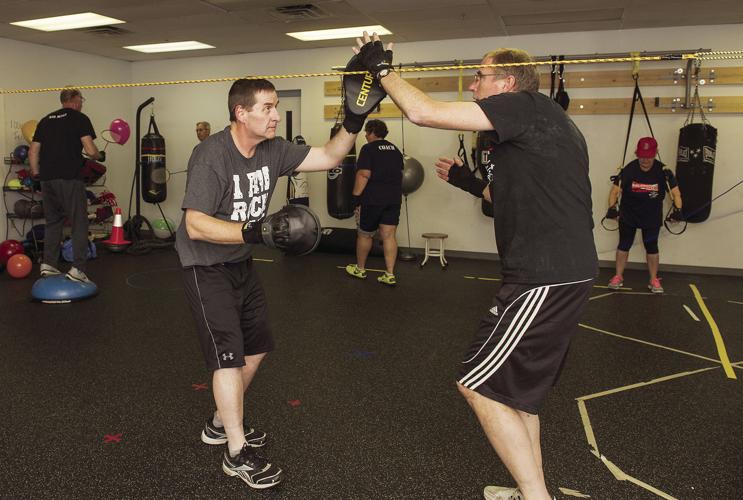
For more than an hour, he moved from exercise to exercise — muscle stretches, spinning on a stationary bike, doing some rapid-fire shadow boxing, hitting a speed bag, more spinning on a bike, and throwing jabs, hooks and uppercuts at a punching bag — and interspersed in between these drills, short aerobic sessions.
What makes this so extraordinary for Laflamme is that he has Parkinson’s disease. For him, every workout is a reason to celebrate.
“I feel 100 percent better,” Laflamme said after completing a session in the Rock Steady Boxing program at the Downtown Gym in Laconia Thursday evening.
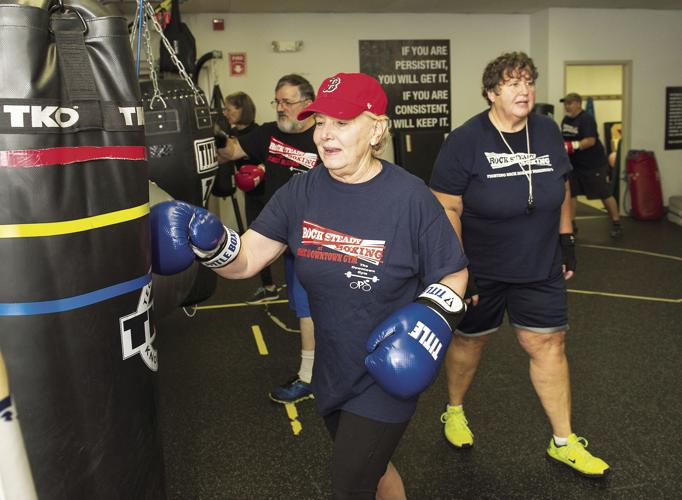
Laflamme and six other Parkinson’s patients were participating in an ongoing program that uses boxing-inspired fitness exercises to slow the symptoms of a progressive neurological disease that causes tremors, muscle rigidity, loss of balance and cognitive, speech and vision impairment.
Laflamme, who has been nicknamed “Flash” by his exercise buddies, has been living with Parkinson’s disease for 6½ years. He began attending the Rock Steady Boxing classes only about six months ago, at the urging of his neurologist.
The Downtown Gym has been offering the program for a year and a half, according Janine Page, the gym’s owner. There are currently 50 people who attend one of the five classes held each week.
“Participants are at all levels in their Parkinson’s challenge,” Page explained.
Betty Collins, one of the coaches on Thursday, explained that Laflamme and the others in that session are among the higher-functioning boxers. There also are classes for those whose Parkinson’s symptoms are more advanced. “Some of them come in wheelchairs,” she said.
Laconia has the only Rock Steady Boxing program in the state, but Page is trying to spread the word about the program’s success in hopes that there will be more locations in the Granite State where the program is offered.
Rock Steady Boxing was started 12 years ago in Indiana by a 40-year-old lawyer diagnosed with early-onset Parkinson’s. Today, the program is offered in every state and several foreign countries. The coaches in each individual program have completed certification training sessions offered by the nonprofit foundation which spearheads the program.
The gym has scheduled a program open house for Saturday, Nov. 24.
The goal of the program, say Page and Collins, is to give those with Parkinson’s a way to fight back.
While many participants have come to the program because of publicity they have seen in newspapers or online or on television, all need a medical release from their doctor in order to take part, Page said.
Exercise is a critical factor for those who have been stricken with various serious medical conditions, not just Parkinson’s, say medical professionals.
“Studies have shown that patients can do better if they exercise,” said Dr. Leslie Suranyi, a neurologist at the Laconia Clinic. By way of example, he explained, “Patients who have had a stroke will have better outcomes if they have received aggressive physical therapy right after their stroke than those without it.”
Suranyi, who treats many Parkinson’s patients as part of his practice, said a program like Rock Steady can slow the progress of Parkinson’s — a degenerative disease with no known cure.
He explained that Parkinson’s results when a person’s brain does not produce enough of a chemical called dopamine. “But more dopamine is released when [Parkinson’s patients] perform any movement or motor task,” Suranyi said. “It doesn’t matter what kind of exercise it is,” he continued. “Exercise is extremely helpful for preserving the function they have.”
Barb Lewis of Laconia, one of Suranyi’s patients who was in Thursday’s class, said that, in addition to attending Rock Steady sessions, she tries to take 10,000 steps a day as part of her exercise routine.
For her, the Rock Steady program means she can face her condition with a far more positive attitude.
“It’s giving me a lot more confidence,” she said.
The camaraderie she feels from her fellow boxers is a real morale-booster.
Dr. Erin Hattan said experience has shown her that Parkinson’s patients like Lewis benefit as much from the socialization they have during whatever exercise program they follow, as they do from the exercises themselves.
“People enjoy the camaraderie,” said Hattan, who has been practicing neurology for eight years. With Rock Steady Boxing, “they’re getting a full-body workout and they enjoy the social aspect.”
Another benefit that Parkinson’s patients can get from exercise, said Suranyi, is that it helps them to better process the medications they have to take.
Six certified instructors help to run the Rock Steady sessions at Downtown Gym, but Page and Collins are quick to point out that they would not be able to offer as many sessions as they do without the help of volunteers.
“We’re always looking for volunteers,” said Collins.
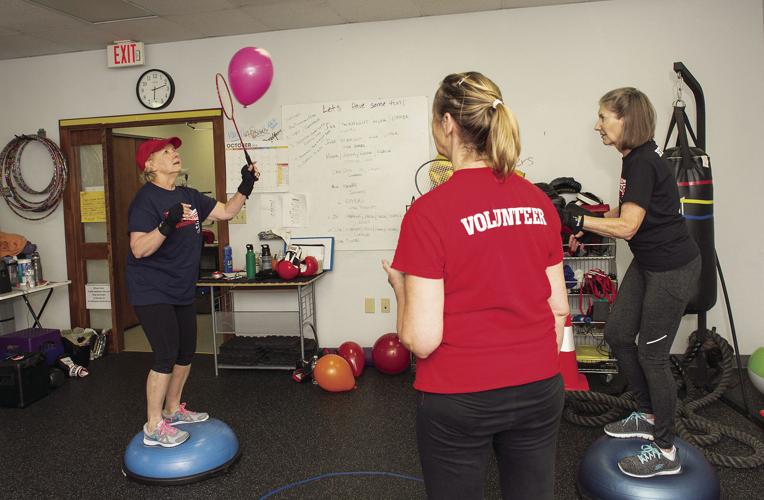
Volunteers, like Kate Fox of Gilford, help to encourage boxers through their routines, and partner with them on various exercises.
Rocky Steady sessions are filled with kinetic energy, loud music and lots of shouting and cheers from the participants. All that hooting and hollering is not just to build team spirit, Collins said. Because Parkinson’s can affect a person’s speech, all the shouted cheers during exercise routines “helps them with their vocalization,” she said.
In addition, the routines are designed so boxers have to multitask, whether it is hollering “Rock Steady ready” during their exercises or standing on a spongy BOSU ball while batting a balloon back and forth with a partner with badminton rackets, which helps with their improve eye-hand coordination and balance.
Suranyi said the benefits of exercise help those with other serious medical conditions, be it diabetes, obesity, or heart disease.
As a nurse experienced in working with cardiac patients, Page knows firsthand the benefits of medically supervised cardiac rehabilitation programs which include exercise appropriate to each individual patient. Exercise helps people maintain a healthy weight and helps improve circulation.
For diabetics, exercise, along with the right diet, helps keep blood-sugar levels closer to where they should be.
Page recalled that one person, who is now a regular at the gym, had been told that, without a change in her lifestyle, she would in time be having to take insulin and eventually would be in a wheelchair.
“People can be afraid of exercise,” she said.
Pike said exercise turned her life around. She formerly had handicap plates on her car, but she traded those plates in for a car rack to transport her kayak.
While being diagnosed with any chronic condition can cause a person to become despondent or withdrawn, Hattan said having Parkinson’s is not a death sentence.
“People with Parkinson’s live as long as anyone else, but they are compromised,“ she said.
Hattan said she recommends the Rock Steady program because she has seen how it has helped her patients. “That’s what I’ve seen in my practice,” she said.


(0) comments
Welcome to the discussion.
Log In
Keep it Clean. Please avoid obscene, vulgar, lewd, racist or sexually-oriented language.
PLEASE TURN OFF YOUR CAPS LOCK.
Don't Threaten. Threats of harming another person will not be tolerated.
Be Truthful. Don't knowingly lie about anyone or anything.
Be Nice. No racism, sexism or any sort of -ism that is degrading to another person.
Be Proactive. Use the 'Report' link on each comment to let us know of abusive posts.
Share with Us. We'd love to hear eyewitness accounts, the history behind an article.