


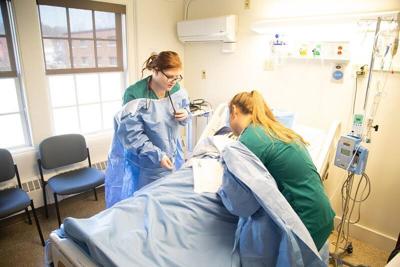
PLYMOUTH — Registered nurses will soon be able to more easily earn their bachelor of science in nursing degree at Plymouth State University when a new program launches later this year.
The registered nurse to bachelor of science in nursing track is coming in fall 2024. Prospective students who have already earned an associate's degree and are licensed as registered nurses in any state can participate in the program.
Professor Julie Cote is the RN to BSN coordinator and chair of the curriculum committee, and is excited about what the program will contribute to nurses. They will also be taking classes to expand their expertise, including pathophysiology, leadership, pharmacology and research.
“We're really focusing on preparing the nurse to help answer questions, to help develop strategies for ensuring that patients have safe discharges, have resources and what they need, and that they're aware of that,” Cote said.
Registered nurses will be able to transfer between 60 and 90 credits toward the 120 total credits required to graduate at PSU with a BSN. Previously, some but not all credits from associate's degrees at other colleges and universities transferred. The new program works with students to accept all of their credits to make the transition easier.
The outcomes of the RN to BSN program are the same as PSU’s traditional nursing program: to graduate with a BSN. But the pathway to get there is different. Students who participate in the RN to BSN program are required to perform up to 100 hours of clinical study working in a local health care setting. Traditional bachelor's degree candidates need to complete 270 hours to fulfill the requirements of their capstone course.
The program is part of a larger initiative in the nursing field to increase the number of nurses with bachelor's degrees in health care institutions. In October 2010, the Institute of Medicine released a significant report, which called for increasing the number of nurses with bachelor's degrees in the workforce to 80% by 2020. While the field only reached 72% as of 2022, according to the U.S. Bureau of Labor Statistics, there has been significant progress toward this goal, with a continued push to get that number higher.
PSU Director of Nursing Donna Driscoll spoke to the importance of the program in a press release.
“This program will fill an important gap in our educational offering and will meet a growing demand for nurses looking to take the next step in their careers,” Driscoll said. “We look forward to seeing how our fully integrated classrooms will benefit from the experience of working nurses, and we believe this program will serve to bolster the much-needed nursing workforce in New Hampshire and beyond.”
Concord Hospital takes an average of 50 PSU students every year for their clinicals. Erin Collins, vice president of nursing practice and development at Concord Hospital, spoke to why this change is important in the industry, and says the hospital encourages RNs to pursue a BSN.
“A BSN degree offers education that goes beyond the foundations of practice. It allows nurses to be able to have greater opportunity within diverse settings within health care,” Collins said. “The benefits of a bachelor's-prepared nurse [are] their education focuses on a well-rounded curriculum, their knowledge development [and] their critical thinking.”
Researchers from New York University published to The Joint Commission Journal of Quality and Patient Safety in 2019 that baccalaureate-prepared RNs reported being significantly better prepared than nurses with associate's degrees on 12 out of 16 areas related to quality and safety, including evidence-based practice, data analysis, and project implementation. A 2019 issue of HealthAffairs points to the benefit of BSNs, in an article citing research from the University of Pennsylvania that each 10% increase of nurses with a BSN in hospitals was associated with 24% more likelihood to survive to discharge with good cerebral performance among patients who experienced in-hospital cardiac arrest.
Cote also spoke to the benefits of more BSNs in the industry.
“A lot of employers recognize that there is a difference in the educational preparation and the outcome for their patients,” Cote said. “And with a movement towards value-based care and a movement towards ensuring that we are providing the most quality safe care ... a lot of nurses are receiving support from their employer to return for an RN to BSN program.”
With a nursing shortage across the country, PSU has made coming back to school for a BSN easy and flexible. RN to BSN students can participate in the program either full- or part-time, and can even take classes online while working.
“We want to offer something that would be somewhat flexible ... unlike our traditional program for the traditional BSN students, who are typically taking a full-time class load because we have a number of classes that must be taken together at the same time,” Cote said. “This offers a lot more flexibility. Students could really come in and take one class at a time.”
The new offering struck a chord with Karmen Gifford, president of the Lakes Region Chamber, as it keeps working nurses local as they further their education.
“It's more opportunity, and another asset in this region that helps people stay here, versus if they decided they were going to go somewhere else to get that continuing education,” she said. “It would remove them from this area. And by being able to keep them in this area, keeping them in their existing jobs, I think that's a value to our communities.”
To make it even easier to support nursing students, PSU is adding a new pre-nursing track for first-year students who do not initially meet the criteria for the nursing program. This allows students to take the prerequisite nursing courses during their first year with the goal of transferring into the nursing program the following year. If successfully transferring into the nursing program for their second year, it will not delay their graduation date.
Every year, as the number of nurses with BSNs increases, health care institutions have realized the importance of nurse education. While nurses also can pursue education past a bachelor’s, adding more baccalaureate-prepared nursese to the workforce has become a top priority in the field.
“It's more of a focus today, more than ever, because the workforce has changed our ability to recruit and maintain and sustain a nursing workforce. This is not unique to New Hampshire, this is across the U.S.,” Collins said. “We're looking at innovative ways, we're looking at partnerships, new programs, new initiatives to help support that and hopefully advance that in a way that continues to sustain excitement in the nursing profession.”


(0) comments
Welcome to the discussion.
Log In
Keep it Clean. Please avoid obscene, vulgar, lewd, racist or sexually-oriented language.
PLEASE TURN OFF YOUR CAPS LOCK.
Don't Threaten. Threats of harming another person will not be tolerated.
Be Truthful. Don't knowingly lie about anyone or anything.
Be Nice. No racism, sexism or any sort of -ism that is degrading to another person.
Be Proactive. Use the 'Report' link on each comment to let us know of abusive posts.
Share with Us. We'd love to hear eyewitness accounts, the history behind an article.