


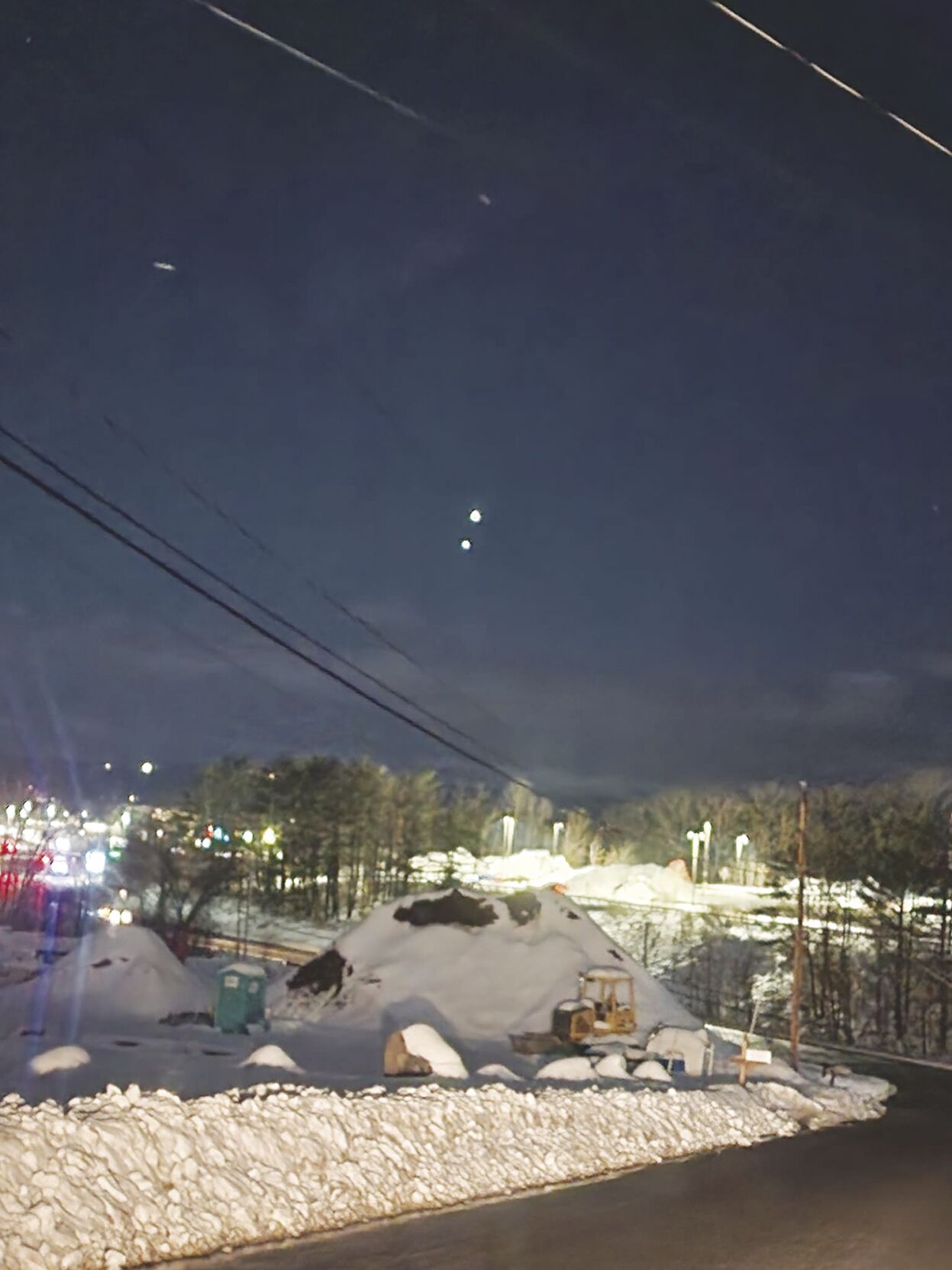
LACONIA — Anyone who missed seeing Venus and Jupiter cross paths on Thursday night will have another chance this weekend.
The conjunction of the planets, according to the Astronomical Almanac, happens when “two bodies have the same apparent ecliptic longitude or right ascension as viewed from a third body.” In less scientific terms, it's when the orbits of two planets line up in a way that makes it appear they are adjacent to one another when observed from Earth.
Pictures of the two planets were prevalent on local social media channels Friday morning, complete with questions about what they were and why they seemed to be "blinking."
“It’s when two objects in the sky happen to be on the same longitude line,” said Paul Winalski, secretary of the New Hampshire Astronomical Society, of the conjunction. “Just like the Earth, the planets are orbiting the sun. They do so in more or less the same plane, but they do so at different speeds.”
Thursday night, the two planets appeared just inches away from each other, an event that experts say occurs only a few days a year. According to Winalski, Jupiter and Venus are in conjunction every nine to 10 months.
“They were only half a degree of arc apart in the sky, so they appear very close,” Winalski said. “They’re many miles away from each other, perhaps a billion.”
As for the blinking and flickering of the planets? Thank the atmosphere.
“The flickering is one of two things. If the duration is longer, it's unlit clouds going in front of them,” explained Winalski. “If it’s momentary, they are low in the sky. You are looking through a lot of the world’s atmosphere rather than just looking up.”
Venus and Jupiter are among the brightest planets. Winalski said six of the eight planets in our solar system are visible with the naked eye thanks to light reflected from the sun.
“The two [planets] furthest away from the sun, Uranus and Neptune, are too dim to be seen without the aid of a telescope,” Winalski wrote in an email. “Jupiter is three times as bright as Sirius, the brightest star. Venus, the brightest planet, is two to three times brighter again.”
Those who missed the planetary "kiss" will still have a few days to spot the adjacent astral bodies. “They will still be close together tonight, but then they will draw apart as they move in their respective orbits,” Winalski said.


(0) comments
Welcome to the discussion.
Log In
Keep it Clean. Please avoid obscene, vulgar, lewd, racist or sexually-oriented language.
PLEASE TURN OFF YOUR CAPS LOCK.
Don't Threaten. Threats of harming another person will not be tolerated.
Be Truthful. Don't knowingly lie about anyone or anything.
Be Nice. No racism, sexism or any sort of -ism that is degrading to another person.
Be Proactive. Use the 'Report' link on each comment to let us know of abusive posts.
Share with Us. We'd love to hear eyewitness accounts, the history behind an article.