


FRANKLIN — A special meeting of city council to discuss a proposal to expend money on a study to determine the scope of work needed to bring the Franklin Opera House and City Hall up to code on Feb. 13 went about as well as Mayor Jo Brown could have expected.
“It went very well. We had a big crowd who spoke up, a lot of people spoke in favor. The $60,000 that was appropriated was unanimous,” Brown said. The money, which was gained from a sale of city property, has been set aside to pay for an engineering firm to evaluate the building to see what it would need to bring it up to modern safety codes.
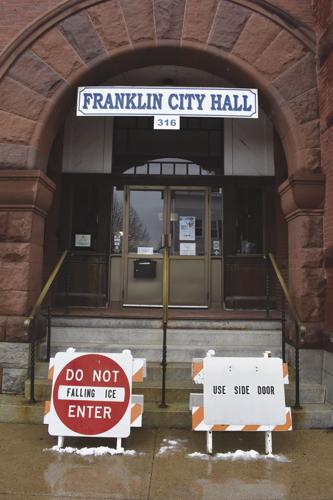
There’s a lot riding on that study. The building, initially constructed in 1892 to give Civil War veterans a place to meet, currently houses both the city’s administrative offices and provides the community with a space for theater, music and other performances.
But the building, at 316 Central St., has been out of code for as long as anyone can remember. Fire Chief Mike Foss said he’s the sixth fire chief to implore the city to do something about the building to bring it up to modern safety standards. Then, on Feb. 1, he decided he had done enough pleading. Foss told the city that they either take serious steps toward addressing the problems, or he would issue a notice of hazardous conditions, meaning that the structure would be shuttered.
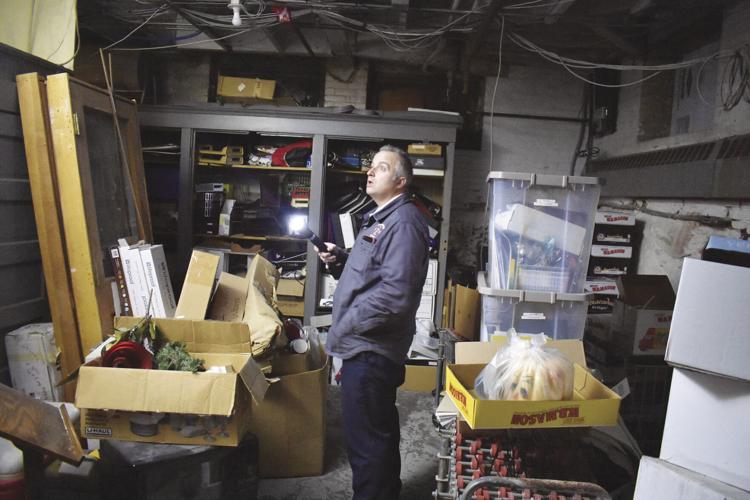
Foss’s line in the sand brings to a close a decades-long period of deferred updates to the building. Catching up on that lost time won’t be easy, as the problems exist from basement to attic. There are extensive dead spaces that don’t have any fire detection, there are insufficient exits for the number of people who gather, there isn’t enough access or exit capacity for people with disabilities, and there’s no fire suppression system. Under-used spaces, including emergency exits, function as storage. Lastly, the electrical and HVAC systems are a knotted tangle, with some of the wiring still knob-and-tube.
“It’s a rat’s nest,” Foss said during a recent tour of the building. “No electrician can really identify what’s live and what’s not.”
At stake is a historic structure, a place for municipal business, and a space for both entertainment and community members young and old to perform. Yet, at this time in Franklin’s history, it represents even more: A test of the community’s resolve to revitalize.
“We’re asking investors to invest in their buildings, the city needs to walk the walk,” said Judie Milner, city manager. “The city residents come here for everything we need to do. This is the face of the city.”
The structure looms large for both administrative functions as well as artistic exploration, Milner said. She noted that 62% of students participate in programming at the Opera House — and that 68% of the city’s students qualify for free or reduced price school meals.
Approving the expenditure for an engineering study is only a down payment, and a small one at that, compared to the bill for fixing all of the building’s shortcomings. That figure won’t be known until after the engineering study is complete, and the city solicits proposals from contractors to do the work outlined in the forthcoming study. But, for discussion purposes, it’s expected to cost millions of dollars.
Brown said the city has been contacted by U.S. Sen. Jeanne Shaheen’s office, inviting them to submit a funding request for the project. If the city needs to shoulder the full cost, and chooses to issue a bond to pay for it, service to that bond would not have to figure into the city’s tax cap limitations.
Community spirit
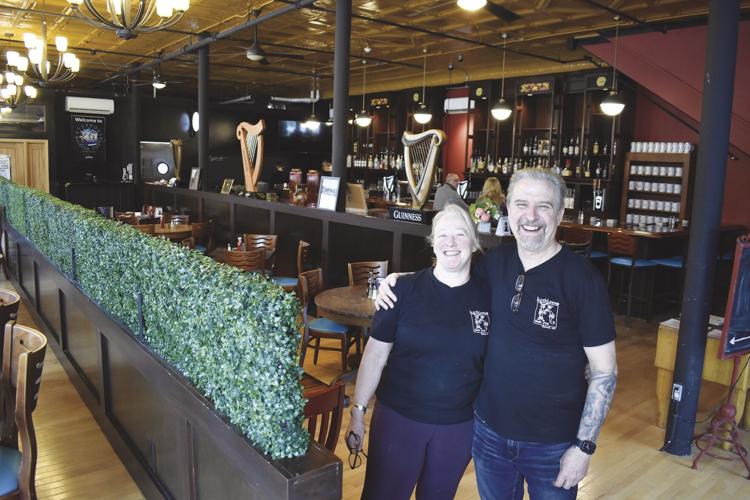
Across the street from the Opera House and City Hall building is Waterhorse Irish Pub, one of the many new investments in the city. Dave McMullen and Maryann who, a couple that serve as owner and executive chef, respectively, said they started renovating the space at 361 Central St. last April and opened on Jan. 5.
They emphasized that Waterhorse — the name refers to an aquatic creature from Irish folklore — isn’t a bar, or a tavern. It’s a public house, intended to serve as a community gathering place. They’ve found their concept has been embraced by their new neighbors.
McMullen said they’ve had a “great” experience so far. “The city has been absolutely fabulous.”
They’ve experienced a warm welcome, whether it’s been from people walking past and offering to help with the extensive renovation to the space, or from City Hall officials who offered to help walk them through any permitting or application processes.
“It’s a sincere warmth of the community,” McMullen said. “To us, it’s become infectious, what can we do to be a valuable asset to the community?”
Parkhust said there’s a strong sense of cooperation and momentum in Franklin.
“Community leaders, mayor and city councilors all agree on how to move Franklin forward,” said Parkhurst, who added that business owners, schools and community members are part of the effort.
“There was a lot of forethought, a lot of groundwork that has been laid, which is now coming to fruition,” Parkhust said.
Much of that groundwork is in the shape of a whitewater park, the first of its kind in New England, which opened last year and offers permanent whitewater features in the Winnipesaukee River as it flows into downtown.
The whitewater park is “a turning point for the city,” McMullen said. “We’d be silly to not want to be a part of that.”
Turning point
The whitewater park was an audacious project spearheaded by Marty Parichand, owner of Outdoor New England, a paddlesports store on Central Avenue, who first brought the idea to the city in 2014. His vision, organized under the nonprofit Mill City Park, was to engineer the bed of the Winnipesaukee River to create whitewater conditions that would attract kayakers and rafters every day of the year.
It was the kind of plan that seemed nearly impossible at first. But, as Parichand said during the build-up, Franklin was a city that was made by its rivers, and it could be re-made by them, too. Since then, Mill City Park secured local funding sources, more than $1.7 million in federal grants and permission from the Department of Environmental Services to reshape the base of the Winnipesaukee River.
With Mill City Park now open to the paddling public, Franklin can market itself as a destination, if not hometown, for those interested in outdoor recreation. The whitewater park adds to a list of nearby amenities that includes mountain biking, disc golf and skiing, all while being a stone’s throw from the Lakes Region and a short drive to mountains for hiking.
Further developments are planned for Mill City Park, including for the shoreline of the river to add a bike pump track, walking trails and viewing areas.
Investors didn’t wait for the park to open. Several projects began once Mill City Park started to build momentum. Those included two breweries and two mill buildings renovated into residences — one market-rate apartments, the other high-end condos.
The difference is already significant, said Jim Aberg, executive director of the Franklin Business and Industrial Development Corporation.
Aberg said the total assessed value of the city’s downtown area, meaning Central Street, bookended by two bridges, was $28 million. Since that measure, more than $65 million has been invested by private property holders into that section of the city.
“That’s a huge impact and really transformative to the character of downtown,” Aberg said.
When the next round of property revaluations are completed, he predicted a “synergistic effect” — owners will see what their property is now worth and will be inspired to invest yet more.
Much of Franklin’s future development will be tied to the success of Mill City Park, he said.
“The growth that we’re experiencing is due in large part to the whitewater park and venue,” Aberg said. “As New England’s only whitewater park, and as it’s growing and developing, that’s going to be a significant economic engine for the city.”
As city residents and officials consider the cost of updating the Opera House and City Hall building, it is occurring at a time when the city is actively recreating its image.
Brown said she is often taken aback to see what her city is now like, particularly in the evenings when there’s a production at the Opera House. Street parking spots are filled, and the restaurants, breweries and pubs are busy.
“I’m from Franklin,” Brown said. “I was born and raised here. To see this kind of activity in Franklin is really exciting.”


(0) comments
Welcome to the discussion.
Log In
Keep it Clean. Please avoid obscene, vulgar, lewd, racist or sexually-oriented language.
PLEASE TURN OFF YOUR CAPS LOCK.
Don't Threaten. Threats of harming another person will not be tolerated.
Be Truthful. Don't knowingly lie about anyone or anything.
Be Nice. No racism, sexism or any sort of -ism that is degrading to another person.
Be Proactive. Use the 'Report' link on each comment to let us know of abusive posts.
Share with Us. We'd love to hear eyewitness accounts, the history behind an article.