


BRISTOL — Schools in the Newfound Area School District exceeded state averages in standardized tests administered in the spring of 2023, scoring higher than many Lakes Region schools.
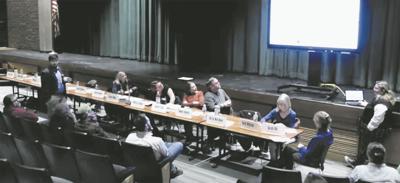
Test results were announced at the Jan. 22 meeting of the Newfound Area School Board.
The results were especially important for Newfound Memorial Middle School, which has faced criticism for its low test scores, cited as one reason for three towns to consider leaving Newfound and forming their own school district. Test scores in 2021 showed only 38% proficiency in English language arts, 34% in science, and 26% in math, all below the statewide average.
ELA scores at NMMS rose to 54% in 2022, to exceed the state average of 49%, and to 63% in 2023 — 10% higher than the state average.
Interim Superintendent Steven Nilhas shared Feb. 1 that, in comparing NMMS with other Lakes Region schools, the numbers presented on Jan. 22 for Inter-Lakes and Winnisquam were not accurate.
“The Newfound Memorial Middle School (NMMS) has made great strides over the past three years with scores improving each year in English-Language Arts, Math, and Science,” Nilhas wrote; but comparing the NMMS scores with area schools “was difficult due to some schools having different grade configurations and [it] resulted in some scores from the 2023 NHSAS that need to be corrected.”
The scores listed below have been updated to reflect the correct numbers.
In 2023, NMMS testing showed 63% proficiency rate in ELA. Inter-Lakes led other Lakes Region schools in ELA with 69% proficiency; Plymouth scored 55%, Winnisquam 45%, Laconia 41%, and Franklin 27%.
Plymouth led in science, with 50% proficiency; Winnisquam was at 40%, Newfound at 38%, Inter-Lakes at 35%, Laconia at 32%, and Franklin at 19%.
In math, Plymouth scored 60% proficiency, followed by Newfound with 42%, Inter-Lakes with 37%, Winnisquam 34%, Laconia 25%, and Franklin 15%.
The district’s leadership team broke down the statistics for each school and placed the testing in the context of national educational goals under what now is known as the Every Student Succeeds Act. The national goals have evolved from the original Elementary and Secondary Education Act of 1965, updated to No Child Left Behind in 2002.
The 2015 ESSA law promotes a multi-tiered system of educational support derived from the medical profession’s triage model. It is “a comprehensive continuum of evidence-based symptomatic practices to support a rapid response to meet students’ needs” — a process that, through periodic screenings of students’ progress, identifies students who need extra help in certain areas or, in extreme cases, require intensive educational intervention.
The Statewide Assessment System is a set of standardized tests administered in the spring that helps to identify strengths and weaknesses in student learning. Education Secretary Miguel Cardona has said standardized tests should be used as a flashlight on what works in education, not as a hammer to force outcomes.
There are four levels of achievement on the tests, with Level 1 indicating a student is below proficiency; Level 2 is approaching proficiency; Level 3 is proficient in applying the measured skills; and Level 4 is highly proficient in applying knowledge. The state sets annual targets for proficiency in each of the testing categories. Those targets are set higher each year.
At Newfound, third graders achieved the highest proficiency scores in math last spring (61%), followed by seventh grade (56%) and fourth grade (50%). All but grades six and 11 met or exceeded state averages.
In ELA, it was seventh graders at the top, with 71% proficient, followed by 11th grade (68%) and eighth grade (63%). All grades exceeded the state average.
Science testing occurs in only three grades, with 11th grade at 44%, fifth grade at 40%, and eighth grade at 38%. Although low, they all exceeded state averages.
The school principals emphasized that, while the students have shown great improvement in their tests scores, they recognize that there is a long way to go.
Linda Green, principal of Bristol Elementary School, said by testing and monitoring students’ progress they are able to determine whether small-group or individual instruction is needed.
“In any of our schools, we try to make sure that we meet all their needs,” she said.
Danbury Elementary School Principal Jessica Pine attributed her school’s lower student test scores in math and ELA to small class sizes where a single student’s performance can throw off the class average.
“We’re working on both,” she said, noting two teachers are working with Title 1 students to improve their performance.
Stacy Giles, principal of the Bridgewater-Hebron Village School, said that, while the scores exceed both state averages and state targets, “we would like them to be even higher” and she outlined some of the work they have been doing, including a partnership with the Newfound Lake Region Association to teach ecology.
Principal Annmarie Holloran said New Hampton Community School is maintaining a lot of its traditions while adjusting them when necessary. That includes its partnerships with the Tapply-Thompson Community Center, Bristol Community Services, Mid-State Health, the private New Hampton School, Gordon Nash Library and the New Hampton Community Church.
“And we have an amazing PTO,” she said.
Middle school Principal Christopher Ulrich noted, “Two years ago, 26% of our students were proficient in math. This past year, we were 42%. That puts us above the state average, and as you can see, it puts us within spitting distance of Inter-Lakes. It puts us well ahead of Laconia, Franklin, and Winnisquam. Plymouth does very well in math; theirs is 60% proficiency. So there’s room for growth.”
Ulrich noted that NMMS has started Science and Math Buddies programs, pairing eighth graders with those in Bristol Elementary.
“If you can teach math, you have to master math,” he said. “So we’ve started that; it’s kind of a trial to see if that’s one of the strategies that will work.”
Speaking of the withdrawal effort, Ulrich said, “If there’s a concern that Newfound Memorial Middle School does not test well, I’m hoping that this data helps disprove it.”
High school Principal Paul Hoiriis, recently tapped for superintendent, cited the success of last year’s graduates, noting 58 students graduated with honors; 12 were New Hampshire scholar-athletes; and six were early graduates. Four Newfound students were among 111 in the state and 5,000 in the country who qualified for U.S. Presidential Scholarships.
“Just let me give you an idea of the other schools in New Hampshire that have students with this recognition,” Hoiriis said. “Proctor Academy, St. Paul’s, Phillips-Exeter, Bishop Guertin, all of our friends down south — Pinkerton, Bedford, Bow, Exeter — Hanover to the west. We are the only Lakes Region school.” He added, “There is one other school besides us north of Concord, and they have one, and that is Kennett.”
Jeannette Shedd, the district’s curriculum coordinator, summed up, “I just think it’s important sometimes that we really take a look collectively at how we’re doing overall. Our teachers are amazing and incredible, as are our paraprofessionals, our staff — this is all of us — collective efficacy coming together to do what’s best for our students.”


(0) comments
Welcome to the discussion.
Log In
Keep it Clean. Please avoid obscene, vulgar, lewd, racist or sexually-oriented language.
PLEASE TURN OFF YOUR CAPS LOCK.
Don't Threaten. Threats of harming another person will not be tolerated.
Be Truthful. Don't knowingly lie about anyone or anything.
Be Nice. No racism, sexism or any sort of -ism that is degrading to another person.
Be Proactive. Use the 'Report' link on each comment to let us know of abusive posts.
Share with Us. We'd love to hear eyewitness accounts, the history behind an article.