


LACONIA — One day in May, Jared Guilmett got a phone call from Tim Burke, the superintendent of the crew renovating the Colonial Theater. Burke told Guilmett that he had better come see something.
“At the time, we were working remotely and keeping site visits to minimum, so for Tim to say I should come down meant this was something big,” Guilmett recalled.
Indeed it was. And heavy.
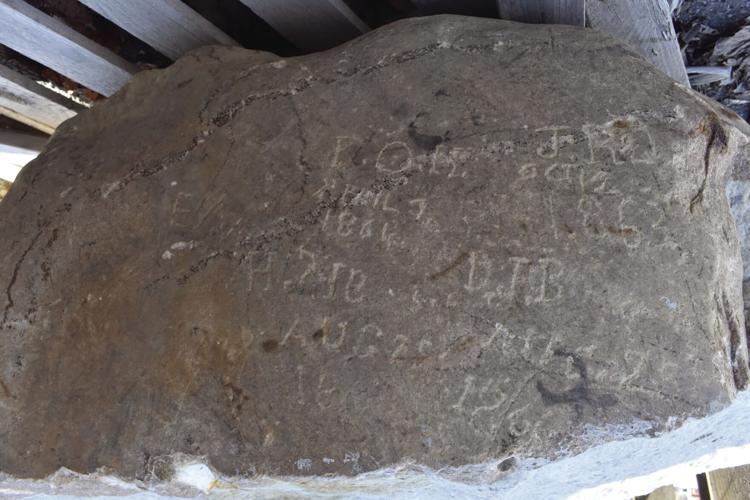
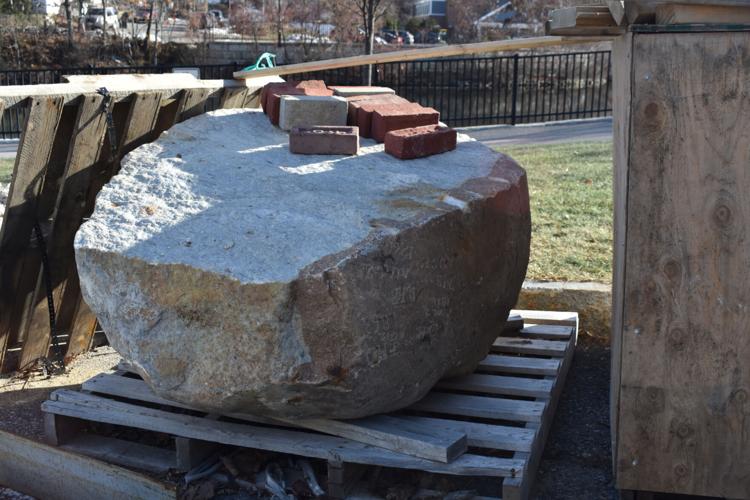
When he got to the scene, Guilmett saw what Burke was talking about: a large chunk of granite with engraving on one face. Workers had found the boulder about two feet below the sidewalk on Canal Street while digging a trench for utility lines.
The engravings appear to be acronyms or initials, or a combination of both, along with dates from 160 years ago. Guilmett is an architect with Misiaszek Turpin, the architectural firm that is working with Bonnette, Page and Stone on the renovation of the historic theater. “I was in shock when I saw the stone and as I ran my fingers across its surface uncovering the dates from the 1800s – I knew I was in contact with something that hadn't seen daylight for decades,” Guilmett said.
Yet, six months later, local historians are still puzzling over what the engravings mean, who might have made them, and why the stone was buried under Canal Street. The stone measures three-and-a-half feet long, two feet tall and four feet wide. It was found with the engraved side facing up. Workers didn’t find any other similar stones in the area, Guilmett said.
Enscripted on the stone are the letters: JR, DJB, EA, IOH, and the dates 8/25/1863 and 10/2/1863.
It seems unlikely to be a grave marker. Neither the shape of the stone nor the style of the engraving is consistent with gravestones of the mid-19th century. Warren Huse, who has written about Laconia history for decades, also doesn’t think that it was part of the canal, which runs underneath downtown. Construction on the canal, which was built to power early manufacturing, was completed around 1830, Huse said.
Huse did have some thoughts on its possibilities, which he detailed in an email he wrote in May. “Looks to me like workmen memorializing the construction of something,” he said, noting that the stone was found approximately where the Russell House stood until it was demolished to make way for the Colonial Theater.
“On the other hand, back in the 1800s they were forever moving things around, so the boulder, with its carvings, could have come from almost anywhere,” Huse added. “It is a puzzlement, but quite exciting!”
Another expert on Laconia history, Pat Tierney, bolstered Huse’s suggestion. Tierney, who was then director of the Laconia Historical and Museum Society, and worshipful master of the Mount Lebanon Lodge of Masons, said that Francis Russell, who had been postmaster for Gilford, lived in the house from 1853 until after the Civil War. Tierney noted that the stone would have been at the northeastern corner of the home’s foundation, which is where Masonic cornerstones are placed. Russell served ten, one-year terms as worshipful master of the Mount Lebanon Lodge.
Russell and his wife, Elizabeth, suffered the loss of two sons in the 1850s, Tierney noted: Earle and Daniel, which could have explained the EA and DJB notations, though he noted that E.A. is also a notation commonly used in Masonic records to indicate “Entered Apprentice.” “IOH” could refer to “Improved Order of Heptasophs,” another fraternal organization of the 19th Century.
Tierney suggested that another notation on the stone, “H. 218” could refer to a biblical chapter and verse. The books of Hosea, Habakkuk, Haggai and Hebrews each contain a 2nd chapter, 18th verse which could be applied to that point in American history or what the Russell family was experiencing.
“Perhaps that was the point,” Tierney said.
Whatever the true story is of the relic’s past, the stone will be part of the Colonial Theater’s next chapter. Bonnette, Page and Stone plans to display the boulder somewhere visible to the public, such as in the theater’s lobby.
“As with this renovation, we have come across many intriguing elements – some of which, like this boulder, will remain a mystery until we have increased capacity to unearth the item’s specific history,” Guilmett said.


(1) comment
It's just an example of how kids tagged before spray paint.
Welcome to the discussion.
Log In
Keep it Clean. Please avoid obscene, vulgar, lewd, racist or sexually-oriented language.
PLEASE TURN OFF YOUR CAPS LOCK.
Don't Threaten. Threats of harming another person will not be tolerated.
Be Truthful. Don't knowingly lie about anyone or anything.
Be Nice. No racism, sexism or any sort of -ism that is degrading to another person.
Be Proactive. Use the 'Report' link on each comment to let us know of abusive posts.
Share with Us. We'd love to hear eyewitness accounts, the history behind an article.