


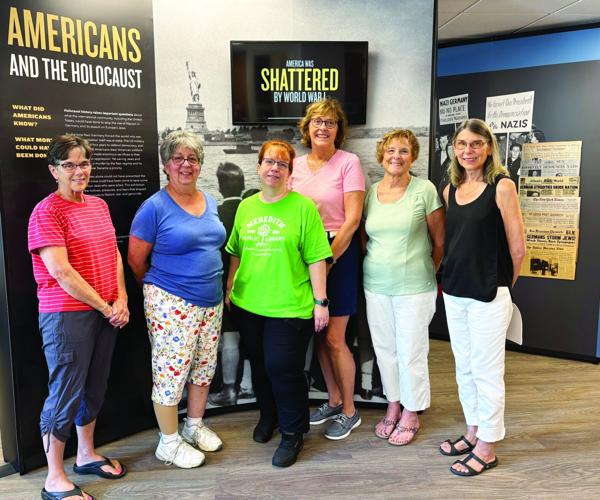
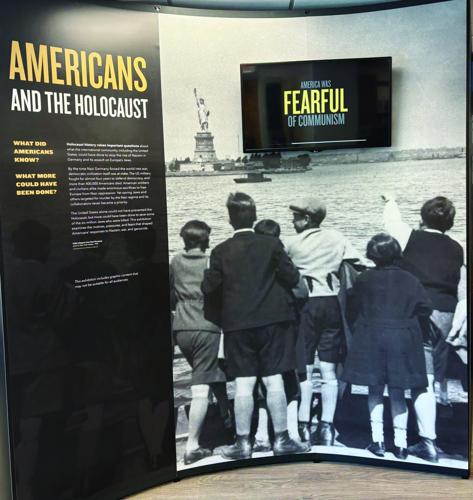

MEREDITH — What did Americans know? What more could we have done?
These questions are the jumping-off point of a traveling exhibit at the Meredith Public Library, titled "Americans and the Holocaust." The exhibit traces the pivotal years leading up to World War II, and the turbulent times of the 1940s war years.
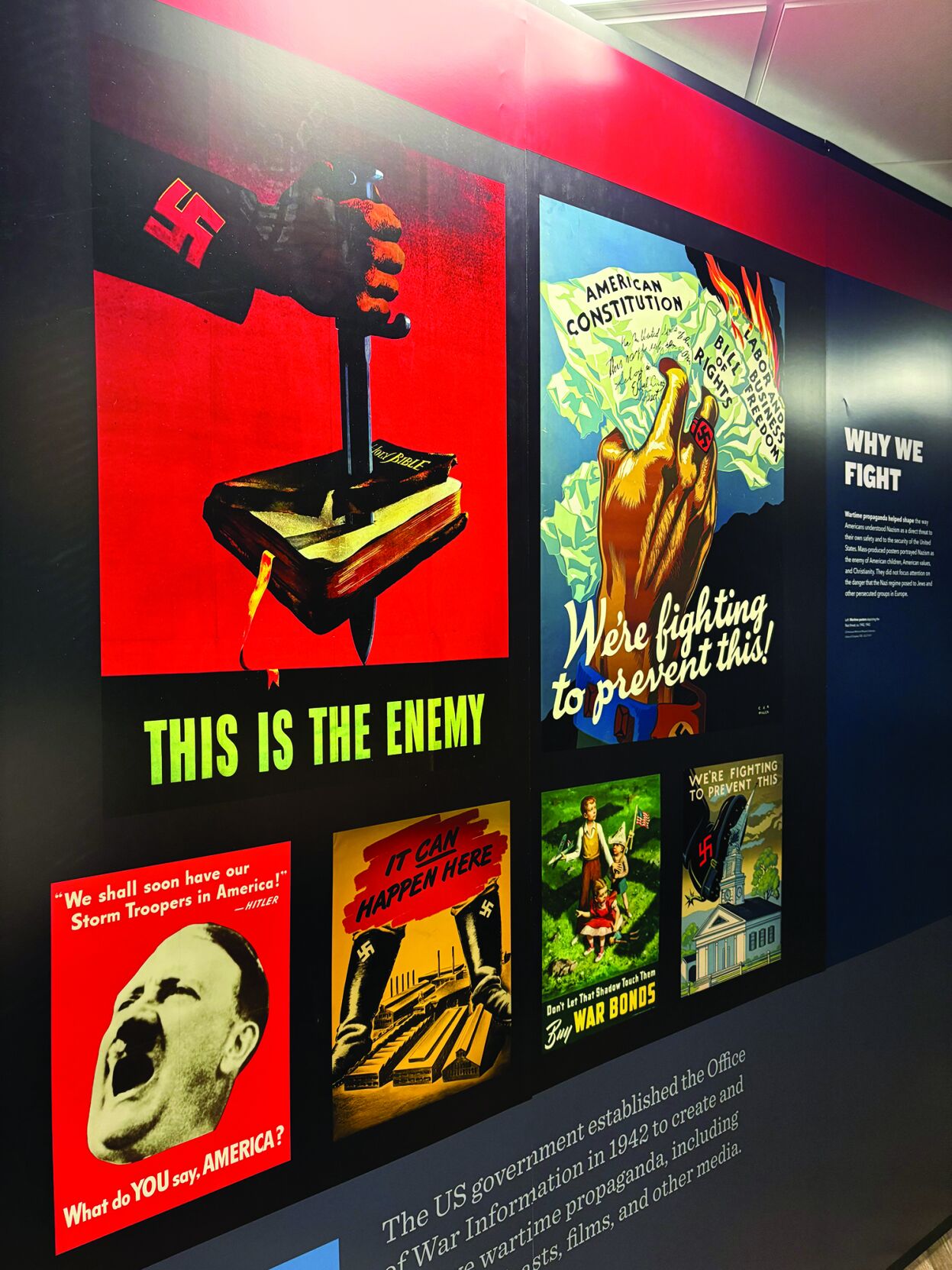
The informative display opened on July 29, and will run through Thursday, Sept. 4, filling the upper exhibit space of the library. Should one expect to see graphic images of the concentration camps, that is not the case. While some photographs give the facts of the war, most of the text and images instead bring to light how Americans perceived what was happening in Europe, and the overall feeling in this country of avoiding the conflict.
“The exhibition is made possible through the United States Holocaust Memorial Museum and the American Library Association. We brought the exhibit to Meredith through a grant we received from the American Library Association," said library Director Erin Apostolos.
“There is a lot to the exhibit, but viewers should know this is not a political statement, but rather an educational and historical display.”
Apostolos and others at the library set their sights on hosting the exhibit when, in 2022, there was a disturbing occurrence in Laconia. “Antisemitic graffiti was discovered, and it was after that we decided to apply for a grant to bring the Holocaust exhibit to the library. We are the only library in New Hampshire to have the exhibit.”
Viewers will enter the exhibit area and be welcomed by a docent who will explain what they will see, and the layout of the panels. After the introduction, attendees will move through the exhibit at their own pace. Each viewer can spend as long as they wish, reading the information on each panel, which traces the happenings in the United States and elsewhere as World War II approached.
There will also be guided tours available. “During the first week of September, we will host middle and high school students from Meredith to see the exhibit,” Apostolos said. Others who would like a group tour should call the library to schedule a date.
To doubters who deny the Holocaust happened, Apostolos says, “I think it is important for people to learn about this moment in history. The younger generations need to know that the Holocaust happened, and we think this exhibit will help them understand.”
The panels are set up for viewers to walk through time in the years before and during World War II. Peppered throughout the exhibit are quotations from Holocaust survivors, citizens, politicians and soldiers. The question of what Americans knew about what was happening in Europe, and what Adolf Hitler and the Nazis had in mind as part of the “final solution” for the Jewish population, is explored in depth.
Viewers will see the news as it was presented on radio and newspapers around the country at the time, and the impact it had. They will learn about the attitude of isolation many American citizens had, and their reluctance to get involved in another war.
Viewers learn some Americans did not know what was happening in concentration camps, and some United States leaders were also, to a certain extent, unaware. Other portions of the exhibit center on average citizens in Europe who were persecuted, and those who sought refuge in this country and elsewhere.
Informative touchscreen kiosks allow viewers to choose a state to see what was happening domestically, and what newspapers in each area were reporting about the war.
Along with the exhibit, special programs will be happening at the library in August. Powerhouse Theatre Collaborative will present a reading on Thursday, Aug. 28. “We will present select readings from ‘The Diary of Anne Frank.’ Maci Johnson, the actress playing Anne, is a dynamic performer, and she will be doing the reading. The entire play will take place at the Colonial Theatre in Laconia from Oct. 10 to 12,” said Bryan Halperin, Powerhouse producer who is directing the play.
Johnson's reading will underscore World War II's impact on young people, such as Anne Frank. “Anne’s story is an important one, and the reading is an easy way for young people to be exposed to what the Holocaust was about. The play gives a historical perspective, and while it is not political, it is relevant to what is happening in the world today,” Halperin added.
Other events taking place during the exhibit installation include a Holocaust film series throughout August; Stark Decency, a presentation by Allen Koop on Tuesday, Aug. 5; Kati Preston, a Holocaust survivor speaking on Monday, Aug. 11; with more programs scheduled. Preston will speak at the Winnipesaukee Playhouse.
“You cannot see the exhibit and not be moved,” Apostolos said.
For exhibit and special event information, visit meredithlibrary.org.


(0) comments
Welcome to the discussion.
Log In
Keep it Clean. Please avoid obscene, vulgar, lewd, racist or sexually-oriented language.
PLEASE TURN OFF YOUR CAPS LOCK.
Don't Threaten. Threats of harming another person will not be tolerated.
Be Truthful. Don't knowingly lie about anyone or anything.
Be Nice. No racism, sexism or any sort of -ism that is degrading to another person.
Be Proactive. Use the 'Report' link on each comment to let us know of abusive posts.
Share with Us. We'd love to hear eyewitness accounts, the history behind an article.