


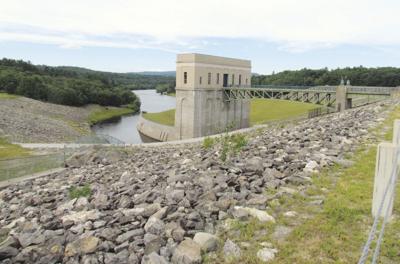
CONCORD — Hurricanes and flooding that devastated the state nearly 100 years ago led to the construction of a series of dams and reservoirs, including the Franklin Falls Dam on the Pemigewasset River, to protect downstream communities in the Merrimack River Valley from future overflows.
Building those dams displaced taxable property within the floodplain and, in 1957, Massachusetts — a beneficiary of New Hampshire’s flood control infrastructure — signed a pact with the Granite State in which the Bay State agreed to make annual payments representing 70% of the lost property taxes in the affected cities and towns. Those included Franklin, Hill, Bristol, and New Hampton.
During the early 1990s, Massachusetts placed a $300,000 cap on its annual contribution and, in 1995, it paid nothing. From then until 2002, it made partial payments, but from 2003 to 2006, it sent nothing to New Hampshire. By that time, it owed $3.2 million.
Then-Gov. John Lynch negotiated a new commitment from then-Massachusetts Gov. Mitt Romney to again live up to the terms of the 1957 pact in 2006. By July of that year, Massachusetts had sent its first check, for $600,000.
By 2014, however, the interstate commission comprising three members from New Hampshire and three from Massachusetts again were at loggerheads about the proper amount of compensation owed. Since 2015, New Hampshire has paid 100% of the lost revenue to the affected communities, without any reimbursement from Massachusetts.
That impasse ended this week, when Attorney-General John Formella named a settlement payment of $3,477,195.30.
“I am pleased that our two great states have been able to reach agreement on this settlement payment to compensate New Hampshire citizens for almost a decade of lost revenue,” Formella said. “I am also proud that this agreement includes a commitment from both states to propose an agreed-upon mechanism to ensure that fair reimbursements will be calculated more easily and paid to New Hampshire on a timely basis in future years.”
That revenue is especially important to the town of Hill, which had to relocate its entire village in the 1940s to accommodate the impoundment area of the Franklin dam.
Franklin’s dam was the first and maybe most important in the flood control management plan for the Merrimack River Valley. Situated just ahead of the confluence of the Pemigewasset and Winnipesaukee rivers that come together to form the Merrimack, the dam provides flood protection along the entire length of the Merrimack River, including Franklin, Northfield, Boscawen, Canterbury, Concord, and Bow. Franklin Falls Dam, along with Blackwater Dam and the dams at Hopkinton and Everett lakes, reduces the chance of flooding in the industrial and residential centers of Manchester and Nashua, and Lowell, Lawrence, and Haverhill in Massachusetts.
The construction of the Franklin dam began in November 1939 and was completed in October 1943 at a cost of $7.9 million, according to the Army Corps of Engineers which oversees the project. The Army Corps estimates that, as of September 2011, the project has prevented $178.3 million in flood damages since it was built.
In addition to requiring the relocation of several homes and businesses in what now is known as Old Hill Village, the work involved the relocation of a Hill cemetery and nine miles of Route 3-A. Throughout the state, the dam projects affected 15 communities, as far north as New Hampton and as far west as Harrisville.


(0) comments
Welcome to the discussion.
Log In
Keep it Clean. Please avoid obscene, vulgar, lewd, racist or sexually-oriented language.
PLEASE TURN OFF YOUR CAPS LOCK.
Don't Threaten. Threats of harming another person will not be tolerated.
Be Truthful. Don't knowingly lie about anyone or anything.
Be Nice. No racism, sexism or any sort of -ism that is degrading to another person.
Be Proactive. Use the 'Report' link on each comment to let us know of abusive posts.
Share with Us. We'd love to hear eyewitness accounts, the history behind an article.